Gender Check 11/16/11 – Northeast

Gender Checks are quick examinations of gender representation in individual news articles for the purpose of discovering trends over time. Click here to read more.

Website: The New York Times

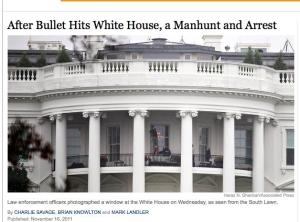
On The New York Times, one of the lead articles featured on the home page as of 5 p.m. EST on Wednesday, November 16 was titled “After Bullet Hit White House, a Manhunt and Arrest.” Its subject was a developing case involving a shooting near the White House this week.

Here is its gender breakdown:

Authors:  Male (3)

Human sources  (listed in order mentioned):

  1. Male – county police spokesman
  2. Male – Park Police sergeant
  3. unknown – Secret Service official

Website: ProPublica

On ProPublica, one of the lead articles featured on the home page as of 5 p.m. EST on Wednesday, November  16 was titled “TSA Puts Off Safety Study of X-Ray Bod Scanners.” Its subject was continuing developments in the investigation into airport security measures.

Here is its gender breakdown:

Author: Male

Human sources  (listed in order mentioned)

  1. Male – TSA Administrator
  2. Female – U.S. Senator

Notes/Analysis: This photo accompanying this story showed a male and female TSA employees operating the scan of a male passenger.

Gender check: 11/15/11 – West

*Gender Checks are quick examinations of gender representation in individual news articles for the purpose of discovering trends over time. Click here to read more.

Website: Seattle Times

Foreign enrollment skyrockets for UW - Seattle Times, 11/15/2011

On the Seattle Times, one of the lead articles featured on the home page as of 10:50 a.m. (PST) Tuesday, Nov. 15, was titled “Foreign enrollment skyrockets for UW.” Its subject was a record number of international students.

Here is its gender breakdown:

Author: Female

Human sources  (listed in order mentioned):

  1. Male, admissions director
  2. Male, director of writing
  3. Male, freshman from China
  4. Male, sophomore from China
  5. Male, associate VP of international relations (at community college)
  6. Female, executive dean for international education programs for the community college district
  7. Female, vice minister of education for China
  8. Female, associate dean of extended learning

Notes/analysis: Two photos appear with the story by a male photographer. One features a male student and the other names a female, though she is not in the foreground.


Website: Seattle P-I

On the Seattle P-I, one of the lead articles featured on the home page as of 10:50 a.m. (PST) Tuesday, Nov. 15, was titled “Wind, rain, snow, cold — what a week ahead.” Its subject was weather.

Here is its gender breakdown:

Author: Male

Human sources  (listed in order mentioned):

None.

Notes/analysis: The story quotes the National Weather Service.

Gender Check 11/14/11 – South

Website: The Miami Herald

On the Miami Herald, one of the lead articles featured on the home page as of 10:30 p.m. (EST) on Monday, Nov.. 14 was “Rubio to GOP: Tone Down Immigration Rhetoric”. Its subject was a Florida senator’s criticism of his party’s stance on immigration issues.

Here is its gender breakdown:

Author: Male

Human sources (listed in order mentioned):

  1. Male – senator (from public comments)
  2. Male – political science professor
  3. Male – law policy group director
  4. Male – law student

Website: Patch (Seminole Heights)

On Patch of Seminole Heights, one of the lead articles featured on the home page as of 10:30 p.m. (EST) on Monday, November 14 was titled “Yard Sales Sprout In Seminole Heights.” Its subject was growing trend in the community.

Here is its gender breakdown:

Author: Male

Human sources (listed in order mentioned)

  1. Female – yard sale coordinator
  2. Female – yard sale participant
  3. Male – yard sale participant

Gender Checks 11/11/11 – South and Northeast

Gender Checks are quick examinations of gender representation in individual news articles for the purpose of discovering trends over time. Click here to read more.

*These two Gender Checks are appearing on a different day than normal. Typically the South appears on Mondays and the Northeast on Wednesdays.

Website: The Miami Herald

On the Miami Herald, one of the lead articles featured on the home page as of 9:00 p.m. (EST) on Friday, Nov. 11 was “Military Uses Keys For Intensive Anti-Terrorism Training Exercise“. Its subject was a week-long air and missile defense training.

Here is its gender breakdown:

Author: Female

Human sources (listed in order mentioned):

  1. Male – Major General
  2. Male – Navy Lt. Commander

Website: Patch (Seminole Heights)

On Patch of Seminole Heights, one of the lead articles featured on the home page as of 9:00 p.m. (EST) on Friday, Nov. 11 was titled “Free Meals and Specials for Vets.” Its subject was programs around the Tampa area for veterans.

Here is its gender breakdown:

Author: Female

Human sources (listed in order mentioned)

None

Website: The New York Times

On The New York Times, one of the lead articles featured on the home page as of 9 p.m. EST on Friday, Nov. 11 was titled “A Gold Rush of Subsidies in the Search for Clean Energy.” Its subject was a

Here is its gender breakdown:

Authors:  Male (2)

Human sources  (listed in order mentioned):

  1. Male – chief executive of energy company (from previous statements)
  2. Male – spokesman for Energy Department
  3. Male – chief executive of energy company
  4. Male – chief executive of energy company
  5. Male – president of solar association
  6. Male – policy director
  7. Male – spokesman for General Electric
  8. Male – analyst

Website: ProPublica

On ProPublica, one of the lead articles featured on the home page as of 9 p.m. EST on Friday, November 11 was titled “EPA Finds Compound Used in Fracking in Wyoming Aquifer.” Its subject was the discovery of a contaminant from oil drilling.

Here is its gender breakdown:

Author: Male

Human sources  (listed in order mentioned)

None

Where are the women in the Romenesko discussion?

Journalism industry icon Jim Romenesko resigned last night, premature of his planned early retirement, following allegations by the Poynter Institute of “questionable attribution” in his posts. Romenesko, considered by some to be the godfather of the aggregator, has run a media news blog at Poynter for the past 12 years. Questions about his writing appear to have been raised by Erika Fry, an assistant editor at the Columbia Journalism Review.

Julie Moos, who is the director of Poynter Online, wrote the posts about the “incomplete” attribution and Romenesko’s resignation. She has also received a large amount of criticism in this situation. Read her original post here to see examples and make your own opinion on the issue.

While there is plenty to be looked at and discussed here, we were drawn in by a Twitter request from Anne Elizabeth Moore: “I’d also like to see a gender breakdown of Romenesko links, Romenesko defenders, and @juliemmoos twitter-detractors. @GenderReport?”

Here’s where it got interesting on our part. While a gender breakdown of all of those subjects would be challenging, time-consuming and perhaps a project we’ll set aside to do more on later, we did pull a few small samples of the conversation to look at.

These were the early posts about the issue that appeared through a Google news search and that were being passed around on Twitter prior to the announcement of Romenesko’s resignation (after that and as of this morning, you’ll find more than 100). Notice anything about the majority of the authors?

And then where are a few “stories” via Storify that collected what the authors suggest are key tweets on the issue. Notice anything here?

Moos herself retweeted (or MT-ed) nearly 100 tweets about the issue as of the end of the business day Thursday, including comments on all sides. These included by rough count 73 tweets from men, 14 from women and six from organizations or groups (some tweet authors, both male and female, were repeated). You’ll find similar results if you look at the comment sections of both of her posts on the issues. Just scroll down through the comments.

Media columnist Jack Shafer asked on Twitter whether all the press critics would be standing up for Romenesko and then proceeded to list 20 of them. By my count, none are female.

And in a wrap up of the discussion and response posted on Romenesko+ on Poynter today by Adam Hochberg, the trend continues. If we don’t include the key players (Moos, Romenesko and Fry) in our count, those who are named as expressing an opinion on the matter are eight men and no women.

While we haven’t completed Moore’s request fully, our quest to look at gender in this conversation did raise some questions.

Where are the women commenting on this issue? If you do a Twitter search for Romenesko, you’ll find some women tweeting about it (and obviously a few women scattered throughout in the above small samples), but in terms of the bulk of the early conversation, it is made to appear, based on all of the above, mostly male dominated.

And where are the women press critics? Is this still a very male dominated position? From Shafer’s collection, it appears so.

These are questions we don’t have answers for, but we’re interested in your thoughts. Let us know what you think in the comment section below.

UPDATE: This post received quite a bit of traffic Friday as the journalism world reacted to Romenesko’s resignation. Here are a few snapshots of responses to our post on Twitter:

Additionally, media writer Rachel Sklar asked Shafer how he defined press critic for his list that included only men. This was his response:

To which media writer Alicia Shepard said, “HELLO???,” noting that she probably tweeted more about Romenesko than she had tweeted in weeks. Also, in response to the exchange, Clara Jeffery, editor of Mother Jones, posted:

Sklar and others suggested a need to begin work on a lady journo list. We’re glad our post helped spark this discussion and we look forward to seeing the list emerge.