Gender Check breakdown: A look at source order and gender

From the initial six-month findings of our Gender Check monitoring project in July, we know that women made up 25.3 percent of sources in the articles we examined. While this tells us the representation given to women at a basic level, it does not reveal how prominently those voices were used within stories. In other words, was the first source in a story — a position of more weight in some respects — more likely to male than female or the other way around?

Now that we’ve had more time to spend with our data, we’ve sought to address this issue. And what we’ve found thus far shows us there are at least some small signs of a lack of prominence of women sources when they do appear in online news articles.

At the six-month mark, we had examined 190 articles, all but three of which had one or more sources. Less than 10 percent of articles had nine or more sources.The most sources a story had was 25 — an article in June from ProPublica about the criminal justice process in murder cases involving children.

Thirty articles (or 15.8 percent) were single source stories. That source was male in 20 of the articles, female in eight and unidentified in two.

The number of female sources only exceeded that of male sources twice: when we were down to two articles at source No. 21 and down to one article at source No. 25. Female sources only exceeded 40 percent at two other times – source No. 16 (four articles) and source No. 22 (two articles).

The first source of the articles in our sample was only female 20.5 percent of the time, but the percentage of third sources that were female jumped to 30.2 percent and the percent of last sources that were female was slightly higher still at 33.1 percent.

Here are the basic findings for the first five sources in a story as well as the last source in the articles.

  • First source: 20.5 percent female (in 187 articles)
  • Second source: 25.4 percent female (in 157 articles)
  • Third source: 30.2 percent female (in 119 articles)
  • Fourth source: 20 percent female (in 85 articles)
  • Fifth source: 24.1 percent female (in 58 articles)
  • Last source: 33.1 percent female (in 157 articles – not including single source stories)

We also looked at expert and non-expert sources of both genders. An expert source is an official or public figure, a person in position of authority or someone with significant knowledge on the subject.

A larger percentage of the female sources referenced in these articles were non-experts compared to male sources. Non-experts made up 34 percent of female sources and only 14.7 percent of male sources. Overall, 26.1 percent of sources were non-experts.

While the number of male non-expert sources never surpassed that of male expert sources, the number of female non-experts exceeded that of female experts at source seven and in 10 more source numbers after that up to No. 25.

These findings in particular raise more questions for us. Does this reflect a lack of female experts as a whole or is something different at work?

We’ll be continuing to watch for trends that emerge in source prominence over time as our study progresses. We’d like to hear from you: What did you find most surprising or interesting about these results? Why do you think there is a higher percentage of female sources that are non-experts than males?

For more information on gender representations in online news, check out our “Findings and Statistics” and “Useful Resources” pages.

Gender check: 8/18/11 – Midwest

*Gender Checks are quick examinations of gender representation in individual news articles for the purpose of discovering trends over time. Click hereto read more.

Website: St. Louis Post-Dispatch(stltoday.com)

On Stltoday.com, one of the lead articles featured on the home page as of 6:30 a.m. (PDT) Thursday, Aug. 18, was titled “St. Charles house fire claims fourth victim, an 8-year-old boy.” Its subject was deaths in a house fire that killed all but an 11-year-old son in a family of five.

Here is its gender breakdown:

Author: Female

Human sources  (listed in order mentioned):

  1. Female, spokeswoman for hospital
  2. Female, spokeswoman for hospital (different than first)
  3. Male, fire captain


Website: St. Louis Beacon

St. Louis Beacon, 8/18/2011

On the St. Louis Beacon, one of the lead articles featured on the home page as of 6:30 a.m. (PDT) Thursday, Aug. 18, was titled “Del Taco developer to prepare designs for restoration.” Its subject was efforts to restore a “flying saucer” building.

Here is its gender breakdown:

Author: Male (intern)

Human sources  (listed in order mentioned):

  1. Male, developer and owner of the former Del Taco building
  2. Female, alderman
  3. Male, local business owner

Notes/analysis: Two photos accompany the story. One is a file photo by a male photographer and another is a file photo by a female intern.

Report Your Thoughts: Where are the women? (Part 2)

Editor’s note: Our findings through our monitoring projects have served to identify and bring attention to the fact that women’s voices are missing, but have left us with more questions than answers. That’s why we’re taking our project a step further by starting a discussion on why this is the case and what can be done about it. This is part of a series of posts each week aiming to start a discussion on gender representations in online news. View past “Report Your Thoughts” discussions here.

—–

Question 2: Where are the women (as sources)?

Last week we launched our “Report Your Thoughts” discussion series with the basic question about our findings: Why? Why are women present in such low numbers in our byline counts of lead articles as well as our looks inside newsrooms? (View this discussion post as well as some of the comments here.)

This week, we’d like to look at a related question: Why are women’s voices absent among news sources?

Here are some facts:

-The Global Media Monitoring Project (2010) found that overall in a study of media platforms from 100 countries that women were 24 percent of news subjects – people heard or read on traditional platforms like newspapers, television and radio in the sample. They were 23 percent of news subjects in the websites monitored.

-At the six-month mark, we’ve found that women make up only 25.3 percent of sources in lead articles on online news sites in our Gender Check study. That percentage is even lower in the most linked to and discussed articles of the web in the New Media Index, where women are only 20.2 percent of sources. Women didn’t fair much better in our sample of lead articles from the 40 “national” sites in the News Frontier Database. In that study, women were 22 percent of sources.

So, in most studies, women are a quarter or fewer of news sources. Why is that?

We want to hear from you. What do you make of these findings. Why is this the case? Share your thoughts in the comment section as well as on Twitter with the hashtag #GRdiscuss or on our Facebook page.

So, for the second week, we ask: Where are the women?

Gender check: 8/16/11 – West

*Gender Checks are quick examinations of gender representation in individual news articles for the purpose of discovering trends over time. Click here to read more.

Website: Seattle Times

Seattle Times, 8/16/11

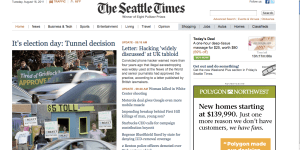
On the Seattle Times, one of the lead articles featured on the home page as of 10:25 a.m. (PDT) Tuesday, Aug. 16, was titled “Tunnel dispute tops election; ballots due today.” Its subject was the last day to vote in the primary election.

Here is its gender breakdown:

Author: Male

Human sources  (listed in order mentioned):

  1. Male, mayor

Notes/analysis: The story mostly provides a roundup of issues and races that voters are casting their ballots on through today.


Website: Seattle P-I

On the Seattle P-I, one of the lead articles featured on the home page as of 10:25 a.m. (PDT) Tuesday, Aug. 16, was titled “Seattle’s ‘green jobs’ program a bust.” Its subject was the progress (or lake thereof) with a federal grant intended to create jobs and weatherize homes in poorer neighborhoods.

Here is its gender breakdown:

Author: Female

Human sources  (listed in order mentioned):

  1. Male, mayor
  2. Male, director of community organizing group
  3. Male, policy director of economic-justice group
  4. Male, U.S. vice president
  5. Male, city’s manager for program
  6. Male, who got certification in insulating walls and sealing air leaks

The debate: Is Newsweek’s cover of Michele Bachmann sexist?

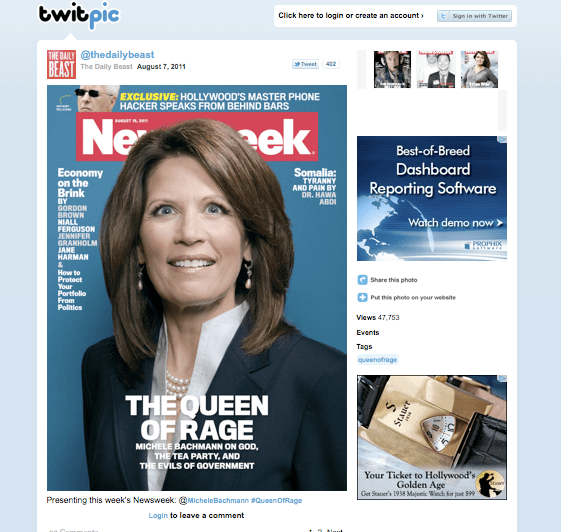
It’s been all the “rage” across media platforms this week: Is this Newsweek cover of GOP presidential candidate Michele Bachmann sexist?

As soon as Newsweek posted this TwitPic of the week's cover Aug. 7, the debate began over whether the image of Michele Bachmann is sexist.

The cover (right) features a close-up of a wide-eyed Bachmann with the headline “QUEEN OF RAGE” that some are saying makes her look “crazy.” The accompanying story has received far less attention.

This isn’t the first time Newsweek has come under fire for its cover of a female politician. Many on both sides have drawn comparisons to a cover of Sarah Palin in running shorts two years ago that was deemed “sexist.” (This also isn’t the first time charges of sexism toward Bachmann have come up in campaign coverage and its not likely to be the last.)

Conservative commentators, like Michelle Malkin, have said the image shows the mainstream media’s liberal bias and have particularly called into question the treatment of conservative women.

Jessica Grose at Slate’s XX Factor said the cover was “unnecessarily unflattering” and pulled out past covers of Republican male candidates that were done using a serious tone (though these were before current editor Tina Brown took over the magazine, as was the Palin cover). Jon Stewart made a similar criticism of Newsweek’s cover photo during “The Daily Show” this week, noting “…Here’s what you can’t say about Michele Bachmann: That she is not photogenic.” (Watch the video here).

The National Organization for Women spoke out against the cover through the Daily Caller. From NOW President Terry O’Neill:

“It’s sexist… Casting her in that expression and then adding ‘The Queen of Rage’ I think [it is]. Gloria Steinem has a very simple test: If this were done to a man or would it ever be done to a man – has it ever been done to a man? Surely this has never been done to a man.”

Gloria Steinem herself has called the photo “borderline.”

Others, like Joan Walsh, have said Brown has “nothing to apologize for.” She points to the fact that there are plenty of shots of “a deranged-looking” George W. Bush, John McCain and Howard Dean that have cropped up in the past. She also linked to a piece from 2006 with what she called “crazy-scary” cover images of Al Gore and Sen. Mark Warner.

As for Newsweek, Brown responded by defending the cover and releasing outtakes from the shoot to show the other options the magazine had and that display a “similar intensity.” In a statement, Brown said, “Michele Bachmann’s intensity is galvanizing voters in Iowa right now and Newsweek’s cover captures that.”

Bachmann herself has for the most part shrugged off questions about the cover by saying, “I didn’t pay a lot of attention to it really.”

What do you think? Is the cover sexist? Share your thoughts in the comment section below.

This is the Gender Report’s Week in Review, a weekly post that highlights some of the major stories related to gender issues this week. Some of these stories may have already appeared in our News Feed or in the week’s Gender Checks. We’ll at times include a longer analysis of stories as well as bring attention to stories that may have slipped through the cracks of the week’s news cycle.