In the Spotlight: Q&A with Global Girl Media

While most of our work here at The Gender Report is focused on identifying the problems and gaps in the representation of women in news coverage, we feel it necessary to take time to recognize those who are working toward solutions. That’s why, starting with this post during Women’s History Month and the week of International Women’s Day, we’re going to try to spend time highlighting an organization that is making strides in this area.

With each feature, we’ll be in correspondence with a member of that organization to have her, or him, answer five questions about its work.

First up, is…

GLOBAL GIRL MEDIA

The Gender Report spoke with Aime Williams, executive director and co-founder of Global Girl Media, via e-mail about the organization’s exciting work to empower teen girls through media training. Here’s what she had to share:

1. For those who are unfamiliar with your work, give us your elevator pitch — What is Global Girl Media?

Global Girl Media (GGM) develops the voice and self-expression of teenage girls in under-served and marginalized communities by training them to become citizen journalists, harnessing the power of new digital media to inspire self-esteem, community activism and social change. By linking young women internationally with seasoned reporters, educators and filmmakers, GGM empowers girls to make media that matters, improves media literacy, and encourages the promotion of healthier media messages about girls and women.

2. What do you consider to be the biggest issue when it comes to the representation of women in journalism and its creation?

Accuracy and complexity. We feel in particular the voices of young women from marginalized or otherwise under-served population are either absent or only heard from in times of war, disaster or crisis, oftentimes victimizing the subject.

Ethan Zuckerman, co-founder of the international blog Global Voices, speaking at a recent TED talk stated, “Sure we are becoming more global, our problems are global in scale, economics, environment, but our media is getting less global by the day…” International news as a percentage of an American television broadcast was 35 percent in the 1970s and it is less than 12 percent today. Access to and authorship of media matters because it underpins how societies respond to the problems they face. In the words of the BBC World Trust, “This makes media not only relevant to the most urgent problems of poverty and marginalization — it makes it critical to solutions designed to address them.”

GGM believes that ensuring access to media information and building capacity for authorship of this information is particularly crucial where media resources are scarce, and therefore oftentimes skewed to a particular dominant ideology or bias.

3. How is your organization a part of the solution?
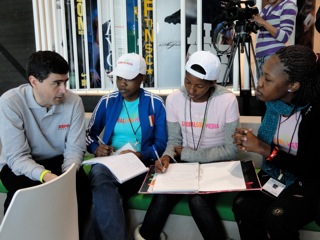
Giobal Girl reporters get tips from an ESPN/Brazil reporter during the 2010 FIFA World Cup. (Courtesy photo)

Our model is unique in that it pairs U.S. communities with international cities, creating a peer-to-peer international network of girls that can break down stereotypes by directly connecting and impacting each other through the internet. Training young women in new media journalism has the unique capability of augmenting all the other aspects of GGM’s activities, cross-cutting between issues of gender equity and self-esteem, cross-cultural communication and media literacy, reproductive rights and economic gains, etc.

What we are attempting to build with our media training program and distribution network is essentially a new model for development: one that sees authentic self-representation as a vibrant partner to economic growth, providing a viable structure for young women to take part in new media for human growth and development.

4. What project are you currently working on that you’re most excited about? Share a little bit about it.

Just as we strategically paired the cities of Los Angeles and Soweto, South Africa, for our pilot program, we have chosen Detroit as the sister city to our two initial international training sites — Sulaimaniyah, Kurdistan (Iraq) and Beirut, Lebanon, for our program expansion in 2011-2012. Our reasoning derives from a perceived lack of media being produced from a female perspective in these regions, in particular, young Arab and Muslim women are either entirely absent from mainstream media or grossly misrepresented and stereotyped.

Given the mass freedom movements in this area the world, now is certainly the time for Global Girl Media to be there! In the United States, there is a global curiosity about Middle Eastern and Arab women. People want to know who they are, what they have to say. Michigan has a large Arab Muslim Population and is also undergoing a period of great change.

In Detroit, the national economic crisis could not be more acute, where an historic industry is being rebuilt and the very first Arab American Museum has recently opened. GGM hopes to work within all three communities to help draw parallels, encourage critical dialogue and provide a broader experience for each Global Girl it trains.

5. What needs does your organization have? How can people get involved?

We are always looking to build our capacity and expand our program. We have an ongoing need for office volunteers, as well as program partners for future development. If there are organizations that want to bring our program to their community, we welcome them to reach out to us. We are always looking for co-sponsors, corporate and foundation support.

Find out more about Global Girl Media by visiting its website at www.globalgirlmedia.org. Follow the organization on twitter @GlobalGirlMedia and “like” it on Facebook here.

Are you a member of an organization that looks to address issues of gender representation in the news? Contact us about being next month’s “In the Spotlight” organization by e-mailing genderreport@gmail.com.

Gender check: 3/3/11 – Midwest

*Gender Checks are quick examinations of gender representation in individual news articles for the purpose of discovering trends over time. Click here to read more.

Website: St. Louis Post-Dispatch (stltoday.com)

On Stltoday.com, one of the lead articles featured on the home page as of 2:45 p.m. (MST) Thursday, March 3, was titled “Jury finds Shepard guilty after he confesses killing University City police sergeant.” Its subject was a man, who the article describes as “mixed race but considers himself black,” being found guilty by a jury after admitting to killing a white police officer, partly as retribution for the shooting of his girlfriend, also black, by a different white police officer who was later cleared in the incident.

Here is its gender breakdown:

Author: Female

Human sources  (listed in order mentioned):

1. Male, suspect

2. Male, judge

3. Male, prosecutor


Website: St. Louis Beacon

On the St. Louis Beacon, one of the lead articles featured on the home page as of 2:45 p.m. (MST) Thursday, March 3, was titled “29,000 answers, one question: How do cities grow?.” Its subject was a look at a population loss of 29,000 people over the course of a decade in St. Louis and what that says about the city and its future.

Here is its gender breakdown:

Author: Male

Human sources  (listed in order mentioned):

1. Male, resident, talk show host

2. Male, alderman

3. Female, press secretary for mayor

4. Male, director of research

5. Male, executive director of restoration group

6. Male, new arrival

7. Female, new arrival (married to above, moved due to her job)

8. Female, new arrival

9. Male, alderman

10. Male, alderman

11. Male, alderman

12. Female, resident, formerly did city planning work

Notes/analysis: The City of St. Louis Board of Aldermen is composed of 28 ward representatives, eight of which are female.

Gender check: 3/1/11 – West

*Gender Checks are quick examinations of gender representation in individual news articles for the purpose of discovering trends over time. Click here to read more.

Website: Seattle Times

On the Seattle Times, one of the lead articles featured on the home page as of 2:30 p.m. (MST) Tuesday, March 1, was titled “State’s monthly job results good, as unemployment drops.” Its subject was the drop in unemployment and strongest monthly job picture in three years.

Here is its gender breakdown:

Author: Male

Human sources  (listed in order mentioned):

1. Male, chief economist

2. Male, spokesman

Notes/analysis: The article was mostly recently released numbers from the Employment Security Department.


Website: Seattle P-I

On the Seattle P-I, one of the lead articles featured on the home page as of 2:30 p.m. (MST) Tuesday, March 1, was titled “Report: Early warnings kept from Seattle School Board.” Its subject was a look at who had knowledge of a report that warned of a billing scandal in a small business contracting program for the school district based on information revealed through internal documents that were recently released.

Here is its gender breakdown:

Author: Male

Human sources  (listed in order mentioned):

1. Male, former director of facilities (from note)

2. Female, former prosecutor (from report she prepared)

3. Male, accountant

4. Male, former employee, subject of issue (in e-mail)

Notes/analysis: Most sources were referenced from documents they had written that were recently released such as a report, e-mails and notes. At the center of the issue are a male employee and a male supervisor of that employee. Also now in question is the female schools superintendent.

‘War on Women’ rages on this week

Filling the majority of the gender-related news hole this week, and throughout the month of February, was the ongoing Republican action on the issues of abortion and women’s health that have been called a “War on Women.”

On the federal level, the U.S. House of Representatives voted at the end of last week as part of a spending bill to eliminate funding to Title X programs, which help low-income families with family planning and contraception, and block Planned Parenthood from receiving federal funding. Roughly a third of Planned Parenthood’s budget comes from federal, state and local governments, according to a New York Times article.

Though the focus of the debate is around its abortion services, the organization doesn’t currently receive federal funds for abortions. The organization’s website highlights that only about three percent of all its health services are abortion related. Planned Parenthood provides family planning, cancer screenings, treatment for sexually transmitted diseases and other services for both men and women but particularly for low-income women.

The House vote was emotional, being preceded by Democratic Rep. Jackie Speier sharing her personal experience with abortion on the floor.

In response to the decision, a campaign to stand with Planned Parenthood was launched, along with a petition and other letter writing campaignsto legislators. A “Rally for Women’s Health” is planned for today, Feb. 26, in New York. A number of public figures have spoken out on the issue this week from Jon Stewart on “The Daily Show” to New York City Mayor Michael R. Bloomberg.

Some of the other budget actions that would affect women include cuts to international family planning (including barring funds from going to the United Nations Population Fund), Head Start and Women Infant Children (WIC) program, which provides food and nutrition assistance for low-income women with children under age 5.

Several state legislatures were in the news for reproductive health and abortion issues in the past week. Here are some of the highlights:

  • A proposed Georgia law could give the death penalty for miscarriages (as described by Mother Jones)
  • Virginia’s General Assembly voted Thursday that abortion clinics should be regulated as hospitals in a move that may put the majority of the clinics out of business.
  • Iowa bills that would allow for “justifiable homicide” in defense of an unborn child, similar to legislation introduced and shelved in South Dakota earlier this month and proposed in Nebraska, have stirred concerns that they could be used to condone the killing of abortion doctors.

Also making headlines was a controversial anti-abortion billboard erected in New York City this week (and subsequently taken down) that angered some residents. The board showed a young black girl with the words “the most dangerous place for an African-American is in the womb.”

Also in the news: Movie time

With the Academy Awards slated for Sunday, in discussion is the representation of women in the film industry, including looks at the “most powerful women” at this year’s Oscars.

Following last year’s history-making awards season in which a woman (Kathryn Bigelow) won the coveted best director award for the first time, no women are up for the prize in 2011. Additionally, no women are up for awards in cinematography. For writing, only nominees for “Winter’s Bone” for adapted screenplay and “The Kids Are All Right” for original screenplay have female authors listed.

A study by the Center for the Study of Women in Television and Film at San Diego State University in 2010 found that women made up only “7 percent of directors, 10 percent of writers, 15 percent of executive producers, 24 percent of producers, 18 percent of editors and 2 percent of cinematographers,” according to a post by Martha Lauzen for the Women’s Media Center.

This is the Gender Report’s Week in Review, a weekly post that highlights some of the major stories related to gender issues this week. Some of these stories may have already appeared in our News Feed or in the week’s Gender Checks. We’ll at times include a longer analysis of stories as well as bring attention to stories that may have slipped through the cracks of the week’s news cycle.

Gender check: 2/24/11 – Midwest

*Gender Checks are quick examinations of gender representation in individual news articles for the purpose of discovering trends over time. Click here to read more.

Website: St. Louis Post-Dispatch (stltoday.com)

On the Stltoday, one of the lead articles featured on the home page as of 3:30 p.m. (MST) Thursday, Feb. 24, was titled “Missouri man pleads guilty in sex slave case.” Its subject was one of five defendants in the alleged sexual slavery and torture of a mentally disabled woman entering a guilty plea.

Here is its gender breakdown:

Author: Male

Human sources  (listed in order mentioned):

1. Male and female, male is one of the co-defendants (couple “said”)

2. Male, defendant that entered guilty plea

3. Female, lawyer

Notes/analysis: This article continues a saga that’s been somewhat controversial since it came to light last fall. It involves accusations of sexual and physical torture over the course of five years, that a U.S. attorney referred to as “among the most horrific ever prosecuted” in the Western District of Missouri. But, at the same time, the alleged ring leader, his wife and many from their community are claiming that the woman was not in fact a sex slave but an active, consenting participant in the actions. They also debate whether she does have “mental deficiencies.” The story, particularly its original headline, on the doubts about the woman’s story also sparked its own drama.


Website: St. Louis Beacon

On the St. Louis Beacon, one of the lead articles featured on the home page as of 3 p.m. (MST) Thursday, Feb. 24, was titled “Monetary gains make solar power a more practical choice.” Its subject was solar energy and the current incentives offered to use it.

Here is its gender breakdown:

Author: Female

Human sources  (listed in order mentioned):

1. Female, of environmental coalition

2. Male, director of operations for chemical distributor

3. Male, of solar company

4. Male, home owner

5. Male, home owner

6. Male, home owner

7. Male, with solar company