HPV vaccine returns to spot of controversy in GOP primaries

Image from http://www.politico.com.

When the HPV vaccine became available in 2006, it was met with both enthusiasm and concerns. (In fact, I reported its arrival, and opposition, on our religiously affiliated college campus). Those concerns were brought back to the front page news cycle this week as the Republican candidates for president have questioned the vaccine’s safety and Gov. Rick Perry’s policies in Texas schools.

Approximately 20 million people are currently infected with HPV in the United States. As many as half of these infections are among adolescents and young adults, ages 15 through 24 years of age, according to the CDC. Most HPV infections are asymptomatic, but four of the 40 types of the STD cause cervical cancer, which kills 4,000 women in the U.S. each year. Other types can cause genital warts in both males and females. More than 35 million doses of HPV vaccine have been distributed in the United States as of June 2011.

The topic was first brought up in the September 7 debate, the first in which Perry participated since announcing his candidacy. At that time, he defended his 2007 mandate of the vaccine for 11 and 12 year old girls in Texas schools, saying he would “always err on the side of saving lives.” Other candidates said he should have let parents opt in to the vaccine, rather than opt out of the mandate. Other candidates, and conservatives, have said the vaccine encourages promiscuity. In May 2007, the Texas legislature overwhelmingly passed a bill vacating the governor’s executive order by a veto-proof margin. Perry, however, still supported the executive order in his 2010 re-election bid for the governor’s office. Currently, Virginia and the District of Columbia require the vaccine for girls entering the sixth grade. Both jurisdictions offer liberal opt-out policies that allow parents to decline to have their daughters vaccinated. (As of April 2011, only 22 percent of sixth-grade girls in D.C. public schools were in the midst of or had completed the vaccinations; Virginia has also tried to repeal the mandate.)

In Monday’s debate, Perry was again criticized for his support of the mandate, and by the end of the week he had reversed his position, telling a GOP event in Virginia that “We should have had an opt-in instead of an opt-out.”

But the bigger story became one of Rep. Michele Bachmann’s attacks on Perry, telling him she had met a mother whose daughter became mentally retarded after receiving the vaccination. She also accused the governor of “crony capitalism” and receiving financial incentives from Merck, the drug company that produces the Guardasil vaccine. (GlaxoSmithKline also produced an HPV vaccine, Cervarix, but this variety only protects against two types of HPV; Guardasil protects against four and is usually the variety in question during debates over the vaccine). Sarah Palin, in what was seen by some as her first attack on Perry, supported Bachmann’s statements in a Fox appearance the next day. Many, including Perry, questioned the factual basis of Bachmann’s statement. Washington Post columnist Michael Gerson: “It is possible that Rick Perry encouraged HPV vaccinations in the wrong way or for the wrong reasons. But it is Bachmann, not Perry, who would put girls and women at greater health risk based on moral confusion and public health illiteracy.” Bachmann’s former campaign manager said she’d “goofed,” as described by the Christian Science Monitor.

No research at this time shows a connection between the HPV vaccination and mental retardation. One bioethicist went as far as to challenge Bachmann’s statement by offering to donate $10,000 to charity if she can prove and verify a single case. Published side effects of Guardasil are similar to other vaccinations, including pain, swelling, itching, bruising, and redness at the injection site, headache, fever, nausea, dizziness, vomiting, and fainting. Gardasil works against HPV types 6, 11, 16 and 18. These four types cause 90 percent of genital warts and types 16 and 18 cause 70 percent of cervical cancer, according to the CDC.

The vaccine is administered in three doses and is recommended by the CDC to start in girls around 11 or 12 because it is most effective when administered before a girl becomes sexually active; the vaccine is approved for women up to 26 years old.

Here are some resources to learn more about HPV and the vaccine:

  • Centers for Disease Control: fact sheets, FAQs, research studies, statistics, and more.
  • Guardasil: site for the vaccination includes parent information, side effect information, and funding assistance programs.

This is the Gender Report’s Week in Review, a weekly post that highlights some of the major stories related to gender issues this week. Some of these stories may have already appeared in our News Feed or in the week’s Gender Checks. We’ll at times include a longer analysis of stories as well as bring attention to stories that may have slipped through the cracks of the week’s news cycle.

In the Spotlight: Q&A with the International Women’s Media Foundation

Editor’s note: This is part of a series of posts featuring organizations making strides in the area of gender representations in the news. View other posts in this series here.

International Women’s Media Foundation

The Gender Report spoke with Nadine Hoffman, director of programs at the International Women’s Media Foundation, via email about the exciting work the organization is doing. Here’s what she had to say:

1. For those who are unfamiliar with your work, give us your elevator pitch — What is the International Women’s Media Foundation?

The IWMF’s mission is to support the advancement of women journalists worldwide. Since 1990, our organization has built a vibrant global network of individuals dedicated to this objective, with the conviction that women’s full participation in news media is crucial to furthering freedom of the press.

2. What do you consider to be the biggest issue when it comes to the representation of women in journalism and its creation?

“The Global Report on the Status of Women in the News Media”

In March 2011, the IWMF released a groundbreaking study, the Global Report on the Status of Women in the News Media, including data from 522 companies in 59 countries. In our research, we looked at every level of the profession, collecting information from 170,000 news media employees from entry level to top management.

The global report shows that for women journalists in many countries, the glass ceiling is still a real phenomenon. This is especially true at middle and senior management levels. Seventy-three percent of top management jobs are held by men. In some regions, women’s representation is much worse than others. In Asia and Oceana, for example, women only hold 13 percent of senior management jobs.

Gender inequity in newsrooms is glaringly obvious at the top, but in reality it is a pervasive problem across the board. Under-representation of women in newsrooms was found in nearly half (44 percent) of all nations included in the study.

[GR: A panel discussion on this report was held Sept. 13 in conjunction with the Center for International Media Assistance. Contributors to the panel event included the report’s author, Carolyn M. Byerly, a professor at Howard University’s department of journalism; Liza Gross, executive director of the International Women’s Media Foundation; Shirley M. Carswell, deputy executive editor of the Washington Post; Mónica Villamizar, correspondent with al-Jazeera English based in Washington, D.C.; and moderator Suzanne Garment of the CIMA advisory council. View a summation of this panel event and watch for a video here.]

3. How is your organization a part of the solution?

The IWMF works to strengthen the role of women journalists in a number of ways. We actively cultivate women’s leadership by offering innovative training, including recent workshops as part of our Reporting on Women and Agriculture: Africa program in Mali, Uganda and Zambia. Our March 2011 International Conference of Women Media Leaders brought together almost 70 top women news executives from 40 countries to create a global plan of action advancing the status of women in media.

We’re also committed to training journalists – men and women – to employ a gender lens in their reporting , seeking out women as sources, investigating issues that affect them and telling their untold stories.

We are perhaps best known for honoring the bravery of women journalists with our annual Courage in Journalism and Lifetime Achievement Awards. [GR: This year’s recipients will be honored at ceremonies in Los Angeles on Oct. 24 and New York on Oct. 27. Read about these women here.]

4. What project are you currently working on that you’re most excited about? Share a little bit about it.

Our Women Entrepreneurs in the Global Digital News Frontier program is one that we are really excited about. With generous support from the Ford Foundation, we’re giving seed funding to women journalists who want to start their own news enterprises, and supporting them through the first year of their entrepreneurial endeavors. We’ve created a call series tailored specifically to their professional development needs, featuring some amazing experts, and we’ve also offered an ongoing coaching component. We hope to expand this program in the coming year to include international women entrepreneurs.

5. What needs does your organization have? How can people get involved?

The IWMF is a small non-profit, and we rely on the strength of our network to advance our cause. We are always looking to enlist new supporters who share our mission. There are several easy ways to get involved

  • Follow us on Twitter @iwmf.
  • Like and friend us on Facebook.
  • Subscribe to receive IWMF updates on our website – www.iwmf.org.
  • Donate online – https://www.iwmf.org/donate.aspx.
  • Contact us about opportunities to collaborate on future programs and events.

Find out more about the International Women’s Media Foundation by visiting its website at www.iwmf.org. View our post on the foundation’s “Global Report on the Status of Women in the News Media” here.

—-

Are you a member of an organization that looks to address issues of gender representation in the news? Contact us about being next month’s “In the Spotlight” organization by emailing genderreport@gmail.com.

Gender check: 9/15/11 – Midwest

*Gender Checks are quick examinations of gender representation in individual news articles for the purpose of discovering trends over time. Click here to read more.

Website: St. Louis Post-Dispatch (stltoday.com)

On the Stltoday.com, one of the lead articles featured on the home page as of 6:45 a.m. (PDT) Thursday, Sept. 15, was titled “Mo. Legislature stuck on local control, Aerotropolis.” Its subject was two issues that hit a snag in the legislature — city control of the police department and a project to make St. Louis a hub for freight flights between China and the Midwest.

Here is its gender breakdown:

Author: Female and male (shared byline)

Human sources  (listed in order mentioned):

  1. Female, state senator (D)
  2. Male, state House speaker (R)
  3. Male, state senator (D)
  4. Male, representative of police officers’ group
  5. Male, former president of the city police officers’ association
  6. Male, state senator (R)
  7. Male, state senator (R)

Notes/analysis: Keep in mind that eight of the 34 members of the Missouri Legislature are female.


Website: St. Louis Beacon

St. Louis Beacon, 9/15/2011

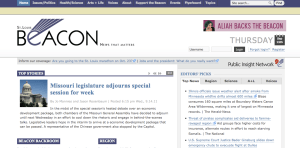
On the St. Louis Beacon, one of the lead articles featured on the home page as of 6:45 a.m. (PDT) Thursday, Sept. 15, was titled “Missouri legislature adjourns special session for week.” Its subject was the same as above, but with a different framing that included the overall economic package containing the freight project.

Here is its gender breakdown:

Author: Female

Human sources  (listed in order mentioned):

  1. Male, state Senate president pro tem (R)
  2. Male, state House speaker (R)
  3. Male, state senator (R)

Notes/analysis: The article also quotes a statement from the governor’s office and a statement from a right to life group. The article includes three mug shots, all of men.

Gender Check 9/14/11 – Northeast

*Gender Checks are quick examinations of gender representation in individual news articles for the purpose of discovering trends over time. Click here to read more.

Website: The New York Times

On The New York Times, one of the lead articles featured on the home page as of 9 p.m. EST on Wednesday, Sept. 14 was titled “There’s an Exciting Clash on the Field. Oh, That’s the Uniform.” Its subject was the growing trend of fashion-forward uniforms in college football.

Here is its gender breakdown:

Author:  Male

Human sources  (listed in order mentioned):

  1. Male – ESPN reporter
  2. Male – Under Armour senior vice president
  3. Male – spokesman for University of Maryland
  4. Male – director of football for Adidas

Website: ProPublica

On ProPublica, one of the lead articles featured on the home page as of 9 p.m. EST on Wednesday, September 14 was titled “What’s Gov. Perry’s Drug Controversy All About?.” Its subject was

Here is its gender breakdown:

Author: Male

Human sources  (listed in order mentioned)

  1. Male – governor and republican presidential candidate

Notes/Analysis: Most of the information for this story came from public statements or prior material compiled on Gov. Perry.

Gender check: 9/13/11 – West

*Gender Checks are quick examinations of gender representation in individual news articles for the purpose of discovering trends over time. Click here to read more.

Website: Seattle Times

“We’re conserving, but water rates may climb” – Seattle Times 9/13/2011

On the Seattle Times, one of the lead articles featured on the home page as of 9 a.m. (PDT) Tuesday, Sept. 13, was titled “We’re conserving, but water rates may climb.” Its subject was water rates.

Here is its gender breakdown:

Author: Female

Human sources  (listed in order mentioned):

  1. Male, consultant
  2. Male, city council’s utilities committee chairman
  3. Male, analyst
  4. Male, chamber of commerce vice president for government relations
  5. Male, member of water system advisory committee
  6. Male, director
  7. Male, city council president
  8. Male, manager of watershed education center
  9. Male, senior civil engineer on the project

Notes/analysis: Four photos are included with the article. All by male photographers. No visible women.


Website: Seattle P-I

On the Seattle P-I, one of the lead articles featured on the home page as of 9 a.m. (PDT) Tuesday, Sept. 13, was titled “A Jersey guy’s love for the Olympics.” Its subject was Bill Bradley’s role in a dam removal project to reopen part of Olympic National Park to spawning salmon.

Here is its gender breakdown:

Author: Male

Human sources  (listed in order mentioned):

  1. Male, former U.S. senator (subject)
  2. Male, late Alaska governor