Gender check: 7/19/11 – West

*Gender Checks are quick examinations of gender representation in individual news articles for the purpose of discovering trends over time. Click here to read more.

Website: Seattle Times

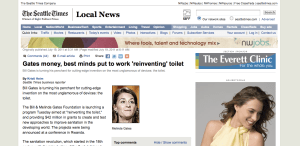
“Gates money, best minds put to work ‘reinventing’ toilet” – Seattle Times, 7/19/2011

On the Seattle Times, one of the lead articles featured on the home page as of 11:10 a.m. (PDT) Tuesday, July 19, was titled “Gates money, best minds put to work ‘reinventing’ toilet.” Its subject was a new program by the Bill & Melinda Gates Foundation aimed at creating new sanitation innovations for the developing world.

Here is its gender breakdown:

Author: Female

Human sources  (listed in order mentioned):

  1. Male, director of initiative
  2. Female, foundation co-chair
  3. Female, executive director of non-profit

Notes/analysis: The lead of the story only mentions Bill Gates, but the only photo with the story is a mug shot of Melinda Gates. Bill is not quoted, while she is.

Website: Seattle P-I

On the Seattle P-I, one of the lead articles featured on the home page as of 11:10 a.m. (PDT) Tuesday, July 19, was titled “State worker who stole, sold files sentenced.” Its subject was a less than two-year sentence for a man who pleaded guilty to selling confidential information.

Here is its gender breakdown:

Author: Male

Human sources  (listed in order mentioned):

  1. Male, former worker (subject)
  2. Female, assistant U.S. attorney
  3. Female, defense attorney

Gender Check: 7/14/11 – Midwest

*Gender Checks are quick examinations of gender representation in individual news articles for the purpose of discovering trends over time. Click here to read more.

Website: St. Louis Post-Dispatch (stltoday.com)

On Stltoday.com, one of the lead articles featured on the home page as of 8 a.m. (PST) Thursday, July 14, was titled “Federal agents seize 2,300 pounds of pot from truck near Pacific.” Its subject was marijuana in a secret compartment of a tractor trailer parked on the side of the interstate.

Here is its gender breakdown:

Author: Female

Human sources (listed in order mentioned):

  1. Male, spokesman with U.S. Immigration and Customs agency

Notes/analysis: This was a developing story.

Website: St. Louis Beacon

On the St. Louis Beacon, one of the lead articles featured on the home page as of 8 a.m. (PST) Thursday, July 14, was titled “Crack cocaine offenders may get early release; neighborhoods hope to avoid reentry problems.” Its subject was a plan to ease sentences of some inmates with crack cocaine sentences.

Here is its gender breakdown:

Author: Male

Human sources (listed in order mentioned):

  1. Male, professor
  2. Female, district judge
  3. Male, chief probation officer
  4. Female, associate professor
  5. Male, resident
  6. Male, alderman
  7. Female, resident
  8. Male, federal parole officer

Notes/analysis: The article also contains several of mug shots of sources — two of women and one of a man.

Gender check: 7/12/11 – West

*Gender Checks are quick examinations of gender representation in individual news articles for the purpose of discovering trends over time. Click here to read more.

Website: Seattle Times

On the Seattle Times, one of the lead articles featured on the home page as of 10:45 a.m. (PST) Tuesday, July 12, was titled “Lava-lamp idea for Soap Lake is refueled.” Its subject was plans for a small town to erect a 60-foot lava lamp..

Here is its gender breakdown:

Author: Female

Human sources  (listed in order mentioned):

  1. Male, architect (new idea)
  2. Female, marketing manager for lava lamp company
  3. Male, mayor
  4. Male, artist who runs museum (original idea)
  5. Male, local farmer
  6. Male, owns local liquor store
  7. Female, longtime resident
  8. Male, local Realtor

Website: Seattle P-I

Seattle P-I, 7/12/11

On the Seattle P-I, one of the lead articles featured on the home page as of 10:45 a.m. (PST) Tuesday, July 12, was titled “Local soldier who lost hand receives Medal of Honor” Its subject was a man who will be the second living person to receive the Medal of Honor for action from Iraq and Afghanistan.

Here is its gender breakdown:

Author: Female

Human sources  (listed in order mentioned):

  1. Male, sgt.
  2. Male, sgt. (who is receiving the medal)

Notes/analysis: Though the images with the story are mostly of the man who will be receiving the medal and generated images of the scene, two also include his wife.

A look at the representation of women in articles of “national” online news outlets

Our purpose here at The Gender Report has been to identify how women are represented in online news and how that compares to traditional media. One of the ways we’re doing that is to look at those sites that are online-only news sources specifically and women’s presence in their coverage and staffs.

Last month, we examined the number of female principal staff at the online news outlets listed in the Columbia Journalism Review‘s News Frontier Database, based on what was included in the sites’ individual database entries. We found that 28 percent of these top editorial staff members were women.

“National” sites in the News Frontier Database

The News Frontier Database, CJR’s collection of searchable data and write-ups on online news outlets, now has a total of more than 130 entries including sites that are nationally situated as well as those that pertain to a particular state or location. It was these “national” sites that we decided to take a closer look at this month.

The database currently contains 40 sites under the “national” search, with three added since June 3, the day we last took a look at it. Those additions still leave these sites in the 19 and 20 percent range in terms of the percentage of women in their principal staffs, which is lower than the overall total.

On July 1 we visited all 40 of these websites at about 11 a.m. (PST) and pulled the top or lead article, which we then “gender checked,” including taking note of the subject, gender of the author (or authors) and the gender breakdown of the sources referenced.

Here’s what was found:

Sourcing

Women made up 22 percent of the sources in the 40 articles monitored. That broke down to 71 male sources and 20 female sources.

Our sample included three stories with one or more female source that contained no male sources. These were also the only articles with more female sources than males — in other words, if a story had male sources, it always had more of them than females.

Fourteen stories that used one or more male source had no female source. These articles contained as many as eight sources total, all of which were male.

Interestingly, 13 stories in the sample cited no human sources. In most cases it was because these quoted other news sources (i.e. according to the New York Times) or were alternative story forms like charts or lists.

Authorship

Of the articles in the sample, 12 were written or produced by a woman, 23 by one or more man, three with a shared byline between one or more man and one or more woman, and two credited to staff. That puts women at 34.3 percent of bylines of those articles that were written by a person of one gender or the other.

As a note for further study, we’ve had regular occurrences of stories we’ve monitored be written by more than one man but very few if any written by just more than one woman. That’s something we’ll keep an eye on in the future.

When gender matters

With this study, we opted to see if the author’s gender made a difference in the use of female sources. It turns out that it did.

The 12 stories written by women used 13 male sources and eight female sources, putting women at 38 percent.

Meanwhile, the 23 stories written by men contained 45 male sources but only five female sources. That meant women were only 10 percent of sources.

For the stories that were produced by both a man and a woman, the percentage was closer to that of female authors, at 37 percent. That separated out to 13 male sources and seven female. Stories attributed to “staff” had no sources as they were both lists.

With or without women as “principal staff”

With the differences seen by the author’s gender, we also decided to take our data a step further and look at it based on our previous study of the gender breakdown of the sites’ “principal staff.” For simplicity, we took the findings from the 23 national sites that listed no females among their principal staff members and compared them to those of the 17 sites with at least one female staff member.

Though the sites with at least one female listed appear to have better representation of women as both authors and sources, the difference was particularly apparent in bylines. Of the lead articles from national online news outlets with no females as principal staff, women had 23.8 percent bylines. Those with at least one female had parity overall with women as 50 percent of authors.

In sourcing, a look at articles from news sites with no principal female staff showed women as 19.3 percent of sources. At sites with one or more female at the top, that percentage reached 26.5 percent.

It’s true that other factors could be at play in these sites to create these differences. More research would need to be done to see if there are other shared characteristics. From initial glance at the data, both groups — those sites without a female principal staff member and those with — include those of the full range of editorial staff sizes as well as coverage topics with few exceptions.

Comparison

This is just one small sample, so further research will be needed to determine how these findings hold up and to see if other factors are at play. However, in comparing the overall percentages of female sources and authors in this study to those of others, it appears to be on target.

The Global Media Monitoring Project (2010), in its first study that included monitoring news websites, found that women were 23 percent of news subjects and bylined 36 percent of stories in its sample.

And, in the first quarter of our weekly Gender Checks of eight online news sites across the United States, we found that thus far women were 24.6 percent of sources and had 31 percent of bylines.

For more data on gender representations in online news, check out our “Findings and Statistics” category or visit our “Useful Resources” page.

Gender check: 7/7/11 – Midwest

*Gender Checks are quick examinations of gender representation in individual news articles for the purpose of discovering trends over time. Click here to read more.

Website: St. Louis Post-Dispatch (stltoday.com)

On Stltoday.com, one of the lead articles featured on the home page as of 9:30 a.m. (PST) Thursday, July 7, was titled “St. Louis closes 18th Street bridge for emergency repairs.” Its subject was closures as a result of repairs to a bridge.

Here is its gender breakdown:

Author: Male

Human sources  (listed in order mentioned):

  1. Male, traffic commissioner

Notes/analysis: The story was only five graphs long and simply detailed expected closures, delays and alternative routes.

Website: St. Louis Beacon

St. Louis Beacon, 7/7/11

On the St. Louis Beacon, one of the lead articles featured on the home page as of 9:30 a.m. (PST) July 7, was titled “As anti-terrorism funding shrinks, controversy grows over how to spend it.” Its subject was cuts to funding bringing about debates in how the security funds should be used.

Here is its gender breakdown:

Author: Male

Human sources  (listed in order mentioned):

  1. Female, Department of Homeland secretary
  2. Male, U.S. representative
  3. Male, U.S. representative
  4. Male, public safety administrator
  5. Female, director of emergency services and homeland security
  6. Male, task force member
  7. Male, research fellow
  8. Male, U.S. senator
  9. Male, spokesman for male U.S. representative
  10. Female, spokeswoman for female U.S. senator
  11. Male, U.S. representative
  12. Male, spokesman for male U.S. senator

Notes/analysis: The article also contains a number of mug shots of sources — four of men and one of a woman.