Second month sees decrease in female sources

We completed our second month’s worth of Gender Checks last week and the results showed a widening gap between male and female representation in news sites.

Our findings are close to being in line with other studies that have been done on gender representation in the news, and, though the results aren’t encouraging for women, they do tell us that our process seems to be working.

Before we fill you in on the results we’d like to remind our readers that this is just a single month’s worth of data from our simple Gender Checks. We hope you understand the limitations of this data, however telling. We’ve only sampled a few articles from eight news sites. Further research is needed to verify any validity across the board.

Feb. 21 – March 21, 2011

We reviewed 30 articles, two in each Gender Check. Each geographical region had four Gender Checks, with the exception of the South, which had three (We missed one week).

For each Gender Check, we looked at two websites — one associated with a newspaper and one that was online-only. We recorded information such as the gender of the author and the breakdown of the genders of the human sources referenced in the articles among other details.  (For more on what Gender Checks are, read our introductory post here.)

Overall, these were the findings:

Sourcing

The articles contained 99 male sources and 26 female sources, which put women at about 21 percent of the human sources referenced in these articles. This is a slightly lower percentage of female sources than the Global Media Monitoring Project found in 2010 — approximately 23 percent of the news subjects on the 84 websites monitored were women.

Here’s how it broke down by geographic region:

  • West: 23 males, 4 female (Women at 14.8 percent)
  • Northeast: 28 males, 3 females (Women at 9.6 percent)
  • Midwest: 39 males, 11 females (Women at 22 percent)
  • South: 9 male, 8 female (Women at 47 percent)

And, as an additional aspect we’re interested to study over time, here’s the breakdown by news sites associated with a traditional newspaper and those that are not.

  • Newspaper website: 41 males, 8 females (Women at 16.3 percent)
  • Online-only:  58 males, 18 females (Women at  23.6 percent)

As we did our Gender Checks this month, the context of sources is particularly useful in examining gender breakdown in sources. We focused on several stories that used government officials, or focused on traditionally male-dominated fields such as law or the financial sector.  It’s an aspect of this issue that we’ll continue to look at in the future. Also important to note is that a decreased number of sources makes for more dramatic data points.

Authorship

Overall, 9 articles were written by an individual woman and 18 by a single man. In addition, two articles had a shared byline with a man and a woman.

Here’s a look by geographic region:

  • West: 1 by an individual woman, 6 by a man, 1 by a man and a woman (1 by contributors)
  • Northeast: 1 by a woman, 6 by a man
  • Midwest: 5 by a woman, 3 by men
  • South: 2 by a woman, 3 by men, 1 by a man and a woman

And, here’s the look by news website association:

  • Newspaper website: 7 by a woman, 5 by a man, 2 by a man and a woman
  • Online-only: 2 by a woman, 13 by a man

When looking at the gender gap in the authors, we’ll also need to keep in mind the make-up of the individual news website’s staff and who is on duty to publish to the web on the day we do our Gender Checks each week. Those factors could play a role in our final results and are elements we’ll be looking into in the future.

Check out how this data compares to last month’s Gender Report on sources and authorship.

We’ll be posting our results like this on a monthly and quarterly basis. As time goes by, we’ll be looking for other trends, including the subjects featured as lead articles on these news websites and what kind of correlation that may have to the gender of the author and the sources. We’ll also be seeking out and sharing the existing explanations on why we see the trends we do.

This is only the beginning of the data we hope to gather here at The Gender Report. Stay tuned for our weekly Gender Checks from each region. Additionally, we’ll be exploring other ways of looking at gender representation in the news in coming posts.

We’re also interested in your feedback. How are we doing? What information are you interested in when it comes to gender representations in online news? Share your thoughts in the comment section below or e-mail us at genderreport@gmail.com.

Gender Check 3/16/11 – Northeast

*Gender Checks are quick examinations of gender representation in individual news articles for the purpose of discovering trends over time. Click here to read more.

Website: The New York Times

On The New York Times, one of the lead articles featured on the home page as of 8 p.m. EST on Wednesday, March 16 was titled “U.S. Calls Radiation ‘Extremely High’ And Urges Deeper Caution In Japan.” Its subject was the developments with Japan’s damaged nuclear reactors.

Here is its gender breakdown:

Authors: Male (three bylines)

Human sources  (listed in order mentioned):

1. Male – chairman of the United States Nuclear Regulatory Commission

2. Male – spokesman for Tokyo Electric

3. Male – spokesman for NRC

4. Female – U.S. senator

5. Male – U.S. energy secretary

Notes/analysis: As much of the news will be dominated by the developing crisis and recovery in Japan, a study of the photographs is particularly interesting from a gender breakdown. Are women more prominent in photos of the surviving victims?

Website: ProPublica

On ProPublica, one of the lead articles featured on the home page as of 8:30 p.m. EST on Wednesday, March 16 was titled “Army Plans New Guidelines To Resolve Denials Of Purple Hearts to Brain-Injured Soldiers.” Its subject was a possible change in guidelines to accept brain injuries as legitimate combat injuries, making those soldiers eligible for the distinguished honor. The story was a co-investigation with a reporter from NPR.

Here is its gender breakdown:

Authors: Male (dual byline)

Human sources  (listed in order mentioned):

1. Male – Army general

2. Male – senior medical officer

3. Male – Army director of soldier programs and services

4. Male – U.S. congressman

5. Female – Army wife and founder of related organization

6. Male – retired army sergeant

Notes/analysis:

Gender Check 3/11/11 South

*Gender Checks are quick examinations of gender representation in individual news articles for the purpose of discovering trends over time. Click here to read more.

Website: The Miami Herald

On the Miami Herald, one of the lead articles featured on the home page as of 3 p.m. (EST) on Friday, March 11 was titled “South Dade Gets Mini-Arsht Center.” Its subject was the announcement of $51 million contract for a new performing arts center to open in the Culter Bay area next month.

Here is its gender breakdown:

Author: Female

Human sources  (listed in order mentioned):

1. Male – managing director of facility

2. Male – mayor of Cutler Bay

3. Male – director of cultural affairs for Miami-Dade County

4. Male – vice mayor of Cutler Bay

Notes/analysis:


Website: Patch (Seminole Heights)

On Patch of Seminole Heights, one of the lead articles featured on the home page as of 3 p.m. (EST) on Friday, March 11 was titled “City’s Review Of New Garden Regulations Pushed Back.” Its subject was the city council’s decision to hold off on a proposal to change fees for neighborhood garden plots.

Here is its gender breakdown:

Author: Male

Human sources  (listed in order mentioned):

1. Female- organizer in support of the fee change

Notes/analysis: Several groups are mentioned but not by individual members.

Gender Check 3/9/11 – Northeast

*Gender Checks are quick examinations of gender representation in individual news articles for the purpose of discovering trends over time. Click here to read more.

Website: The New York Times

On The New York Times, one of the lead articles featured on the home page as of 7:30 p.m. EST on March 9 was titled “A Glow In The Desert.” Its subject was a feature on a Texas homestead.

Here is its gender breakdown:

Authors: Female

Human sources  (listed in order mentioned):

1. Male – man living on the homestead

Notes/analysis: The story is a balance of direct interviews and quotes from the subject’s blog.

Website: ProPublica

On ProPublica, one of the lead articles featured on the home page as of 7:30 p.m. EST on March 9 was titled “Former Bush EPA Official Says Fracking Exemption Went Too Far; Congress Should Revisit.” Its subject was a process used to filter water that the former official says is not actually safe without regulation.

Here is its gender breakdown:

Author: Male

Human sources  (listed in order mentioned):

1. Male – former EPA official

2. Male – Congressman

3. Female – Congresswoman

4. Male – government agency committee member

5. Male – former administrator with EPA

Notes/analysis: This story was published as a Q&A, and as such the other sources mentioned are all references by the story’s subject himself, not the reporter.

In the Spotlight: Q&A with Global Girl Media

While most of our work here at The Gender Report is focused on identifying the problems and gaps in the representation of women in news coverage, we feel it necessary to take time to recognize those who are working toward solutions. That’s why, starting with this post during Women’s History Month and the week of International Women’s Day, we’re going to try to spend time highlighting an organization that is making strides in this area.

With each feature, we’ll be in correspondence with a member of that organization to have her, or him, answer five questions about its work.

First up, is…

GLOBAL GIRL MEDIA

The Gender Report spoke with Aime Williams, executive director and co-founder of Global Girl Media, via e-mail about the organization’s exciting work to empower teen girls through media training. Here’s what she had to share:

1. For those who are unfamiliar with your work, give us your elevator pitch — What is Global Girl Media?

Global Girl Media (GGM) develops the voice and self-expression of teenage girls in under-served and marginalized communities by training them to become citizen journalists, harnessing the power of new digital media to inspire self-esteem, community activism and social change. By linking young women internationally with seasoned reporters, educators and filmmakers, GGM empowers girls to make media that matters, improves media literacy, and encourages the promotion of healthier media messages about girls and women.

2. What do you consider to be the biggest issue when it comes to the representation of women in journalism and its creation?

Accuracy and complexity. We feel in particular the voices of young women from marginalized or otherwise under-served population are either absent or only heard from in times of war, disaster or crisis, oftentimes victimizing the subject.

Ethan Zuckerman, co-founder of the international blog Global Voices, speaking at a recent TED talk stated, “Sure we are becoming more global, our problems are global in scale, economics, environment, but our media is getting less global by the day…” International news as a percentage of an American television broadcast was 35 percent in the 1970s and it is less than 12 percent today. Access to and authorship of media matters because it underpins how societies respond to the problems they face. In the words of the BBC World Trust, “This makes media not only relevant to the most urgent problems of poverty and marginalization — it makes it critical to solutions designed to address them.”

GGM believes that ensuring access to media information and building capacity for authorship of this information is particularly crucial where media resources are scarce, and therefore oftentimes skewed to a particular dominant ideology or bias.

3. How is your organization a part of the solution?

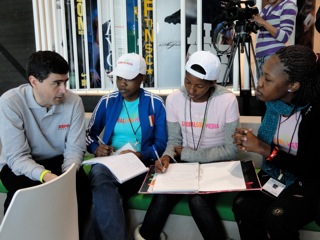
Giobal Girl reporters get tips from an ESPN/Brazil reporter during the 2010 FIFA World Cup. (Courtesy photo)

Our model is unique in that it pairs U.S. communities with international cities, creating a peer-to-peer international network of girls that can break down stereotypes by directly connecting and impacting each other through the internet. Training young women in new media journalism has the unique capability of augmenting all the other aspects of GGM’s activities, cross-cutting between issues of gender equity and self-esteem, cross-cultural communication and media literacy, reproductive rights and economic gains, etc.

What we are attempting to build with our media training program and distribution network is essentially a new model for development: one that sees authentic self-representation as a vibrant partner to economic growth, providing a viable structure for young women to take part in new media for human growth and development.

4. What project are you currently working on that you’re most excited about? Share a little bit about it.

Just as we strategically paired the cities of Los Angeles and Soweto, South Africa, for our pilot program, we have chosen Detroit as the sister city to our two initial international training sites — Sulaimaniyah, Kurdistan (Iraq) and Beirut, Lebanon, for our program expansion in 2011-2012. Our reasoning derives from a perceived lack of media being produced from a female perspective in these regions, in particular, young Arab and Muslim women are either entirely absent from mainstream media or grossly misrepresented and stereotyped.

Given the mass freedom movements in this area the world, now is certainly the time for Global Girl Media to be there! In the United States, there is a global curiosity about Middle Eastern and Arab women. People want to know who they are, what they have to say. Michigan has a large Arab Muslim Population and is also undergoing a period of great change.

In Detroit, the national economic crisis could not be more acute, where an historic industry is being rebuilt and the very first Arab American Museum has recently opened. GGM hopes to work within all three communities to help draw parallels, encourage critical dialogue and provide a broader experience for each Global Girl it trains.

5. What needs does your organization have? How can people get involved?

We are always looking to build our capacity and expand our program. We have an ongoing need for office volunteers, as well as program partners for future development. If there are organizations that want to bring our program to their community, we welcome them to reach out to us. We are always looking for co-sponsors, corporate and foundation support.

Find out more about Global Girl Media by visiting its website at www.globalgirlmedia.org. Follow the organization on twitter @GlobalGirlMedia and “like” it on Facebook here.

Are you a member of an organization that looks to address issues of gender representation in the news? Contact us about being next month’s “In the Spotlight” organization by e-mailing genderreport@gmail.com.