Skip to content
  • Home
  • About us
  • Who we are
  • Studies and Statistics
    • Byline Report
    • Our studies
    • Other research
    • Fact sheet – 2011
  • Features and Posts
    • The Basics
    • Reading List
    • Week in Review
    • In the Spotlight
  • Useful resources

The Gender Report

A closer look at gender and online news

women in journalism

Report Your Thoughts: Why does it matter?

August 25, 2011September 21, 2011Jasmine R. Linabary1 Comment

Editor’s note: Our findings through our monitoring projects have served to identify and bring attention to the fact that women’s voices are missing, but have left us with more questions than answers. That’s why we’re taking our project a step further by starting a discussion on why this is the case and what can be done about it. This is part of a series of posts each week aiming to start a discussion on gender representations in online news. View past “Report Your Thoughts” discussions here.

—–

Question 3: Why does it matter?

For the past two weeks since we launched our “Report Your Thoughts” discussion, we’ve asked and discussed (mostly via the Twitter hashtag #GRdiscuss) the basic question of “Why?” — Why are women present in such low numbers in our byline counts of lead articles as well as our looks inside newsrooms? And why are women’s voices absent among news sources?

Now we want to turn the discussion in a different direction to the question: Why does it matter? If women are a quarter or less of news sources and slightly over a third of authors, what difference does that make?

We want to hear from you. Why is it important that women have a part in producing the news and have their voices heard as news sources? Share your thoughts in the comment section as well as on Twitter with the hashtag #GRdiscuss or on our Facebook page.

Update: As has been the case, most of the discussion for this week’s question took place via Twitter using the hashtag #GRdiscuss. A few people and organizations took part by commenting on the question. Others retweeted and shared parts of the discussion.

Here are some of the highlights:

Report Your Thoughtsdiscussion, female bylines, female sources, gender, online news, women in journalism, women in the news

Despite reduced sample, women lose ground in authorship in seventh month

August 24, 2011September 20, 2011Joy BaconLeave a comment

Seventh Month: July 26 – August 18, 2011

During our seventh month of Gender Checks, we reviewed 22 articles, two in each Gender Check with some regions not reporting out each week. For each Gender Check, we looked at two websites from that region — one associated with a newspaper and one that was online-only. For our monitoring, we pulled the top or lead articles on their websites at the time of the check and gathered information on the gender of the author, the breakdown of the genders of the human sources referenced in the articles and other details. (For more on what Gender Checks are, read our introductory post here.)

Sourcing

Overall, the articles contained 52 male sources and 17 female sources, which meant women were 24.6 percent of the human sources referenced.

Here’s how it broke down by geographic region:

  • West: 25 males, 2 female (Women at 7.4 percent)
  • Northeast: 8 males, 3 females (Women at 27.3 percent)
  • Midwest: 19 males, 12  females (Women at 38.7 percent)
  • South: Not included in this report

Here’s the breakdown by news sites associated with a traditional newspaper and those that are not.

  • Newspaper website: 27 males, 9 females (Women at  25 percent)
  • Online-only: 25 males, 8 females (Women at 24.2 percent)

Authorship

This month 7 articles were written by an individual woman and 13 by one or more man, which meant women were 35 percent of authors of one gender or the other this month, which is a drop from 43.3 percent the previous month. The highest came in the fourth month with women as 57.1 percent of bylines, the only month that women were in the majority. There were two shared bylines between a man and a woman each for a print and online site.

Here’s how bylines broke down by geographic region:

  • West: 1 story by an individual woman, 7 by an individual man
  • Northeast: 3 by a woman, 1 by a man and 2 with a shared byline between a man and a woman
  • Midwest: 3 by a woman, 5 by a man
  • South: Not included in this report.

Here’s how women did in bylines between newspaper sites and online-only sites this month:

  • Newspaper website: 3 by a woman, 7 by a man and 1 with a shared byline between a man and woman
  • Online-only: 4 by a woman, 6 by a man, 1 with a shared byline

As always, we remind our readers that these findings reflect a limited amount of data (a month’s worth) from our simple Gender Checks. We hope you recognize the limitations of this data, since we’ve only sampled a few articles from eight news sites. Further research and time is needed to verify any validity across the board.

To look at past month breakdowns and other data on gender representations in online news, check out our “Findings and Statistics” category. Read our report from our first six months of Gender Checks here.

Findings and Statistics, Our studiesauthorship, female bylines, gender, Gender Checks, online news, sources, women in journalism, women in the news

Gender Check breakdown: A look at female authors, sources by article subject

August 12, 2011September 10, 2011Jasmine R. LinabaryLeave a comment

Is there a difference in the representation of women as sources and authors based on the subject of the article?

This is a question we’d been asking ourselves. We did look at the issue of coverage type when we examined the number of female principal staff members for online news sites through the Columbia Journalism Review’s News Frontier Database and found differences, but we’d yet to address it through our article monitoring.

Since marking six months of our Gender Check monitoring project and releasing our initial findings at the end of July, we’ve had a chance to spend some more time with our data and look at it from different angles, including this one.

We went back through our findings and looked at each of the 190 article we gender checked by topic. To have a basis of comparison as well as a some-what standardized approach, we opted to use (to the best of our ability) the Global Media Monitoring Project‘s news stories classification system (Click for a PDF of the system). This system divides articles into eight categories with a numbering system for further breakdowns within each category. Due to the number of articles in our sample at this time, we’ve opted just to look at the representation of women in each of the main categories, though we hope to look at further divisions in the future. None of our articles fell under the categories of “Other” and ‘The Girl-Child,” so we’ll just be sticking to the six remaining categories.

In terms of the subject classification of the articles we monitored in the first six months of our Gender Check project, the largest number fell under “Crime and Violence” (62 out of 190). That was followed by “Politics and Government” (41), “Economy” (38), “Social and Legal” (24), “Science and Health” (16) and “Celebrity, Arts, Media and Sports” (9).

Within those categories, here’s what we found:

Sourcing

The classification with the lowest percentage of female sources was “Social and Legal” at 19.8 percent followed closely by “Politics and Government” at 20.2 percent. The highest percentage of female sources went to “Science and Health” at 30.4 percent.

Here’s the breakdown by classification:

  • Politics and Government: 142 males, 36 females (Women as 20.2 percent)
  • Economy: 100 males, 34 females (Women as 25.4 percent)
  • Science and Health: 55 males, 24 females (Women as 30.4 percent)
  • Social and Legal: 73 males, 18 females (Women as 19.8 percent)
  • Crime and Violence: 180 males, 73 females (Women as 28.9 percent)
  • Celebrity, Arts, Media and Sports: 22 males, 9 females (Women as 29 percent)

Authorship

Even though they had the highest percentage of female sources, “Science and Health” articles did not fair well when it came to female bylines. Articles in this classification had the lowest percentage of female authors at 25 percent. The closest to byline parity was in “Economy” where females made up 44.7 percent of authors.

Here’s how it separated out by classification:

  • Politics and Government: 15 stories by women, 23 by men, 3 shared bylines between a man and a woman (Women as 36.6 percent)
  • Economy: 17 by women, 21 by men (Women as 44.7 percent)
  • Science and Health: 4 by women, 11 by men, 1 shared (Women as 25 percent)
  • Social and Legal: 9 by women, 13 by men, 2 shared (Women as 37.5 percent)
  • Crime and Violence: 18 by women, 35 by men, 8 shared, 1 by contributors (Women as 29 percent)
  • Celebrity, Arts, Media and Sports: 3 by women, 6 by men (Women as 33.3 percent)

We’ll be continuing to watch for trends that emerge in subject areas over time as our study progresses. We’d like to hear from you. What did you find most interesting or surprising about these results? What are you curious to know?

For more information on gender representations in online news, check out our “Findings and Statistics” and “Useful Resources” pages.

Findings and Statistics, Our studiesarticle subject, authorship, female bylines, Gender Checks, online news, sourcing, women in journalism

Report Your Thoughts: Where are the women? (Part 1)

August 10, 2011September 10, 2011Jasmine R. LinabaryLeave a comment

Editor’s note: Our findings through our monitoring projects have served to identify and bring attention to the fact that women’s voices are missing, but have left us with more questions than answers. That’s why we’re taking our project a step further by starting a discussion on why this is the case and what can be done about it. This is part of a series of posts each week aiming to start a discussion on gender representations in online news. View past “Report Your Thoughts” discussions here.

—–

Question 1: Where are the women (in bylines and in the newsroom)?

We’d like to start off our discussions with the most basic question about our findings: Why? Why are women present in such low numbers in our byline counts of lead articles as well as our looks inside newsrooms?

Since the late 1970s, women have made up the majority of college journalism majors, but that has yet to transfer over to the industry itself.

Here are some facts:

– The American Society of News Editors’ 2011 Newsroom Census found that women made up 36.9 percent of those working full time at daily U.S. newspapers. That percentage has fluctuated only slightly since the study began in 1999.

-The Global Media Monitoring Project (2010) found that overall in a study of media platforms from 100 countries that 37 percent of stories were reported by women. That percentage was 36 percent in the monitoring of online news sites from 16 countries.

-At the six-month mark, we’ve found that women wrote 37.7 percent of the lead articles on the online news sites in our Gender Check study if articles with no bylines and those with shared bylines between a man and a woman are taken out of the equation, but 34.7 percent when those are included. Among the top discussed and linked to articles around the web via the New Media Index, they bylined 31.3 percent of articles by authors or one gender or the author and only 26.3 percent overall in the first six months of 2011. In our look at the principal staff members of online-only news sites in the News Frontier Database, we discovered that women hold only 28 percent of these positions.

There have been many reasons and factors associated with this absence of women from newsrooms and among lead bylines, but we want to hear from you. What do you make of these findings. Why is this the case? If you are a woman with a background or training in journalism but are not currently working in the field, we want to know your story.

We invite you to share your thoughts as well as any personal stories here in the comment section as well as on Twitter with the hashtag #GRdiscuss or on our Facebook discussion board.

So, where are the women?

Update: We’ll also note that the International Women’s Media Foundation’s  “The Global Report on the Status of Women in the News Media”  that came out in March uncovered similar trends in its look at nearly 60 countries and more than 500 companies (Read our past post on this study here). The study found that 73 percent of the top management jobs were occupied by men. Overall, women held 36 percent of reporter positions.

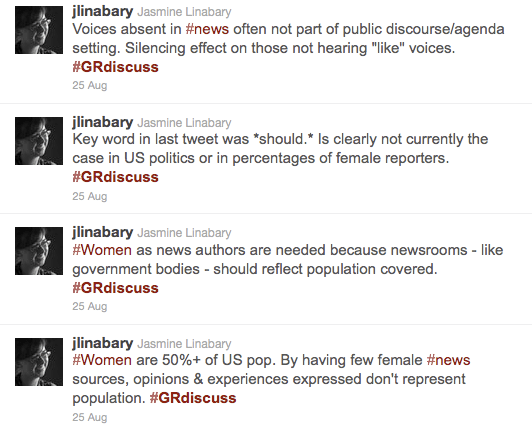
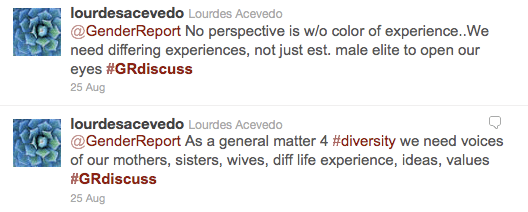
Update 2: Much of the discussion for this week’s question took place on Twitter using the hashtag #GRdiscuss. A few people and groups participated by sharing their thoughts on the question as well as comments and links on women’s representation in the media in general. Many more retweeted parts of the discussion.

The most retweeted was one of my own comments on the subject:

Here’s a sample of some of the other highlights:

To view more tweets in the discussion, search the #GRdiscuss hashtag on Twitter. You can still join the discussion and share your thoughts by commenting below.

Report Your Thoughtsdiscussion, female bylines, gender, online news, women in journalism

Getting the discussion started: Gender representations in online news

August 10, 2011August 30, 2011Jasmine R. LinabaryLeave a comment

Is your voice being represented in the news? Odds are, if you’re a woman, probably not. Women make up 50.7 percent of the U.S. population, according to the most recent census, but when it comes to representation in the news they are present in much lower numbers.

The presence of women is what we’ve been attempting to calculate here at The Gender Report, particularly when it comes to the emergent platform of online news. Thus far, we’ve found that among lead articles on online news sites, both those associated with a newspaper and those that are online-only, women make up only 25.3 percent of sources. That percentage drops lower when we look at the most linked to and discussed articles of the web in the New Media Index in which women are only 20.2 percent of sources.

And, when it comes to producing online news, women haven’t reached parity there either. Our counts have found that once articles with no bylines and those with shared bylines between a man and a woman are taken out of the equation, women wrote 37.7 percent of the lead articles on the online news sites in our study. Of the top articles around the web, they bylined 31.3 percent. They are also absent among the principal staff members of online-only news sites, filling 28 percent of these positions, based on our look at the News Frontier Database.

These numbers, while serving to identify and bring attention to the fact that women’s voices are missing, present us with more questions than answers. That’s why we’d like to take our project a step further by starting a discussion on why this is the case and what can be done about it.

For the next several weeks, we’ll be posting discussion questions here on our website with the tag “Report Your Thoughts” as well as through Facebook and Twitter (using the hashtag #GRdiscuss). We hope you’ll get involved by sharing your thoughts and comments on questions like: Where are the women? Why does it matter? What’s the solution? And who’s working toward change?

Join us in this conversation. Let’s get the discussion started.

Report Your Thoughtsauthorship, discussion, female bylines, gender, online news, sourcing, women in journalism
Previous Articles
Next Articles

Recent Posts

  • Women in journalism: Reading list for 10/27/2014
  • Women in journalism: Reading list for 9/14/2014
  • Women in journalism: Reading list for 8/10/2014

What is The Gender Report?

The Gender Report is a website that aims to monitor gender representations in online news. Contact us at genderreport@gmail.com. Follow @genderreport on Twitter.

Connect with us

  • On Facebook
  • On Twitter

Most Popular

  • Women in journalism: Reading list for 11/10/2013
  • Home
  • Week in Review: Feb. 7 – Feb. 11
  • New report documents persistent gender inequalities in U.S. media

Search

Enter your email address to follow The Gender Report and receive notifications of new posts by email.

Join 198 other subscribers

RSS

RSS Feed

Blog at WordPress.com.
Privacy & Cookies: This site uses cookies. By continuing to use this website, you agree to their use.
To find out more, including how to control cookies, see here: Cookie Policy
  • Subscribe Subscribed
    • The Gender Report
    • Join 198 other subscribers
    • Already have a WordPress.com account? Log in now.
    • The Gender Report
    • Subscribe Subscribed
    • Sign up
    • Log in
    • Report this content
    • View site in Reader
    • Manage subscriptions
    • Collapse this bar
 

Loading Comments...