*Gender Checks are quick examinations of gender representation in individual news articles for the purpose of discovering trends over time. Click hereto read more.
On the Miami Herald, one of the lead articles featured on the home page as of 10:30 a.m. (EST) on Friday, July 15 was titled “MDC Not Likely To Lose Accreditation, Say Experts.” Its subject was the possibility of part-time faculty numbers jeopardizing Miami Dade College’s status as a higher-ed institution.
Here is its gender breakdown:
–Author: Male
–Human sources (listed in order mentioned):
Male -college president (from a previously released letter)
Male – spokesman
Female – spokeswoman
Female – policy analyst
Notes/analysis: Some key sources for this story declined comment.
On Patch of Seminole Heights, one of the lead articles featured on the home page as of 10:30 a.m. (EST) on Friday, July 15 was titled “Looking for a Gas Bargain? Try These Pumps.” Its subject was a listing of local gas stations and their current prices.
*Gender Checks are quick examinations of gender representation in individual news articles for the purpose of discovering trends over time. Click here to read more.
On Stltoday.com, one of the lead articles featured on the home page as of 8 a.m. (PST) Thursday, July 14, was titled “Federal agents seize 2,300 pounds of pot from truck near Pacific.” Its subject was marijuana in a secret compartment of a tractor trailer parked on the side of the interstate.
Here is its gender breakdown:
–Author: Female
–Human sources (listed in order mentioned):
Male, spokesman with U.S. Immigration and Customs agency
*Gender Checks are quick examinations of gender representation in individual news articles for the purpose of discovering trends over time. Click here to read more.
On The New York Times, one of the lead articles featured on the home page as of 10:30 a.m. EST on Wednesday, July 13 was titled “In Retreat, Murdoch Drops TV Takeover.” Its subject was the continued developments in the British news outlets’ missteps.
Here is its gender breakdown:
–Authors: Male (shared byline)
–Human sources (listed in order mentioned):
Male – company deputy chairman (as quoted from press release)
Male – prime minister (as quoted from statement)
Male – political party leader
Male – member of Parliament
Male – committee member (as quoted from public statement)
Male – committee member (as quoted from public statement)
Male – former prime minister
Notes/Analysis: Much of this story and its quotes were taken from publicly released statements or debates in open committees.
Male – New York Times reporter (from his own writing)
Notes/analysis: This story used mostly a previous New York Times article that provided the interview. Other information came from previous ProPublica reporting on similar topics.
*Gender Checks are quick examinations of gender representation in individual news articles for the purpose of discovering trends over time. Click here to read more.
On the Seattle Times, one of the lead articles featured on the home page as of 10:45 a.m. (PST) Tuesday, July 12, was titled “Lava-lamp idea for Soap Lake is refueled.” Its subject was plans for a small town to erect a 60-foot lava lamp..
On the Seattle P-I, one of the lead articles featured on the home page as of 10:45 a.m. (PST) Tuesday, July 12, was titled “Local soldier who lost hand receives Medal of Honor” Its subject was a man who will be the second living person to receive the Medal of Honor for action from Iraq and Afghanistan.
Here is its gender breakdown:
–Author: Female
–Human sources (listed in order mentioned):
Male, sgt.
Male, sgt. (who is receiving the medal)
Notes/analysis: Though the images with the story are mostly of the man who will be receiving the medal and generated images of the scene, two also include his wife.
New drama over the Dominique Strauss-Kahn sexual assault charges turned into a media frenzy over the last week as the credibility of the alleged victim was called into question.
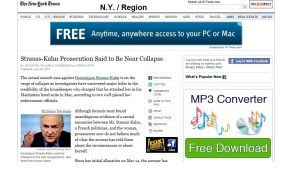
The New York Times broke the news June 30 that prosecutors were finding holes in the woman’s story and that the case was possibly near collapse. The following day, Strauss-Kahn, a 62-year-old French politician and the former head of the International Monetary Fund, was released on his own recognizance.
This story from the New York Times broke the news about prosecutors questioning the accuser's credibility in the Strauss-Kahn case on June 30.
The actual incident in question took place in May when a 32-year-old housekeeper from Guinea entered the Strauss-Kahn’s suite in a New York hotel to clean it. What happened in the next 20 minutes is what’s under dispute. She’s said it was assault while representatives of Strauss-Kahn have claimed it was consensual. (For some of the details of the incident, see “What happened in room 2806” from the New York Times.)
Among prosecutors’ claims regarding her credibility were that the woman had lied about abuse on her asylum application, had ties to people with criminal backgrounds (including a man she visited the day after the incident and spoke with and some “unexplained” deposits in her bank account), discrepancies on tax returns and changes in her account of what happened that day. However, as many sources have noted, prosecutors did not call into question the sexual assault itself.
Her attorney spoke to the press about the allegations as well as pointed out the strong physical evidence that is still present in the case. He also said the woman would come forward and share her story. Thus far, others have come out to speak to the woman’s credibility, including her union, and have pointed out that these claims of her “lying” may not be what they seem. More often, it has been a case of her listening to poor advice. A statement from the Hotel Workers’ Union pointed out that if she did lie regarding her immigration and tax forms it only makes her “one of probably millions of people who have done the same things.” (For more, read “DSK maid fights back” from the Daily Beast.)
From there, the media erupted both at home and abroad. Since these revelations, the story has grown with now other legal suits coming into play.
Most striking from a media standpoint has been a New York Post cover story that claimed the woman was a “hooker.” She is now fighting back by filing a suit against the Post.
Her credibility wasn’t the only being challenged. Shortly after stories came out about the New York case crumbling, a French writer, Tristane Banon, who had claimed that Strauss-Kahn had tried to
assault her in 2003, announced she would officially accuse him. His lawyers responded by saying they would file a counter complaint against Banon.
Dozens of opinion pieces and analyses have been written on the case. A few can be found linked to below.
Some of the key points of discussion have been the dangers of narratives — whether it was that people were too quick to believe the claims of sexual assault were true because it was a typical case of “the powerful vs. the powerless” or that others were grappling with a belief that a victim must be “perfect” or without blemish. Others have simply pointed out that none should be too quick to judge either side.
Concerns additionally have been expressed over what this attention and treatment will mean for future rape or sexual assault victims (and their likelihood to report their experiences). Writers have pointed out that high-profile cases like this feed into the myth that a disproportionate percentage of sexual assault claims are false. In reality, it’s estimated to be between 2 and 10 percent.
Also receiving attention was the fact that U.S. news sources are continuing their practice to not name the woman involved. We’ll be addressing that issue separately in an upcoming post.
Update (July 11): The next court date in the case has been postponed until Aug. 1 to allow time for further investigation, according to an Associated Press article.
This is the Gender Report’s Week in Review, a weekly post that highlights some of the major stories related to gender issues this week. Some of these stories may have already appeared in our News Feed or in the week’s Gender Checks. We’ll at times include a longer analysis of stories as well as bring attention to stories that may have slipped through the cracks of the week’s news cycle.


 The Gender Report