Gender Check 7/6/11 – Northeast

*Gender Checks are quick examinations of gender representation in individual news articles for the purpose of discovering trends over time. Click here to read more.

Website: The New York Times

On The New York Times, one of the lead articles featured on the home page as of 9:30 a.m. EST on Wednesday, July 6 was titled “Better Lives For Mexicans Cut Allure of Going North.” Its subject was a decline in immigrants crossing the Mexican border.

Here is its gender breakdown:

Authors: Male

Human sources  (listed in order mentioned):

  1. Male – Mexican student
  2. Male – director of migration project organization
  3. Male – economist
  4. Male – director of consular affairs
  5. Male – student’s father
  6. Male – student’s brother
  7. Male – teacher
  8. Male – demographer
  9. Male – Mexican government worker
  10. Female – volunteer
  11. Male – student’s brother
  12. unknown- state department official
  13. Male – demographer

Website: ProPublica

On ProPublica, one of the lead articles featured on the home page as of 9:30 a.m. EST on Wednesday, July 6 was titled “Casey Anthony Trial Shows the Limits of Forensic Science in Proving How a Child Died.” Its subject was the recent not guilty verdict in a child’s murder case and the evidence presented, or not presented, in the trial.

Here is its gender breakdown:

Authors:  Female

Human sources  (listed in order mentioned):

  1. Female – medical examiner (as quoted from autopsy report)
  2. Male – forensic chemist (as quoted from trial testimony)
  3. Male – forensic pathologist (as quoted from trial testimony)
  4. Male – state attorney (as quoted by Reuters)

Notes/analysis: This story used mostly legal documents, filings and past reporting for its information.


May brought few female sources, bylines in New Media Index stories

Women made up less than 15 percent of both sources and authors in the top linked to and discussed articles in the blogosphere in May, significantly lower than the findings of the first four months of the year.

Since January, we’ve been gender checking each of the top articles based on the links that the Project for Excellence in Journalism provides through its New Media Index roundups in addition to our geographical checks each week.

The New Media Index chronicles the top five linked to and discussed news stories and opinion pieces around the web in a Monday through Friday week based on leading commentary on blogs and social media sites. We chose to focus on the main top five in the blogosphere. In cases where more than one link was provided on the subject, we’ve picked the first mentioned or that which appears based on the writing as more dominant to check, unless it is specifically mentioned that two articles shared the attention for that particular subject.

From each of the articles, we’ve been cataloging the gender of the authors or creators, the source breakdown by gender and the subject matter. Overall, in the first four months of checking the New Media Index, women made up 21.8 percent of sources and 31.3 percent of authors.

Women were found in lower percentages of both in May. Here’s the breakdown:

May 2011

New Media Index: May 23-27, 2011

Between May 2 and May 27, we found the following. In total, only 12 articles could be checked this month. No links were supplied by the PEJ roundup for the week of May 16 to 20 because a special report was done on the Israel-Palestine conflict that week. Additionally, as has been the case in the past, a link to a specific story was not included for several large news events including Bin Laden’s death (at least the first week), the Shriver-Schwarzenegger split and the Joplin tornado. Other months have had between 17 and 25 articles to check, so the lower amount may have played a role in the results overall.

Here’s what the 12 articles showed:

  • In the articles monitored this month, women made up 13.3 percent of sources. The articles included 39 male sources and six female sources.
  • Eight articles were written or produced by men and only one was by a woman. Additionally, two were by both a man and a woman and one was not bylined.
  • Two top linked-to articles in blogs were opinion pieces. Both were by male authors.

Links this month predominately came from the LA Times, with a few for the BBC, one from the Washington Post and one from the New York Times.

For more information or research on women’s representation in the news media, check out our “Useful Resources” page as well as our other posts on findings and statistics.

Check back on The Gender Report next week for June’s findings from the New Media Index.

Gender check: 7/5/11 – West

*Gender Checks are quick examinations of gender representation in individual news articles for the purpose of discovering trends over time. Click here to read more.

Website: Seattle Times

Seattle Times, 7/5/2011

On the Seattle Times, one of the lead articles featured on the home page as of 9:30 a.m. (PST) Tuesday, July 5, was titled “Black Diamond split over big growth plans.” Its subject was debate over a large development.

Here is its gender breakdown:

Author: Male

Human sources  (listed in order mentioned):

  1. Male, developer
  2. Male, resident
  3. Female, mayor
  4. Female, opponent
  5. Male, resident (former mayor)
  6. Male, company’s chief entitlement officer
  7. Male, council member
  8. Male, city manager
  9. Male, council member
  10. Male, development and environmental services director

Notes/analysis: Four photos appear with the piece, taken by a female photographer. Two feature a single male (and story source) and one features a single female (and story source). The fourth is an image of a town landmark.


Website: Seattle P-I

On the Seattle P-I, one of the lead articles featured on the home page as of 9:30 a.m. (PST) Tuesday, July 7, was titled “Tuesday’s commute could be gridlock with Lions Club convention.” Its subject was officials getting the word out about traffic in light of the largest convention in Seattle in “at least two decades.”

Here is its gender breakdown:

Author: Male

Human sources  (listed in order mentioned):

  1. Female, WSDOT spokeswoman
  2. Male, Seattle DOT spokesman
  3. Female, Metro spokeswoman

Gender Check – 7/1/11 – South

*Gender Checks are quick examinations of gender representation in individual news articles for the purpose of discovering trends over time. Click here to read more.

Website: The Miami Herald

On the Miami Herald, one of the lead articles featured on the home page as of 9 a.m. (EST) on Friday, July 1 was titled “President Hugo Chavez’s revelation: Fighting Cancer After Surgery In Cuba.” Its subject was an admission from the Venezuelan president that his continuing illness is becoming serious.

Here is its gender breakdown:

Author: Female

Human sources (listed in order mentioned):

  1. Male – Venezuelan president (from public statement)
  2. Male – Venezuelan vice president (from public statement)
  3. Female – Venezuelan legislator

Website: Patch (Seminole Heights)

On Patch of Seminole Heights, one of the lead articles featured on the home page as of 9 a.m. (EST) on Friday, July 1 was titled “Meet Tampa Fire Rescue’s William Oglesby.” Its subject was a Q&A with the local fire department’s driver/engineer.

Here is its gender breakdown:

Author: Female

Human sources (listed in order mentioned):

  1. Male – feature subject

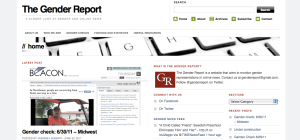
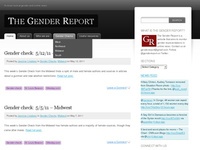
Live now: The Gender Report transitions to a new design

The Gender Report got a new look this week, which we hope will give you, our readers, a better snapshot of our offerings.

After
Before

We use WordPress.com as our platform and decided to switch design themes to a look that would showcase what we have to offer. While we appreciated the functions of our previous theme, “Fusion,” for our first six months in operation, our advancement and further development called for something new. To that end, we selected “The Morning After,” a newer theme with a magazine style. Though no design is perfect, we feel this new theme will allow us more flexibility to highlight certain posts and features as well as more opportunities to display our content. In turn, we hope that gives our readers better access to our work and the different aspects of our project. In light of this switch, we’ll also be looking to add more visuals and graphics to our posts, which will enhance readability and add value to our posts.

The transition to that new theme occurred June 29 (Please visit our home page for the full effect), but we’ll still be doing some fine-tuning. Though the biggest design changes have taken place, you may still notice some more subtle changes in the days to come.

Even with this redesign, you can still expect to find the same monitoring, resources and research work on representations of women in online news. We’ll be continuing to put out our weekly Gender Checks and Week in Review posts as well as sharing new resources and our recent findings.

We welcome your feedback. Along with thoughts about the design, also feel free to let us know if there are features or post topics you’d like to see from us. Share your ideas in the comment section below or email genderreport@gmail.com.