Gender check: 7/5/11 – West

*Gender Checks are quick examinations of gender representation in individual news articles for the purpose of discovering trends over time. Click here to read more.

Website: Seattle Times

Seattle Times, 7/5/2011

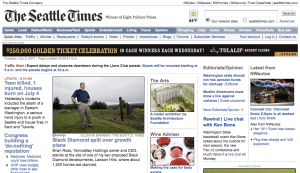
On the Seattle Times, one of the lead articles featured on the home page as of 9:30 a.m. (PST) Tuesday, July 5, was titled “Black Diamond split over big growth plans.” Its subject was debate over a large development.

Here is its gender breakdown:

Author: Male

Human sources  (listed in order mentioned):

  1. Male, developer
  2. Male, resident
  3. Female, mayor
  4. Female, opponent
  5. Male, resident (former mayor)
  6. Male, company’s chief entitlement officer
  7. Male, council member
  8. Male, city manager
  9. Male, council member
  10. Male, development and environmental services director

Notes/analysis: Four photos appear with the piece, taken by a female photographer. Two feature a single male (and story source) and one features a single female (and story source). The fourth is an image of a town landmark.


Website: Seattle P-I

On the Seattle P-I, one of the lead articles featured on the home page as of 9:30 a.m. (PST) Tuesday, July 7, was titled “Tuesday’s commute could be gridlock with Lions Club convention.” Its subject was officials getting the word out about traffic in light of the largest convention in Seattle in “at least two decades.”

Here is its gender breakdown:

Author: Male

Human sources  (listed in order mentioned):

  1. Female, WSDOT spokeswoman
  2. Male, Seattle DOT spokesman
  3. Female, Metro spokeswoman

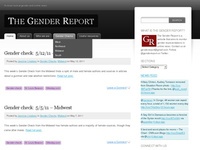
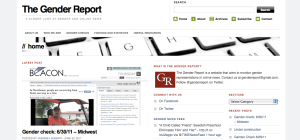
Live now: The Gender Report transitions to a new design

The Gender Report got a new look this week, which we hope will give you, our readers, a better snapshot of our offerings.

After
Before

We use WordPress.com as our platform and decided to switch design themes to a look that would showcase what we have to offer. While we appreciated the functions of our previous theme, “Fusion,” for our first six months in operation, our advancement and further development called for something new. To that end, we selected “The Morning After,” a newer theme with a magazine style. Though no design is perfect, we feel this new theme will allow us more flexibility to highlight certain posts and features as well as more opportunities to display our content. In turn, we hope that gives our readers better access to our work and the different aspects of our project. In light of this switch, we’ll also be looking to add more visuals and graphics to our posts, which will enhance readability and add value to our posts.

The transition to that new theme occurred June 29 (Please visit our home page for the full effect), but we’ll still be doing some fine-tuning. Though the biggest design changes have taken place, you may still notice some more subtle changes in the days to come.

Even with this redesign, you can still expect to find the same monitoring, resources and research work on representations of women in online news. We’ll be continuing to put out our weekly Gender Checks and Week in Review posts as well as sharing new resources and our recent findings.

We welcome your feedback. Along with thoughts about the design, also feel free to let us know if there are features or post topics you’d like to see from us. Share your ideas in the comment section below or email genderreport@gmail.com.

Gender check: 6/30/11 – Midwest

*Gender Checks are quick examinations of gender representation in individual news articles for the purpose of discovering trends over time. Click here to read more.

Website: St. Louis Post-Dispatch(stltoday.com)

Stltoday.com, 6/30/2011

On Stltoday.com, one of the lead articles featured on the home page as of 8:45 a.m. (PST) Thursday, June 30, was titled “Former Brentwood official admits stealing $30,000 for gambling.” Its subject was a former city administrator admits to embezzling.

Here is its gender breakdown:

Author: Male

Human sources  (listed in order mentioned):

  1. Male, mayor
  2. Males (2), defense lawyers (together said)
  3. Male, former city administrator, suspect

Website: St. Louis Beacon

St. Louis Beacon, 6/30/11

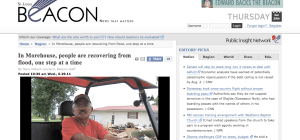
On the St. Louis Beacon, one of the lead articles featured on the home page as of 8:45 a.m. (PST) June 30, was titled “In Morehouse, people are recovering from flood, one step at a time.” Its subject was a look at how the people of one community are dealing with the after-effects of flooding.

Here is its gender breakdown:

Author: Female

Human sources  (listed in order mentioned):

  1. Female, resident
  2. Male, mayor
  3. Male, resident
  4. Male, FEMA spokesperson
  5. Female, Hoopa group (helping)
  6. Male, reverend
  7. Female, resident

Notes/analysis: The article also contains a photo slideshow. Those images with human figures feature a single person. There were five with males (two of the mayor) and four with females.

Gender Checks show higher count of female bylines in fourth month, fewer female sources in fifth

Though the fact that we missed some Gender Checks in the fourth and fifth months of this project may have slightly altered our results, overall between the two months women represented 25.7 percent of sources and 44.8 percent of bylines in the articles we monitored.

The percent of female authors in particular is significantly higher than what we found in our first three months of Gender Checks. During that time, women were 31 percent of authors. This difference is largely attributed to our fourth month (see findings below) in which for the first time in this study the number of female authors outnumbered the amount of males. That result may have been due to the fact that we missed several Gender Checks from the Northeast that month, and, of our four regions, it tends (at least as an average of our first three months) to return the lowest percentage of female bylines.

For each Gender Check, we looked at two websites from that region — one associated with a newspaper and one that was online-only. In doing so, we pulled the top articles on their websites at the time of the check and gathered information on the gender of the author and the breakdown of the genders of the human sources referenced in the articles among other details. (For more on what Gender Checks are, read our introductory post here.)

Here’s more detail on our findings of both sourcing and authorship from the two months broken down by geographic region and news site association:

Fourth Month: April 19 – May 20, 2011

We reviewed 32 articles, two in each Gender Check. This month we had five Gender Checks from the Midwest and South, four from the West and only two from the Northeast.

Sourcing

The articles contained 71 male sources and 31 female sources, which put women at about 30.4 percent of the human sources referenced in these articles. This does not include sources whose gender was not identifiable.

Here’s how it broke down by geographic region:

  • West: 13 males, 6 female (Women at 31.6 percent)
  • Northeast: 15 males, 6 females (Women at 28.6 percent)
  • Midwest: 20 males, 13 females (Women at 39.4 percent)
  • South: 23 male, 6 female (Women at 20.7 percent)

And, here’s the breakdown by news sites associated with a traditional newspaper and those that are not.

  • Newspaper website: 41 males, 15 females (Women at 26.8 percent)
  • Online-only:  30 males, 16 females (Women at 34.8 percent)

Authorship

Overall, 16 articles were written by an individual woman and 12 by one or more man, which meant for the first time in this study there were more female than male authors. All geographic areas were fairly evenly split. As stated earlier in this post, this may not have been the case if we had completed an equal number of Gender Checks in the Northeast this month, as it has shown to have the lowest percentage of female bylines thus far in our study. In addition, four articles had a shared byline with a man and a woman.

Here’s a look by geographic region:

  • West: 5 by an individual woman, 3 by an individual man
  • Northeast: 2 by a woman, 2 by a man
  • Midwest: 4 by a woman, 2 by a man, 4 by a man and a woman
  • South: 5 by a woman, 5 by a man

And, here’s the look by news website association:

  • Newspaper website: 9 by a woman, 5 by a man, 2 by a man and a woman
  • Online-only: 7 by a woman, 7 by a man, 2 by a man and a woman

Fifth Month: May 24 – June 24, 2011

We reviewed 30 articles, two in each Gender Check. This month that included five Gender Checks from the West and Midwest, four in the Northeast and only one in the South. Keep in mind that the lack of Gender Checks from the South may have changed slightly our results overall. In the first quarter, the South had slightly higher percentages of women authors and sources than the other geographic regions.

Sourcing

The articles contained 62 male sources and 15 female sources, which put women at about 19.5 percent of the human sources referenced in these articles. This does not include sources whose gender was not identifiable (particularly unnamed sources with no pronoun modifiers, which we saw more often this month).

The Northeast and Midwest performed particularly poorly for women this month. Here’s how it broke down by geographic region:

  • West: 18 males, 7 female (Women at 28 percent)
  • Northeast: 19 males, 2 females (Women at 9.5 percent)
  • Midwest: 20 males, 3 females (Women at 13 percent)
  • South: 5 male, 3 female (Women at 37.5 percent)

And, here’s the breakdown by news sites associated with a traditional newspaper and those that are not.

  • Newspaper website: 37 males, 11 females (Women at 22.9 percent)
  • Online-only:  25 males, 4 females (Women at 13.9 percent)

Authorship

Overall, 10 articles were written by an individual woman and 20 by one or more man, which meant women were 33.3 percent of authors this month. There were no shared bylines.

Here’s a look by geographic region:

  • West: 2 stories by an individual woman, 8 by an individual man
  • Northeast: 4 by a woman, 4 by a man
  • Midwest: 3 by a woman, 7 by a man
  • South: 1 by a woman, 1 by a man

For authorship, the number of female bylines newspaper sites and online-only sites matched this month. Here’s the look of what that meant in numbers:

  • Newspaper website: 5 by a woman, 10 by a man
  • Online-only: 5 by a woman, 10 by a man

A reminder for our readers: These results reflect a limited amount of data from our simple Gender Checks. We hope you recognize the limitations of this data, since we’ve only sampled a few articles from eight news sites (and in some cases, as in these past two months, not as consistently as we would have liked). Further research and time is needed to verify any validity across the board.

To look at past month breakdowns and other data on gender representations in online news, check out our “Findings and Statistics” category.
Gender check: 6/28/11 – West

*Gender Checks are quick examinations of gender representation in individual news articles for the purpose of discovering trends over time. Click here to read more.

Website: Seattle Times

On the Seattle Times, one of the lead articles featured on the home page as of 12:15 p.m. (PST) Tuesday, June 28, was titled “April home prices rise in Seattle and other U.S. cities, but analysts cautious.” Its subject was that home prices rose from the previous month for the first time in eight months, though analysts caution that it may just be a sign of temporary increases.

Here is its gender breakdown:

Author: Male

Human sources  (listed in order mentioned):

1. Male, chairman of index committee

2. Male, managing partner at investment bank

Notes/analysis: Most of the story was numbers based.


Website: Seattle P-I

On the Seattle P-I, one of the lead articles featured on the home page as of 12:15 p.m. (PST) Tuesday, June 28, was titled “Lesbian can sue UW for job discrimination, court rules.” Its subject was the Court of Appeals overturning a lower court ruling the statute of limitations had run out on a woman’s ability to sue the University of Washington, where she had worked, for what she claims was a hostile work environment.

Here is its gender breakdown:

Author: Female

Human sources  (listed in order mentioned):

1. Female, subject

2. Male, her boss (according to complaint)

Notes/analysis: The story mainly rehashes the complaint and states the court’s reversal. The woman’s claims are based on her experience with her male boss’ treatment of her after he found out she was a lesbian. Among other things, he told her not to “flaunt” her sexual orientation. Here’s a link to the P-I’s original story on the suit when it was first filed: “UW sued by lesbian who says boss harassed her.”