Gender check: 2/22/11 – West

*Gender Checks are quick examinations of gender representation in individual news articles for the purpose of discovering trends over time. Click here to read more.

Website: Seattle Times

On the Seattle Times, one of the lead articles featured on the home page as of 2 p.m. (MST) Tuesday, Feb. 22, was titled “U.S: Seattle couple, 2 other Americans killed by pirates.” Its subject was the deaths of four Americans (two male and two female) who were taken hostage and killed by pirates while sailing on their yacht off the coast of East Africa.

Here is its gender breakdown:

Author: AP and Seattle Times staff (with a male and a female contributor mentioned at the end)

Human sources  (listed in order mentioned):

1. Female, niece of the one of the female victims

2. Female, victim (via an e-mail sent before Valentine’s Day)

3. Male, animal shelter director who worked with one of the male victims

4. Male, monsignor (speaking of couple)

5. Male, professor, friend of one of the male victims

6. Male, general of U.S. Central Command

7. Male, pirate

8. Male, head of Dryad Maritime Intelligence

Notes/analysis: Sources speak on three of the four people killed as individuals. One of the females is only referenced as part of a couple with her husband whose background is described. She is named twice — with a different first name each time (Jean vs. Jane). Based on other news sources, her name appears to be Jean.


Website: Seattle P-I

On the Seattle P-I, one of the lead articles featured on the home page as of 2 p.m. (MST) Tuesday, Feb. 22, was titled “Up to 6 inches of snow possible by Thursday.” Its subject was a winter storm watch issued for the Seattle area and a large part of Western Washington.

Here is its gender breakdown:

Author: Male (with a male contributor)

Human sources  (listed in order mentioned):

1. Male, department of transportation spokesman

2. Male, meteorologist (via his weather blog)

Women make up 27.6% of sources in first month

We completed our first month’s worth of Gender Checks last week and the results were, well, not terribly surprising.

Our findings are close to being in line with other studies that have been done on gender representation in the news, and, though the results aren’t encouraging for women, they do tell us that our process seems to be working.

Before we fill you in on the results we’d like to remind our readers that this is just a single month’s worth of data from our simple Gender Checks. We hope you understand the limitations of this data, however telling. We’ve only sampled a few articles from eight news sites. Further research is needed to verify any validity across the board.

Jan. 18 – Feb. 18, 2011

We reviewed 38 articles, two in each Gender Check. Each geographical region had five Gender Checks, with the exception of the South, which had four (We missed one week).

For each Gender Check, we looked at two websites — one associated with a newspaper and one that was online-only. We recorded information such as the gender of the author and the breakdown of the genders of the human sources referenced in the articles among other details.  (For more on what Gender Checks are, read our introductory post here.)

Overall, these were the findings:

Sourcing

The articles contained 144 male sources and 55 female sources, which put women at about 27. 6 percent of the human sources referenced in these articles. This is a slightly higher percentage of female sources than the Global Media Monitoring Project found in 2010 — approximately 23 percent of the news subjects on the 84 websites monitored were women.

Here’s how it broke down by geographic region:

  • West: 29 males, 17 females (Women at 37 percent)
  • Northeast: 65 males, 19 females (Women at 22.6 percent)
  • Midwest: 34 males, 10 females (Women at 22.7 percent)
  • South: 16 male, 9 female (Women at 36 percent)

And, as an additional aspect we’re interested to study over time, here’s the breakdown by news sites associated with a traditional newspaper and those that are not.

  • Newspaper website: 66 males, 31 females (Women at 32 percent)
  • Online-only: 78 males, 24 females (Women at 23.5 percent)

As we did our Gender Checks this month, we tried to provide context as we could when the gender gap in the sourcing was particularly stark — such as the number of women in that profession (like this one on female judges) or in that political arena (like this one on women in the Missouri Legislature) — because sometimes that becomes a factor in source selection. It’s an aspect of this issue that we’ll continue to look at in the future.

Authorship

Overall, 11 articles were written by an individual woman and 19 by a single man. In addition, three articles had a shared byline with a man and a woman, four were shared bylines by men, and one was written by three men and one woman. If we just look at the articles written by a single author, women made up 36.7 percent of the authors — roughly what the GMMP in 2010 found.

Here’s a look by geographic region:

  • West: 5 by an individual woman, 4 by a man, 1 by a man and a woman
  • Northeast: 1 by a woman, 6 by one to three men, 2 by a man and a woman, 1 by three men and one woman
  • Midwest: 2 by a woman, 8 by men (one of which was by two men)
  • South: 3 by a woman, 5 by men (one of which was written by two men)

And, here’s the look by news website association:

  • Newspaper website: 8 by a woman, 8 by a man or multiple men, 3 by a man and a woman
  • Online-only: 3 by a woman, 15 by a man, 1 by three men and one woman

When looking at the gender gap in the authors, we’ll also need to keep in mind the make-up of the individual news website’s staff and who is on duty to publish to the web on the day we do our Gender Checks each week. Those factors could play a role in our final results and are elements we’ll be looking into in the future.

We’ll be posting our results like this on a monthly and quarterly basis. As time goes by, we’ll be looking for other trends, including the subjects featured as lead articles on these news websites and what kind of correlation that may have to the gender of the author and the sources. We’ll also be seeking out and sharing the existing explanations on why we see the trends we do.

This is only the beginning of the data we hope to gather here at The Gender Report. Stay tuned for our weekly Gender Checks from each region. Additionally, we’ll be exploring other ways of looking at gender representation in the news in coming posts.

We’re also interested in your feedback. How are we doing? What information are you interested in when it comes to gender representations in online news? Share your thoughts in the comment section below or e-mail us at genderreport@gmail.com.
Gender check: 2/17/11 – Midwest

*Gender Checks are quick examinations of gender representation in individual news articles for the purpose of discovering trends over time. Click here to read more.

Website: St. Louis Post-Dispatch (stltoday.com)

On Stltoday.com, one of the lead articles featured on the home page as of 3 p.m. (MST) Thursday, Feb. 17, was titled “Missouri House OKs local control for St. Louis police.” Its subject was the Missouri House of Representatives giving its (initial) approval to provide city officials authority over the city’s police department.

Here is its gender breakdown:

Author: Male

Human sources  (listed in order mentioned):

1. Female, state representative, Democrat

2. Male, governor (paraphrased)

3. Male, speaker of the house, Republican

Notes/analysis: Click here for an earlier Gender Check that looked at the gender breakdown in the Missouri Legislature.


Website: St. Louis Beacon

On the St. Louis Beacon, one of the lead articles featured on the home page as of 3 p.m. (MST) Thursday, Feb. 17, was titled “Razing Chrysler North plant raises lots of question.” Its subject was the debate around the use and marketing of a no-longer-in-use Chrysler plant and whether it should be demolished.

Here is its gender breakdown:

Author: Male

Human sources  (listed in order mentioned):

1. Female, U.S. senator, Democrat

2. Male, mayor

3. Male, county executive

4. Male, state representative, Republican

5. Male, state senator, Republican

Notes/analysis: In both articles this week, a woman’s actions led the story — whether it was her bill in the legislature or her letter she sent about her concerns. Even though women made up only one-fourth of the sources between the two stories (two women to six men), they were the cause of the news.

Gender check: 2/15/11 – West

*Gender Checks are quick examinations of gender representation in individual news articles for the purpose of discovering trends over time. Click here to read more.

Website: Seattle Times

On the Seattle Times, one of the lead articles featured on the home page as of 12:30 p.m. (MST) Tuesday, Feb. 15, was titled “Data center may be too big for state needs.” Its subject was the cost of a complex being built to consolidate roughly three dozen state data centers.

Here is its gender breakdown:

Author: Female

Human sources  (listed in order mentioned):

1. Female, spokeswoman, Department of Information Services

2. Male, representative to state legislature (Republican)

3. Male, representative (Democrat)

4. Female, development manager

5. Male, OFM deputy director

Notes/analysis: Both women mentioned are with the department that will operate the center.


Website: Seattle P-I

On the Seattle P-I, one of the lead articles featured on the home page as of 12:30 p.m. (MST) Tuesday, Feb. 15, was titled “Teen kicked by Seattle cop wants $450,000 from city.” Its subject subject was a case of alleged police abuse during a drug bust as well as a roundup of recent cases of police abuse caught on video.

Here is its gender breakdown:

Author: Male

Human sources  (listed in order mentioned):

1. Male, attorney

2. Male, deputy chief

3. Male, officers guild president

4. Male, prosecutor

5. Male, city attorney

Notes/analysis: Most sources were paraphrased. Most of the individuals mentioned in the story are male, with the exception of two teenage girls (one of which was punched in the face by an officer) and U.S. Attorney Jenny Durkan, who with others will meet to respond to requests to investigate the department.

Week in Review: Feb. 7 – Feb. 11

*Week in Review is a weekly post that highlights some of the major stories related to gender issues this week. Some of these stories may have already appeared in our News Feed or in the week’s Gender Checks. We’ll at times include a longer analysis of stories as well as bring attention to stories that may have slipped through the cracks of the week’s news cycle.

Women in the publishing industry

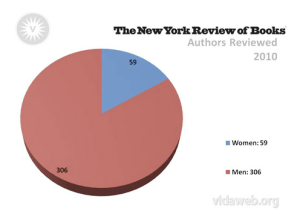
VIDA, an organization for women in the literary arts, recently released statistics from 2010 that showed a disparity in the number of female book reviewers and books by women that are reviewed in magazines and literary journals compared to men. The group showed its findings through 40 different pie charts looking at 14 magazines. Only on two charts did women outnumber men (cover to cover authors at The Atlantic and in authors reviewed at Poetry). Here are some examples of their findings:

Graph by VIDA
  • Only about 14 percent of the authors reviewed by The New Republic werefemale — 55 male authors and nine females.
  • The New York Times Book Review had 438 male bylines and 295 female bylines,and those reviewed a total of 807authors, 283 of which were women.
  • The New York Review of Books women had 39 bylines to men’s 200 and 59 female authors were reviewed compared to 306 men.

The issue was picked up across the web, mostly by women and a few men, and spurred debate this week around why this gap exists. Continue reading