Skip to content
  • Home
  • About us
  • Who we are
  • Studies and Statistics
    • Byline Report
    • Our studies
    • Other research
    • Fact sheet – 2011
  • Features and Posts
    • The Basics
    • Reading List
    • Week in Review
    • In the Spotlight
  • Useful resources

The Gender Report

A closer look at gender and online news

Our studies

Studies undertaken by The Gender Report.

Recap: A look at The Gender Report’s first six months in numbers

July 29, 2011August 23, 2011Jasmine R. LinabaryLeave a comment

Editor’s note: Six months ago, we set out to look at how women are represented in online news both as sources and as authors. To mark our progress, this week we’re reviewing our findings as well as unveiling new statistics based on what we’ve uncovered thus far in a series of posts. View other six-month coverage here.

—–

We’ve spent the past six months looking at gender in Internet news through our own studies and as well as those by others. To review what we’ve accomplished in that time and what it says about the state of women in online journalism, we’ve pulled together our stats through a roundup list as well as some graphs (Scroll below the slideshow for the full list of stats plus links). Here’s our refresher as well as a great way to check out our work if you’re new to The Gender Report.

This slideshow requires JavaScript.

Gender Checks

Through our weekly Gender Checks, which started the week of Jan. 18 and were our cornerstone study, we’ve looked at a total of eight U.S. news websites (one associated with a traditional newspaper and another that is online-only), two from each of the four geographic regions. In that study, we’ve thus far found the following:

–Month 1: Women as 27.6 percent of sources and with 32.3 percent of bylines (of articles by a person or several of one gender or the other, not including shared bylines between a woman and a man)
–Month 2: Women as 20.8 percent of sources and with 33.3 percent of bylines
–Month 3: Women as 23.5 percent of sources and with 26.9 percent of bylines
–First quarter totals: Women as 24.6 percent of sources and with 31 percent of bylines
–Month 4: Women as 30.4 percent of sources and with 57.1 percent of bylines
–Month 5: Women as 19.5 percent of sources and with 33.3 percent of bylines
–Month 6: Women as 27 percent of sources and with 43.3 percent of bylines
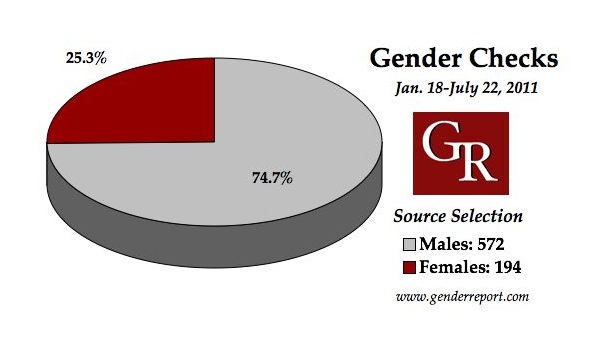
–Six month totals: Women as 25.3 percent of sources and with 37.7 percent of bylines (34.7% overall)

New Media Index

In addition, we’ve also been examining the sourcing and authorship from the most linked to and talked about articles on the web, via the Project for Excellence in Journalism’s New Media Index:

–January 2011: Women as 21.3 percent of sources and with 33.3 percent of bylines (of articles by a person or several of one gender or the other, not including shared bylines between a woman and a man)
–February 2011: Women as 28 percent of sources and with 41.7 percent of bylines
–March 2011: Women as 15.2 percent of sources and with 28.6 percent of bylines
–April 2011: Women as 25 percent of sources and with 28.6 percent of bylines
–May 2011: Women as 13.3 percent of sources and with 11.1 percent of bylines
–June 2011: Women as 20.2 percent of sources and with 36 percent of bylines
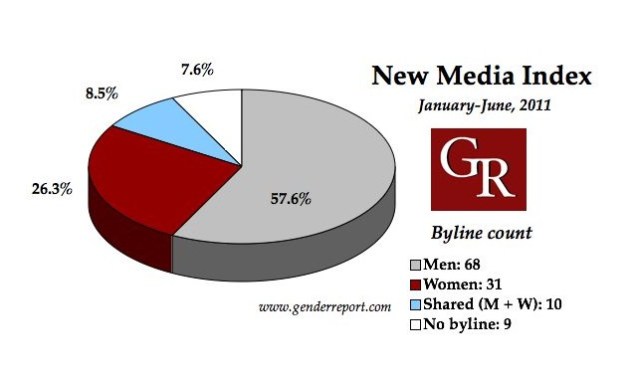
–Six months: Women as 20.2 percent of sources and with 31.3 percent of bylines (26.3 percent overall)

News Frontier Database

We’ve also spent some time looking at the information that can be gleaned through or as an off-shoot of the Columbia Journalism Review’s News Frontier Database.

  • Women made up 28 percent of the “principal staff” of online news outlets (as of June 3, 2011)
  • Women were 22 percent of sources and bylined 30 percent of articles overall in a July 1 sample of the lead articles from the 40 “national” online news outlets in the database.

The Gender Report got a shout-out for these studies from Michael Meyer who is in charge of the database during an interview he did with the media blog 10,000 Words in July.

Newsroom staff breakdowns

To look at gender representations in news creation in a different way aside from a byline count, we’ve been taking stock of the breakdown in each newsroom of the news sites included in our Gender Check monitoring via their online staff lists:

West:

  • Seattle Times: Women as 45.5 percent of staff.
  • Seattle P-I: Women as 30 percent of staff.

Midwest:

  • St. Louis Post-Dispatch: Women as 31.3 percent of staff.
  • St. Louis Beacon: Women as 60 percent of staff.

*Data from the Northeast and the South still to come.

Author gender and source selection

With our six-month statistics in hand as well as those from our monitoring of the 40 sites located nationally in the News Frontier Database, we decided also to look at whether the author’s gender affected the use of female sources. Here’s what each of these studies showed:

–News Frontier Database “national site study: Women were 38 percent of sources in articles by females and 10 percent of sources in articles by males. Women were 37 percent of sources in those articles with a shared byline by a male and a female.

–New Media Index study: Women were 28.9 percent of sources in articles by females and 19.3 percent of sources in articles by males. Women were only 11.9 percent of sources in articles with a shared byline by a male (or several) and a female.

–Gender Check study: Women were 28.1 percent of sources in articles by females and 21.8 percent of sources in articles by males. Women were 33 percent of sources in articles with a shared byline by a male (or several) and a female.

This issue is one that we’ll continue to look at in the future, particularly because of the differences we are seeing in the shared bylines.

Other studies

For a comparison, here’s what some other studies on the subject of women and journalism (some specifically related to newspapers and some to online outlets) have uncovered:

American Society of News Editors

2011 Newsroom Census: Women made up 36.9 percent of those working full time at daily U.S. newspapers.

International Women’s Media Foundation’s “The Global Report on the Status of Women in the News Media” (Released March 2011)

Women currently hold 27 percent of top management jobs and 26 percent of governing jobs in the news media globally.

Women hold 36 percent of reporter jobs, or positions at the “junior professional level” and 41 percent of positions at the senior professional level, which includes anchors, senior writers and producers.

Global Media Monitoring Project (2010)

Overall, 37 percent of stories were reported by women, and 36 percent of stories in the online samples were bylined by women.

Women were 24 percent of news subjects – people heard or read on traditional platforms like newspapers, television and radio in the sample. They were 23 percent of news subjects in the websites monitored.

Our take

Check back on The Gender Report tomorrow (Saturday) for our take on what we’ve learned so far and what we hope to look at in our next six months.

Findings and Statistics, Our studies, Six monthsfemale bylines, gender, Gender Checks, New Media Index, News Frontier Database, online journalism, online news, sourcing, women in journalism

Six months: Findings on women as sources, authors in Gender Check monitoring project

July 27, 2011August 23, 2011Jasmine R. LinabaryLeave a comment

Editor’s note: Six months ago, we set out to look at how women are represented in online news both as sources and as authors. To mark our progress, this week we’re reviewing our findings as well as unveiling new statistics based on what we’ve uncovered thus far in a series of posts. View other six-month coverage here.

—–

On Jan. 18, 2011, we began a project to monitor U.S. news websites as part of an effort to look at gender representations in online news.

In this effort, we monitored two websites — one associated with a newspaper and one that was online-only — in four different geographic regions once a week. These websites included the Seattle Times, Seattle P-I, New York Times, ProPublica, Stltoday.com, St. Louis Beacon, Miami Herald and Patch (Seminole Heights).

We pulled the lead article from each site at the time we visited and performed a “Gender Check” by recording information on the gender of the author and the breakdown of the genders of the human sources referenced in the articles among other details. (For more on what Gender Checks are, read our introductory post here.)

Last week, with our Gender Check from the South, we completed six months’ worth of monitoring. Between Jan. 18 and July 22, we monitored a total of 190 articles, averaging about 32 articles a month. This included 52 articles each from the West and Midwest regions, 46 articles from the Northeast and 40 articles from the South. These lower counts in the Northeast and South may have some slight affect overall, but these regions’ standings among the others have remained fairly consistent over time.

Without further ado, here are our findings:

Sourcing

During our first six months of Gender Checks, women made up 25.3 percent of human sources referenced in the articles we monitored. This broke down to 572 male sources and 194 female sources. This does not include those whose gender could not be identified.

The high came with women as 30.4 percent of sources in the fourth month followed by our low at 19.5 percent in the fifth month.

Seventy-one of the 190 articles monitored contained only male sources (no female sources), or roughly 37.4 percent. This compared to 11 articles with only female sources, or 5.8 percent. Four articles contained no sources at all.

Among geographic regions, the West and the South both had the highest percentage of women as sources at roughly 30 percent. The Northeast was the lowest at 20.7 percent.

Here’s how that broke down geographically:

  • West: 128 males, 55 female (Women at 30 percent)
  • Northeast: 207 males, 54 females (Women at 20.7 percent)
  • Midwest: 158 males, 51 females (Women at 24.4 percent)
  • South: 79 male, 34 female (Women at 30.1 percent)

Online-only outlets have continued a trend of using a slightly higher percentage of female sources than those associated with a newspaper that we first started observing in our first quarter findings. After six months, women were 28.1 percent of sources at online-only sites versus 22.4 percent at newspaper-connected sites. This trend of the online-only sites having the higher percentage of female sources held true in every region. Among the newspaper sites were the two lowest percentages of woman as sources, coming from the New York Times (only 14.2 percent) and Stltoday.com (at 19 percent). We’ll note that when you divide out the numbers by individual news sites, the number of articles in our sample is still low, so that should be kept in mind. We’ll still need to see if those trends for specific news sites hold over time.

Online-only sites also had a few more sources overall, attributable to the fact that the St. Louis Beacon and then ProPublica had the highest number of sources in our study. However, the number was brought down by the Patch site in the category, which had the lowest number of sources in our sample.

  • Newspaper website: 291 males, 84 females (Women at 22.4 percent)
  • Online-only:  281 males, 110 females (Women at 28.1 percent)

Authorship

Overall, women wrote 66 of the articles in our study, while men bylined 109. Fourteen articles had a shared byline between a man (or men) and a woman. One article was by contributors. This meant women bylined 34.7 percent of articles in our study, and 37.7 percent of articles by a person (or persons) of one gender or the other.

Eleven articles were written by more than one man, but no articles in our sample were written by more than one woman.

During one month of our study, the count of women’s bylines exceeded that of men. In the fourth month, women bylined 16 of 32 stories. Men wrote 12 and the remainder were shared bylines between a man and a woman.

When the numbers are looked at by geographic region, the Northeast had the lowest percentage of female bylines with 23.9 percent of the articles. In our sites from the South, women were near parity with 45 percent.

  • West: 17 stories by an individual woman, 32 by one or more man, two with a shared byline between a man and a woman, one by contributors (Women at 32.7 percent overall)
  • Northeast: 11 by an individual woman, 28 by one or more man, seven with a shared byline (Women at 23.9 percent overall)
  • Midwest: 20 by a woman, 28 by one or more man, four with a shared byline (Women at 38.5 percent overall)
  • South: 18 by a woman, 21 by one or more man, one with a shared byline (Women at 45 percent overall)

In bylines we again observed another trend we began seeing during our first quarter findings. Though newspaper-related sites may have fewer female sources than their online-only counterparts, they do fair better than them when it comes to bylines. Of the articles from newspaper sites in our study, 38.9 percent were bylined by women. This compared to 30.5 percent at online-only outlets. The same trend held true in all geographic regions, except the Northeast, where ProPublica had a very slightly higher percentage of female bylines than the New York Times — a difference at this point of less than a percent.

  • Newspaper website: 37 by a woman, 47 by one or more man, 10 with shared bylines between a man and woman, one by contributors (Women at 38.9 percent overall)
  • Online-only: 29 by a woman, 62 by one or more man, four with shared bylines (Women at 30.5 percent overall)

Author gender and source selection

Like we have with our other recent monitoring studies, we also looked at how the author’s gender affected the use of female sources. Again, we saw a difference, with women having a higher percentage of female sources than men, though the difference was not as large quite as large as in the other studies.

In this case in our first six months, females were 28.1 percent of sources in articles written by women and 21.8 percent in those written by men. Articles with a shared byline between a man and women had women as 33 percent of sources. Though differences in sourcing between articles by men and those by women have been consistent across our three studies, these shared bylines have not, which is something we’ll continue to explore.

In review

We’ll still be doing our weekly Gender Checks for the next six months. Be sure to keep an eye out for our other monthly tallies as well as individual Gender Checks. Review past posts on Gender Check findings below:

  • Women wrote more than 40 percent of articles in month six of Gender Checks
  • Gender Checks show higher count of female bylines in fourth month, fewer female sources in fifth
  • First quarter: Women are 24.6 percent of sources, 31 percent of authors
  • Third month finds dip in percentage of female authors
  • Second month sees decrease in female sources
  • Women make up 27.6% of sources in first month

As a note to our readers, we hope you remember that our study is still young and has some limitations. Further research is still needed. For other data on gender representations in online news and to compare these findings to others’, check out our “Findings and Statistics” category and our “Useful Resources” page.

We’re interested in what you make of the findings. Share your thoughts in the comment section below or email us at genderreport@gmail.com. Stay tuned for posts coming Friday and Saturday that recap all of our findings here at The Gender Report thus far and what we’ve learned from them.

Findings and Statistics, Our studies, Six monthsauthorship, female bylines, gender, Gender Checks, online news, sources, women in journalism, women in the news

Six months: Our findings of gender representation in the New Media Index

July 26, 2011August 16, 2011Jasmine R. LinabaryLeave a comment

Editor’s note: Six months ago, we set out to look at how women are represented in online news both as sources and as authors. To mark our progress, this week we’re reviewing our findings as well as unveiling new statistics based on what we’ve uncovered thus far in a series of posts. View other six-month coverage here.

—–

“Of the most talked about articles on the web, how many feature women? How many are produced by females?”

Those were some of the questions we asked at the start of our project that led us to monitor each of the top articles in the Project for Excellence in Journalism‘s weekly New Media Index reports based on the links provided. The New Media Index presented an avenue to look for answers to these questions since it culls the top five linked to and discussed stories and opinion pieces from the web during a Monday through Friday week based on commentary from blogs and social media sites. We chose to focus in on the main top five in the blogosphere.

Each month between 12 and 29 articles could be checked, for a total of 118 articles over the six-month period between January and June 2011. Even though there were on average five subjects each week, at times more than one link was offered on the subject. In those cases, we chose to monitor the first mentioned or that which appeared based on the writing as more dominant, unless it was specifically mentioned that two articles shared the attention, in which case we checked both. For some weeks or subjects, no links were provided, resulting in lower numbers during those months’ totals.

The top news source of the links PEJ provided during this time frame was the LA Times, with more than 60 of the 118 articles we monitored, followed by the Washington Post and then the BBC. All other news sources had two or fewer articles in the sample. From each article, we recorded the subject matter, the gender breakdown of the sources and the gender of the authors or producers, similar to what we’ve done with our weekly “gender checks.”

Here’s what was found:

Sourcing

Women made up 20.2 percent of sources whose gender could be identified during the first six months of the year. This calculated out to 323 male sources and 82 female sources.

The low point for female sources came in May, in which they were only 13.3 percent of sources. The high was in February with 28 percent.

Startling was the fact that 49 of the 118 articles contained no female sources at all (but did have male sources) — or 41.5 percent. Only three articles were the reverse with no male sources. Ten articles had no sources and these were mostly op-eds.

We also took a look at the number of articles with a single male vs. a single female news subject as the focus. Eighteen articles featured a single male subject, versus eight that were about a single female subject. Four of the articles were interviews. All of the interview subjects were male (an interview with Microsoft chief executive officer Steve Ballmer popped up twice but is counted once). Of the eight about women, three were about Sarah Palin, the former Alaska governor and Republican political figure, and two featured GOP presidential candidate Michele Bachmann.

Authorship

A woman (or two) bylined 31.3 percent of articles by authors of one gender or the other and 26.3 percent overall. A total of 68 articles were by one or more man, 31 by one or more woman, 10 with a shared byline between a man (or several) and a woman, and nine were not bylined.

The low for female authorship occurred in May, when women made up a minuscule 11.1 percent of authors of one gender or the other. The high was again in February with women as 41.7 percent.

Nineteen articles linked to were op-ed or commentary pieces during the past six months. Only three of those were by women. One of the 19 was a staff editorial.

Seven articles were written by more than one person of the same gender. Two were shared bylines with females and five shared bylines among males.

Author gender and source selection

We also decided to take a closer look at whether the gender of the author affected the percentage of female sources.

Females made up 28.9 percent of sources in articles by women in the sample. That percentage dropped to 19.3 percent in articles by men. In articles with shared bylines between a man (or men) and a woman, 11.9 percent of sources were women.

We also examined this during our recent study of the lead articles from 40 online news outlets situated nationally in the Columbia Journalism Review’s News Frontier Database. In that study, women were 38 percent of sources in stories by women and only 10 percent of sources in stories by men. Different than the findings here, in that study the percentage of female sources in stories with a shared byline between both a man and a woman were closer to that of those by female authors, at 37 percent.

This issue is something we will continue to look at with our studies in the future.

A look back

We’ll be continuing to monitor the New Media Index for the next six months, so be sure to check back for our monthly counts. To review our past posts on our New Media Index studies, see the links below:

  • Examining gender representations in the New Media Index (June-April)
  • May brought few female sources, bylines in New Media Index stories
  • Women’s presence higher in June after low showing in May’s New Media Index count

As a note to our readers, we hope you remember that our study is still young and has some limitations. Further research is still needed. For other data on gender representations in online news and to compare these findings to others’, check out our “Findings and Statistics” category and our “Useful Resources” page.

Findings and Statistics, Our studies, Six monthsauthorship, female bylines, gender, New Media Index, online news, sourcing, women in journalism

Women wrote more than 40 percent of articles in month six of Gender Checks

July 25, 2011August 13, 2011Jasmine R. LinabaryLeave a comment

Editor’s note: Six months ago, we set out to look at how women are represented in online news both as sources and as authors. To mark our progress, this week we’re reviewing our findings as well as unveiling new statistics based on what we’ve uncovered thus far in a series of posts. View other six-month coverage here.

—–

Women had more than 40 percent of bylines in the sixth month of stories we monitored in our weekly Gender Checks. Females also rebounded from our lowest showing of 19.5 percent of sources in the fifth month.

Since this marks our sixth month of our Gender Checks project, we’ll be unveiling the half-year roundup of our findings later this week. For now, here’s a look at the representation of women during just our sixth month:

Sixth Month: June 28 – July 22, 2011

During our sixth month of Gender Checks, we reviewed 32 articles, two in each Gender Check. This month that included four Gender Checks from each geographic region. For each Gender Check, we looked at two websites from that region — one associated with a newspaper and one that was online-only. For our monitoring, we pulled the top or lead articles on their websites at the time of the check and gathered information on the gender of the author, the breakdown of the genders of the human sources referenced in the articles and other details. (For more on what Gender Checks are, read our introductory post here.)

Sourcing

Overall, the articles contained 105 male sources and 39 female sources, which meant women were 27 percent of the human sources referenced.

Here’s how it broke down by geographic region:

  • West: 22 males, 11 female (Women at 33.3 percent)
  • Northeast: 43 males, 14 females (Women at 24.6 percent)
  • Midwest: 32 males, 10 females (Women at 23.8 percent)
  • South: 8 male, 4 female (Women at 33.3 percent)

Sites associated with newspapers used a low percentage of female sources this month. Here’s the breakdown by news sites associated with a traditional newspaper and those that are not.

  • Newspaper website: 56 males, 11 females (Women at 16.4 percent)
  • Online-only:  49 males, 28 females (Women at 36.4 percent)

Authorship

This month 13 articles were written by an individual woman and 17 by one or more man, which meant women were 43.3 percent of authors of one gender or the other this month, which is one of our higher percentages by month. The highest came in the fourth month with women as 57.1 percent of bylines, the only month that women were in the majority. There were two shared bylines between a man and a woman.

Here’s how bylines broke down by geographic region:

  • West: 4 stories by an individual woman, 4 by an individual man
  • Northeast: 2 by a woman, 4 by men and 2 with a shared byline between a man and a woman
  • Midwest: 3 by a woman, 5 by a man
  • South: 4 by a woman, 4 by a man (or two)

Here’s how women did in bylines between newspaper sites and online-only sites this month:

  • Newspaper website: 5 by a woman, 10 by men and 1 with a shared byline between a man and woman
  • Online-only: 8 by a woman, 7 by a man, 1 with a shared byline

As always, we remind our readers that these findings reflect a limited amount of data (a month’s worth) from our simple Gender Checks. We hope you recognize the limitations of this data, since we’ve only sampled a few articles from eight news sites. Further research and time is needed to verify any validity across the board.

To look at past month breakdowns and other data on gender representations in online news, check out our “Findings and Statistics” category. Check back later this week for our full sixth-month report.

Findings and Statistics, Our studies, Six monthsauthorship, female bylines, gender, Gender Checks, online news, sources, women in journalism, women in the news

Women’s presence higher in June after low showing in May’s New Media Index count

July 15, 2011July 30, 2011Jasmine R. LinabaryLeave a comment

The number of female authors and sources in the top articles in the blogosphere climbed again in June after a low showing in May.

Here at the Gender Report we’ve been monitoring the top articles based on links provided in the Project for Excellence in Journalism‘s weekly New Media Index roundups, which chronicle the top five linked to and discussed news stories and opinion pieces around the web in a Monday to Friday week based on commentary on blogs and social media sites. We focus on the main top five in the blogosphere. When more than one link was provided on the topic, we’ve monitored the first mentioned or the one that appears based on the writing to be more dominant, unless it is specifically mentioned that two articles shared the attention for that particular subject.

In May, we saw a new low with women as only 13.3 percent of sources and even fewer authors in the 12 articles that could be monitored that month. Women were more present in June’s count, particularly among bylines. Here’s what we found:

June 2011

PEJ New Media Index: June 13-17, 2011

Between May 30 and July 1, the New Media Index included 29 articles could be checked — more than double the amount from last month. For five topics this month, two articles shared the attention, contributing to the higher overall article count. Only one story did not have a link provided this month — Obama’s Afghanistan plan — when instead a special report was done.

Here’s what was uncovered:

  • Women were 20.2 percent of sources in this month’s articles. The articles contained 83 male sources and 21 female sources.
  • This month 16 articles were written or produced by a man and nine articles were written by a woman (or in one case, two). Three were by both a man or two and a woman and one was not bylined.
  • Like last month, two top linked-to articles in blogs were opinion pieces. Both were by male authors.

Again, links this month predominately came from the LA Times, with a few for the BBC and individual articles from four other news sources.

For past months’ findings as well as other findings on gender and the online news, visit our findings and statistics page.

Coming soon: Check back on The Gender Report for a look at the overall findings from the first six months of our monitoring of the New Media Index articles.

Findings and Statistics, Our studiesauthorship, female bylines, gender, New Media Index, sources, women in journalism
Previous Articles
Next Articles

Recent Posts

  • Women in journalism: Reading list for 10/27/2014
  • Women in journalism: Reading list for 9/14/2014
  • Women in journalism: Reading list for 8/10/2014

What is The Gender Report?

The Gender Report is a website that aims to monitor gender representations in online news. Contact us at genderreport@gmail.com. Follow @genderreport on Twitter.

Connect with us

  • On Facebook
  • On Twitter

Most Popular

  • Features and Posts
  • Home
  • Women in journalism: Reading list for 10/27/2014
  • Women in journalism: Reading list for 9/14/2014
  • Women in journalism: Reading list for 8/10/2014

Search

Enter your email address to follow The Gender Report and receive notifications of new posts by email.

Join 198 other subscribers

RSS

RSS Feed

Blog at WordPress.com.
Privacy & Cookies: This site uses cookies. By continuing to use this website, you agree to their use.
To find out more, including how to control cookies, see here: Cookie Policy
  • Subscribe Subscribed
    • The Gender Report
    • Join 198 other subscribers
    • Already have a WordPress.com account? Log in now.
    • The Gender Report
    • Subscribe Subscribed
    • Sign up
    • Log in
    • Report this content
    • View site in Reader
    • Manage subscriptions
    • Collapse this bar
 

Loading Comments...