Skip to content
  • Home
  • About us
  • Who we are
  • Studies and Statistics
    • Byline Report
    • Our studies
    • Other research
    • Fact sheet – 2011
  • Features and Posts
    • The Basics
    • Reading List
    • Week in Review
    • In the Spotlight
  • Useful resources

The Gender Report

A closer look at gender and online news

female bylines

Lowest percentage of female authors yet in August’s New Media Index count

September 9, 2011January 28, 2012Jasmine R. LinabaryLeave a comment

August’s look at articles in the New Media Index produced an eight-month low in female bylines and one of the lowest percentages of female sources. Time will tell whether these numbers are related to a change in the methodology for determining the top five most discussed and linked to articles on the web.

Here at The Gender Report, we’ve been monitoring the web’s top articles based on links provided in the Project for Excellence in Journalism‘s weekly New Media Index roundups since January. These posts chronicle the top five news stories and opinion pieces around the web in a Monday to Friday week based on commentary on blogs and social media sites. We’ve chosen to focus on the top five in the blogosphere.

Aug. 1 marked some changes to the New Media Index report. PEJ updated its methodology to use more sites to track the top stories and began using a larger sample size and range of sources. (Read more about those change and the process here.)

For the purpose of our study, this has meant changes in the sources of links. During the first seven months of the year, the majority of links provided mostly came from the LA Times, Washington Post and in less frequency the BBC, and were mostly news articles with some opinion pieces (in other words, almost exclusively traditional media sources). This month we’ve noticed more diversity in the link sources, including from blogs and company’s direct postings.

When more than one link was provided on the topic, we’ve monitored the first mentioned or the one that appears based on the writing to be more dominant, unless it is mentioned that two articles shared the attention for that particular subject. This happened in higher volumes this month, resulting in a larger sample of articles overall.

In July, we released our findings from the first six months of monitoring. In that time, women were 20.2 percent of sources and had 31.3 percent of bylines (of articles by a person or several of one gender or the other, not including shared bylines between a woman and a man).

Here’s what we found specifically in the past month:

August 2011
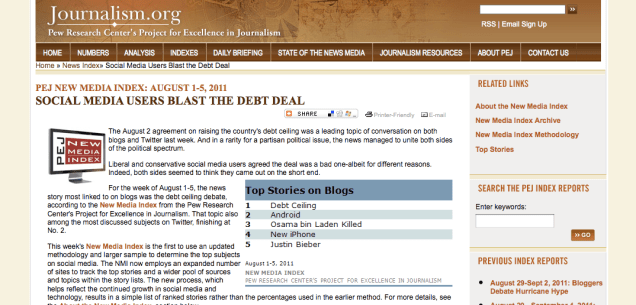
PEJ New Media Index: August 1-5, 2011

Between Aug. 1 and Sept. 2, the New Media Index included 33 articles that could be checked. Reoccurring topics included the 2012 presidential campaign and the new iPhone — both appeared in the top five in four out of the five weeks. More than one link was included for nine topics. One link related to the iPhone in week four was no longer functioning and no link was provided for the No. 3 story of Google buying Motorola in week three.

Here’s what we found:

  • Women were 14.1 percent of sources in this month’s articles. The articles contained 67 male sources and only 11 female sources. This is the second lowest female source total we’ve seen. The low thus far came in May with women at 13.3 percent.
  • Most shockingly 18 out of the 33 linked to articles contained no human sources at all (though one or two did reference a company or an unnamed and unidentified official). Nearly all of those links were to posts or reviews as opposed to traditional news articles. In addition, eight articles featured only male sources.
  • Only three articles or posts were written or produced by a woman while 27 articles were by men. That means women wrote only 10 percent of articles or posts by authors of one gender or the other. Two were uncredited and one was by staff. That percentage of female authors fell below our previous low of 11.1 percent in May.

We’ll be keeping an eye on these findings in the coming months to see if we deduce other trends emerging now that the methodology for the top five articles has changed. For past months’ findings as well as other statistics on gender and the online news, visit our findings and statistics page or view our six-month recap of all of our projects and studies here.

Findings and Statistics, Our studiesfemale bylines, female sources, gender, New Media Index, Project for Excellence in Journalism, sourcing, women in journalism

Report Your Thoughts: What organizations or individuals are making strides?

September 8, 2011October 18, 2011Jasmine R. LinabaryLeave a comment

Editor’s note: Our findings through our monitoring projects have served to identify and bring attention to the fact that women’s voices are missing, but have left us with more questions than answers. That’s why we’re taking our project a step further by starting a discussion on why this is the case and what can be done about it. This is part of a series of posts each week aiming to start a discussion on gender representations in online news. View past “Report Your Thoughts” discussions here.

—–

Question 5: What organizations or individuals are making strides?

We started this series by reviewing and discussing the problems of the representation of women in the news (mostly via the Twitter hashtag #GRdiscuss). We talked about why women are absent as sources and authors of the news as well as why women should be included. Findings, including from our studies here at The Gender Report, show that women are a quarter or less of news sources and slightly over a third of news authors.

Now we are on to solutions. Last week, we discussed ideas to increase the number of women who are sources and authors of the news. Now, we want to point out individuals and organizations who are making a difference in this area.

We want to hear from you. Tell us about an individual or a group making strides. What part of the problem are they working on and what’s their solution? How can people get involved?

Join the discussion by sharing your thoughts in the comment section as well as on Twitter with the hashtag #GRdiscuss or on our Facebook page.

Update: The following organizations were suggested during discussion, mainly on Twitter using the #GRdiscuss hashtag.

  • Women’s Media Center, specifically its SheSource.org project
  • International Women’s Media Foundation
  • Global Girl Media (Check out our post on this group here)
  • The Association for Education in Journalism and Mass Communications’ Commission on the Status of Women
  • The OpEd Project
  • World Pulse
  • Global Press Institute

Add your favorite organization or individual working for change to the list via the comment section below. Also, check out our “Gender and News” list on Twitter for others worth checking out.

Report Your Thoughtsdiscussion, female bylines, female sources, gender, online news, solutions, women in journalism

Report Your Thoughts: What’s the solution?

September 1, 2011October 1, 2011Jasmine R. LinabaryLeave a comment

Editor’s note: Our findings through our monitoring projects have served to identify and bring attention to the fact that women’s voices are missing, but have left us with more questions than answers. That’s why we’re taking our project a step further by starting a discussion on why this is the case and what can be done about it. This is part of a series of posts each week aiming to start a discussion on gender representations in online news. View past “Report Your Thoughts” discussions here.

—–

Question 4: What’s the solution?

Now that we’ve discussed (mostly via the Twitter hashtag #GRdiscuss) the reasons why women are absent as sources and authors of the news as well as why it matters that women are included, we’d like to shift the focus to how we can effect change in this area.

So, what’s the solution? Women make up a quarter or less of news sources and slightly over a third of news authors. What are some ways to increase the percentage of women included as news sources and increase the number of female reporters in the newsroom and with lead bylines?

Share your thoughts in the comment section as well as on Twitter with the hashtag #GRdiscuss or on our Facebook page.

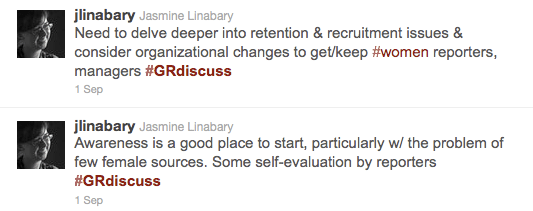
Update: Discussion of this week’s question so far as mostly taken place on Twitter with the #GRdiscuss hashtag.

Here are some snapshots of the discussion:

Report Your Thoughtsdiscussion, female bylines, female sources, gender, online news, sourcing, women in journalism

Report Your Thoughts: Why does it matter?

August 25, 2011September 21, 2011Jasmine R. Linabary1 Comment

Editor’s note: Our findings through our monitoring projects have served to identify and bring attention to the fact that women’s voices are missing, but have left us with more questions than answers. That’s why we’re taking our project a step further by starting a discussion on why this is the case and what can be done about it. This is part of a series of posts each week aiming to start a discussion on gender representations in online news. View past “Report Your Thoughts” discussions here.

—–

Question 3: Why does it matter?

For the past two weeks since we launched our “Report Your Thoughts” discussion, we’ve asked and discussed (mostly via the Twitter hashtag #GRdiscuss) the basic question of “Why?” — Why are women present in such low numbers in our byline counts of lead articles as well as our looks inside newsrooms? And why are women’s voices absent among news sources?

Now we want to turn the discussion in a different direction to the question: Why does it matter? If women are a quarter or less of news sources and slightly over a third of authors, what difference does that make?

We want to hear from you. Why is it important that women have a part in producing the news and have their voices heard as news sources? Share your thoughts in the comment section as well as on Twitter with the hashtag #GRdiscuss or on our Facebook page.

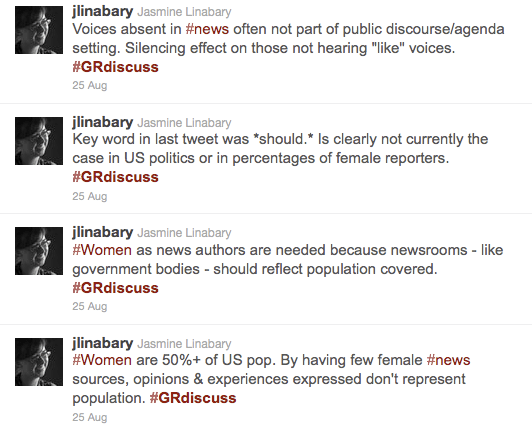
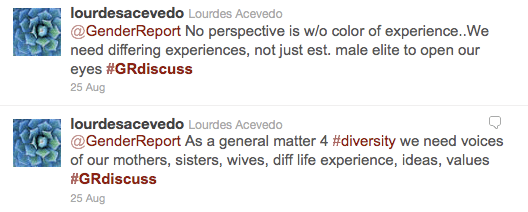
Update: As has been the case, most of the discussion for this week’s question took place via Twitter using the hashtag #GRdiscuss. A few people and organizations took part by commenting on the question. Others retweeted and shared parts of the discussion.

Here are some of the highlights:

Report Your Thoughtsdiscussion, female bylines, female sources, gender, online news, women in journalism, women in the news

Despite reduced sample, women lose ground in authorship in seventh month

August 24, 2011September 20, 2011Joy BaconLeave a comment

Seventh Month: July 26 – August 18, 2011

During our seventh month of Gender Checks, we reviewed 22 articles, two in each Gender Check with some regions not reporting out each week. For each Gender Check, we looked at two websites from that region — one associated with a newspaper and one that was online-only. For our monitoring, we pulled the top or lead articles on their websites at the time of the check and gathered information on the gender of the author, the breakdown of the genders of the human sources referenced in the articles and other details. (For more on what Gender Checks are, read our introductory post here.)

Sourcing

Overall, the articles contained 52 male sources and 17 female sources, which meant women were 24.6 percent of the human sources referenced.

Here’s how it broke down by geographic region:

  • West: 25 males, 2 female (Women at 7.4 percent)
  • Northeast: 8 males, 3 females (Women at 27.3 percent)
  • Midwest: 19 males, 12  females (Women at 38.7 percent)
  • South: Not included in this report

Here’s the breakdown by news sites associated with a traditional newspaper and those that are not.

  • Newspaper website: 27 males, 9 females (Women at  25 percent)
  • Online-only: 25 males, 8 females (Women at 24.2 percent)

Authorship

This month 7 articles were written by an individual woman and 13 by one or more man, which meant women were 35 percent of authors of one gender or the other this month, which is a drop from 43.3 percent the previous month. The highest came in the fourth month with women as 57.1 percent of bylines, the only month that women were in the majority. There were two shared bylines between a man and a woman each for a print and online site.

Here’s how bylines broke down by geographic region:

  • West: 1 story by an individual woman, 7 by an individual man
  • Northeast: 3 by a woman, 1 by a man and 2 with a shared byline between a man and a woman
  • Midwest: 3 by a woman, 5 by a man
  • South: Not included in this report.

Here’s how women did in bylines between newspaper sites and online-only sites this month:

  • Newspaper website: 3 by a woman, 7 by a man and 1 with a shared byline between a man and woman
  • Online-only: 4 by a woman, 6 by a man, 1 with a shared byline

As always, we remind our readers that these findings reflect a limited amount of data (a month’s worth) from our simple Gender Checks. We hope you recognize the limitations of this data, since we’ve only sampled a few articles from eight news sites. Further research and time is needed to verify any validity across the board.

To look at past month breakdowns and other data on gender representations in online news, check out our “Findings and Statistics” category. Read our report from our first six months of Gender Checks here.

Findings and Statistics, Our studiesauthorship, female bylines, gender, Gender Checks, online news, sources, women in journalism, women in the news
Previous Articles
Next Articles

Recent Posts

  • Women in journalism: Reading list for 10/27/2014
  • Women in journalism: Reading list for 9/14/2014
  • Women in journalism: Reading list for 8/10/2014

What is The Gender Report?

The Gender Report is a website that aims to monitor gender representations in online news. Contact us at genderreport@gmail.com. Follow @genderreport on Twitter.

Connect with us

  • On Facebook
  • On Twitter

Most Popular

  • Gender Check 3/16/12 - South and Northeast
  • Women in journalism: Reading list 5/28/2012
  • Women in journalism: Reading list 10/14/2012
  • Home

Search

Enter your email address to follow The Gender Report and receive notifications of new posts by email.

Join 198 other subscribers

RSS

RSS Feed

Create a free website or blog at WordPress.com.
Privacy & Cookies: This site uses cookies. By continuing to use this website, you agree to their use.
To find out more, including how to control cookies, see here: Cookie Policy
  • Subscribe Subscribed
    • The Gender Report
    • Join 198 other subscribers
    • Already have a WordPress.com account? Log in now.
    • The Gender Report
    • Subscribe Subscribed
    • Sign up
    • Log in
    • Report this content
    • View site in Reader
    • Manage subscriptions
    • Collapse this bar
 

Loading Comments...