Claims of DSK accuser’s ‘weakened credibility’ whip media into frenzy

New drama over the Dominique Strauss-Kahn sexual assault charges turned into a media frenzy over the last week as the credibility of the alleged victim was called into question.

The New York Times broke the news June 30 that prosecutors were finding holes in the woman’s story and that the case was possibly near collapse. The following day, Strauss-Kahn, a 62-year-old French politician and the former head of the International Monetary Fund, was released on his own recognizance.
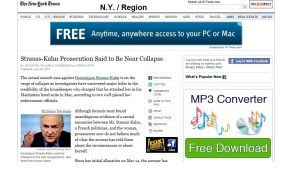
This story from the New York Times broke the news about prosecutors questioning the accuser's credibility in the Strauss-Kahn case on June 30.

The actual incident in question took place in May when a 32-year-old housekeeper from Guinea entered the Strauss-Kahn’s suite in a New York hotel to clean it. What happened in the next 20 minutes is what’s under dispute. She’s said it was assault while representatives of Strauss-Kahn have claimed it was consensual. (For some of the details of the incident, see “What happened in room 2806” from the New York Times.)

Among prosecutors’ claims regarding her credibility were that the woman had lied about abuse on her asylum application, had ties to people with criminal backgrounds (including a man she visited the day after the incident and spoke with and some “unexplained” deposits in her bank account), discrepancies on tax returns and changes in her account of what happened that day. However, as many sources have noted, prosecutors did not call into question the sexual assault itself.

Her attorney spoke to the press about the allegations as well as pointed out the strong physical evidence that is still present in the case. He also said the woman would come forward and share her story. Thus far, others have come out to speak to the woman’s credibility, including her union, and have pointed out that these claims of her “lying” may not be what they seem. More often, it has been a case of her listening to poor advice. A statement from the Hotel Workers’ Union pointed out that if she did lie regarding her immigration and tax forms it only makes her “one of probably millions of people who have done the same things.” (For more, read “DSK maid fights back” from the Daily Beast.)

From there, the media erupted both at home and abroad. Since these revelations, the story has grown with now other legal suits coming into play.

Most striking from a media standpoint has been a New York Post cover story that claimed the woman was a “hooker.” She is now fighting back by filing a suit against the Post.

Her credibility wasn’t the only being challenged. Shortly after stories came out about the New York case crumbling, a French writer, Tristane Banon, who had claimed that Strauss-Kahn had tried to
assault her in 2003, announced she would officially accuse him. His lawyers responded by saying they would file a counter complaint against Banon.

Dozens of opinion pieces and analyses have been written on the case. A few can be found linked to below.

Some of the key points of discussion have been the dangers of narratives — whether it was that people were too quick to believe the claims of sexual assault were true because it was a typical case of “the powerful vs. the powerless” or that others were grappling with a belief that a victim must be “perfect” or without blemish. Others have simply pointed out that none should be too quick to judge either side.

Concerns additionally have been expressed over what this attention and treatment will mean for future rape or sexual assault victims (and their likelihood to report their experiences). Writers have pointed out that high-profile cases like this feed into the myth that a disproportionate percentage of sexual assault claims are false. In reality, it’s estimated to be between 2 and 10 percent.

Also receiving attention was the fact that U.S. news sources are continuing their practice to not name the woman involved. We’ll be addressing that issue separately in an upcoming post.

Update (July 11): The next court date in the case has been postponed until Aug. 1 to allow time for further investigation, according to an Associated Press article.

This is the Gender Report’s Week in Review, a weekly post that highlights some of the major stories related to gender issues this week. Some of these stories may have already appeared in our News Feed or in the week’s Gender Checks. We’ll at times include a longer analysis of stories as well as bring attention to stories that may have slipped through the cracks of the week’s news cycle.

Gender Check 6/29/11 – Northeast

*Gender Checks are quick examinations of gender representation in individual news articles for the purpose of discovering trends over time. Click here to read more.

Website: The New York Times

On The New York Times, one of the lead articles featured on the home page as of 2:30 p.m. EST on Wednesday, June 29 was titled “France Admits to Arming Libyan Rebels.” Its subject was the recent announcement of the NATO’s country involvement with the rebel forces in the ongoing conflict.

Here is its gender breakdown:

Authors: Male and Female (shared by-line)

Human sources  (listed in order mentioned):

  1. Male – French military spokesman
  2. Male – Colonel

Notes/analysis: Much of this story’s information came from previous reporting from French news outlet Le Figaro.

Website: ProPublica

ProPublica, 6/29/2011

On ProPublica, one of the lead articles featured on the home page as of 2:30 p.m. EST

on Wednesday, June 29 was titled “The Hardest Cases: When Children Die, Justice Can Be Elusive.” Its subject was the criminal justice process for murder cases involving children. The story was a collaboration with NPR and PBS’ Frontline.

Here is its gender breakdown:

Authors: Male and Female (shared by-line)

Human sources  (listed in order mentioned):

  1. Female – medical examiner
  2. Male – pathologist
  3. Male – convict
  4. Unknown- 9-1-1 operator
  5. Female – forensic pathologist (as quoted from a published report)
  6. Male – medical examiner
  7. Male – judge
  8. Male – friend of convict
  9. Female – office manager (as quoted from court documents)
  10. Male – pathologist
  11. Male – doctor (as quoted from court documents)
  12. Female – nurse (as quoted from court documents)
  13. Female – convict’s wife (as quoted from court documents)
  14. Female – victim’s mother (as quoted from court documents)
  15. Male – assistant district attorney (as quoted from court documents)
  16. Female – lawyer
  17. Male – professor (as quoted from court documents)
  18. Male – pathologist (as quoted from court documents)
  19. Male – doctor
  20. Male – doctor
  21. Female – convict
  22. Female – therapist (as quoted from court documents)
  23. Male – judge (as quoted from court documents)
  24. Male – district attorney
  25. Female – convict

Notes/analysis: This story used mostly legal documents, filings and past reporting for its information. Many of the sources quotes in this manner explicitly declined interviews for the story.

Weiner resigns, highlights gender differences in political performance

The past week’s events in politics have brought a new attention to the presence, or lack thereof, of women in political positions.

Anthony Weiner, who resigned this week from Congress after his lewd online behavior became public, was just the latest male politician to be criticized for inappropriate sexual behavior while in office. His announcement followed the tails of former presidential candidate John Edwards’ criminal trial for his alleged use of campaign funds to cover up his affair in 2008. The Gender Report also has covered the actions of former governor Arnold Schwarzenegger and IMF chair Dominique Strauss-Kahn.

Several news commentators used the latest scandal to point to gender differences in politicians’ actions and approaches to their elected offices. The New York Times reported that women in the House introduce more bills, participate more vigorously in key legislative debates and give more of the one-minute speeches that open each daily session. In 2005 and 2006, women averaged 14.9 one-minute speeches; men averaged 6.5. Kathryn Pearson, the researcher behind this data, commented that “ women in Congress are still really in a situation where they have to prove themselves to their male colleagues and constituents. There’s sort of this extra level of seriousness.”

The Associated Press reported that voters believe female elected officials are more likely to focus on their jobs and less prone than men to distraction or scandal.

Women currently hold 16.6 percent of the 535 seats in Congress and 23.5 percent of the seats in state legislatures. There are 6 female governors; of the 100 big-city mayors, 8 are women. Looking ahead to the 2012 presidential race, Rep. Michele Bachmann is currently the only female candidate for the GOP.

The New York Daily News commented that Weiner’s scandal actually could help female candidates who may run for his vacated seat, because they could capitalize on voters seeing all male candidates as having the potential for another scandal or inappropriate behavior while in office.

Other reports pointed to underlying gender differences in sexualized behavior that happens regardless of the person leading a public or private life. Virginia Rutter, writing for CNN,  noted that Americans gravitate towards political sex scandals as another manifestation of men’s exploitation of power and the victimization angle of the women involved. A Washington Times article spoke to some of the women involved with Weiner online who say the disagree with the victim-like labels. At this time only one of the women he messaged or contacted online has been identified as a minor.

Michigan Gov. Jennifer Granholm told the AP  women succeed in office in part because they bring many “traditionally female” qualities to the job like a willingness to build consensus and seek solutions rather than fights.

“Men in power get a lot more attention from the opposite sex than women do. The temptation of that, the flattery, the ego is more pervasive as a result… Women in office typically don’t have men coming onto us. We’re so busy trying to get the family together, multitasking and getting the job done.”

This is the Gender Report’s Week in Review, a weekly post that highlights some of the major stories related to gender issues this week. Some of these stories may have already appeared in our News Feed or in the week’s Gender Checks. We’ll at times include a longer analysis of stories as well as bring attention to stories that may have slipped through the cracks of the week’s news cycle.

Women breaking journalism’s glass ceiling: The ascent of Jill Abramson and others

The past two weeks have been filled with women moving up the ranks in journalism. Most barrier-shattering has been the announcement that Jill Abramson will be the new executive editor of The New York Times, the first woman to fill that spot in the paper’s 160-year history.

Many have noted and cheered the historic nature of the moment, including the women who sued the newspaper in 1974 over sex discrimination. Abramson noted that she “stands on the shoulders” of the women who came before her, and even acknowledged some by name during her speech before the Times’ staff.

Columnist Gail Collins, who herself broke a barrier at the Times by becoming its first female editorial page editor, noted how significant the moment is for women: “In this one great paper, maybe we’ve reached the ultimate goal of the entire women’s movement, which is to make it utterly normal for women to be everywhere, including the top.”

While Abramson’s appointment is good news for women, it’s not yet common across the board. Studies, like the “The Global Report on the Status of Women in the News Media” by the International Women’s Media Foundation that came out earlier this year, have identified a general “glass ceiling” for women in U.S. newsrooms once they reach the senior management level, after which their presence falls from 41.5 percent to the 23.3 percent at the top-level management.

But, news like this can help facilitate positive steps forward in changing those percentages, as Poynter’s Jill Geisler suggests in a piece highlighting what Abramson’s appointment could mean for women in journalism. She says it can serve as inspiration and motivation to the many current female journalism students. “Seeing a woman lead a legacy institution into the digital future can be a powerful motivator,” she writes.

Abramson herself has given the nod to the value of her appointment to women in several interviews, but notes she felt it wasn’t as a result of her sex that she achieved the position.

“Number one, I know I didn’t get this job because I’m a woman; I got it because I’m the best qualified person. But nonetheless what it means to me is that the executive editor of the New York Times is such an important position in our society, the Times itself is indispensable to society, and a woman gets to run the newsroom, which is meaningful.” (The Guardian)

Abramson had been pegged as the “heiress-apparent” to replace outgoing executive editor Bill Keller and was described as such in a profile by New York Magazine last fall.

Some have asked whether her gender will have any effect on the newsroom or the paper. Time will tell, but in terms of content and based on her interest in “hard-edged” in-depth investigative stories and international stories, she’s said, “I don’t think anyone is fearful that I’m going to bring soft news on to the front page” (Via the Guardian). And some stories, including this one from Politico, noted the Abramson’s toughness has often been referred to using “masculine” describers. Those include comments like, “She’s got more balls than the New York Yankees.”

However, others have pointed out ways in which feminism, particularly through her writing projects, has always been part of Abramson’s career, including a piece from The Nation calling her a “feminist journalist.”

Outside of her gender, conversation also circled around what her appointment would mean for innovation and for digital advancement. Most reports, including those from Times insiders via Twitter (like this one), have said this move will be positive. Abramson launched her Twitter account Thursday with a humorous exchange with Felix Salmon of Reuters who had predicted she wouldn’t start tweeting until she takes over in September. Her response? “Wrong!”

Moving up and moving on

Aside from Abramson, several other women have been on the move this month. Here are a few:

  • Vivian Schiller, who was forced out as NPR chief executive in March, has been appointed the chief digital officer of NBC News, a newly created position.
  • Katie Couric signed a multi-year contract with ABC to host a new daytime talk show. She will also serve as a contributor to several ABC News programs. Couric recently finished out her contract as “CBS Evening News” anchor, a position that broke barriers by making her the first woman to solo anchor a weekday evening news program on a major network.
  • Susie Ellwood, currently chief executive of the Detroit Media Partnership, was named executive vice president and general manager of USA Today.
  • Also in Gannett Co., Janet Hasson was named president and publisher of The Journal News. She was formerly senior vice president/audience development and strategy for the Detroit Media Partnership, publisher of the Detroit Free Press and The Detroit News.

This is the Gender Report’s Week in Review, a weekly post that highlights some of the major stories related to gender issues this week. Some of these stories may have already appeared in our News Feed or in the week’s Gender Checks. We’ll at times include a longer analysis of stories as well as bring attention to stories that may have slipped through the cracks of the week’s news cycle.

Gender Check 4/20/11 – Northeast

*Gender Checks are quick examinations of gender representation in individual news articles for the purpose of discovering trends over time. Click here to read more.

Website: The New York Times

On The New York Times, one of the lead articles featured on the home page as of 8:30 a.m. EST on Wednesday, April 20 was titled “Ohio County Losing Its Young to Painkillers’ Grip.” Its subject was a former industrial town that has been hit with deaths due to drug overdoses.

Here is its gender breakdown:

Author: Female

Human sources  (listed in order mentioned):

1. Male – state governor (from public statement)

2. Male – police chief

3. Female – nurse

4. Male – father

5. Female – mother

6. Male – counselor

7. Female – mother

8. Male – state assemblyman

9. Female – spokeswoman for the governor

Notes/analysis: The photo accompanying the story pictured three victims of drug overdosing, all male.

Website: ProPublica

On ProPublica, one of the lead articles featured on the home page as of 8:30 a.m. EST on Wednesday, April 20 was titled “Fracking Chemicals Cited in Congressional Report Stay Underground.” Its subject was the injection of chemicals into the ground by gas drillers.

Here is its gender breakdown:

Author: Male

Human sources  (listed in order mentioned):

1. Female – policy analyst (from an earlier ProPublica story)

2. Male – spokesman (from an email)

Notes/Analysis: Most of this story came from the Congressional report as well as former coverage of the topic by ProPublica.