Violence abroad hits Mexican journalists, Peace Corps

Image from streaming AP video at http://www.washingtonpost.com.

Around the world this week, women were facing violent obstacles to their roles in their communities, including Americans abroad in the Peace Corps as well as two native Mexican female reporters.

Mexican Journalists

This week, two female journalists became the latest victims of increasing violence in Mexico over the past year. The two women were found slain (possibly strangled), naked and bound behind a cemetery in Mexico City, an area previously believed to be a “relatively safe harbor” as reported by the LA Times. It was still unconfirmed if the women had been sexually assaulted.

Ana Marcela Yarce Viveros, a veteran reporter, helped found the news magazine Contralinea and was most recently working in advertising sales for them. The other,  Rocio Gonzalez Trapaga, was a former reporter for Mexico’s dominant TV broadcaster, Televisa and most recently working as a freelance reporter. According to the Associated Press, the women were longtime friends. Although no direct motive was being released, Contralinea has sharply criticized the government in the past. Authorities did not believe the crimes were related to the women’s work as journalists. Mexico City law requires prosecutors to investigate such crimes involving women as gender-related.

Since 2006, more than 60 journalists have been killed in Mexico, mostly in the northern states. The Committee to Protect Journalists ranks Mexico as one of the most dangerous country for reporters due to violence from drug cartels and local governments.

Peace Corps

More than 30 current and former Peace Corps volunteers, mostly women, testified before a Congressional investigation this week about their experience with violence and sexual assault during their time abroad.

The statements said the international volunteer organization failed to take reports of sexual assault seriously, or discouraged volunteers from pursuing justice in the local jurisdictions.

A previous hearing was held in May, when women reported similar stories of discarded complaints. The Huffington Post reported that between 2000 and 2009, an average of 22 women in the organization each year report being victims of rape or attempted rape. An ABC “20/20”  investigation from January found more than 1,000 of the 44,000 who have served in the past decade have reported rape or sexual abuse while volunteering for the organization abroad. The agency acknowledges that the ratio of reports to actual counts of violence is quite skewed.

In September, two former Peace Corps volunteer sued the organization to release annual survey data  on safety and security, staffing, training and the effectiveness of programs broken down by country. Peace Corps volunteers currently work in 77 countries around the world. The group’s 2010 survey data showed 87 percent of respondents reported feeling usually safe or very safe where they live, with 91 percent reporting the same where they work.

Peace Corps statements released said the organization’s top priority is the health and safety of its volunteers: “We are implementing numerous reforms to better protect [them] and provide effective and compassionate support to victims.” The agency has acknowledged that under-reporting is high and that its statistics are incomplete. Legislation pending in Congress would require better staff training, protection for whistleblowers and more complete crime statistics.This year mark’s the organization’s 50th anniversary.

This is the Gender Report’s Week in Review, a weekly post that highlights some of the major stories related to gender issues this week. Some of these stories may have already appeared in our News Feed or in the week’s Gender Checks. We’ll at times include a longer analysis of stories as well as bring attention to stories that may have slipped through the cracks of the week’s news cycle.
Reflections and action from Women’s Equality Day

Friday, Aug. 26, marked the 91st anniversary of the 19th Amendment, which granted women the right to vote. To mark what is referred to as Women’s Equality Day, a number of news outlets, blogs and women’s groups as well as President Barack Obama shared thoughts, statements and stories about the anniversary.

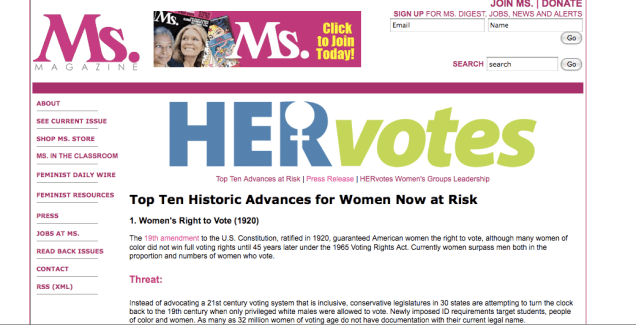
Additionally, a number of women’s groups have gotten together to launch HERvotes, a campaign to mobilize women voters in 2012 specifically around the issues of health care and economic rights (Check out the website: www.hervotes.org).

In line with that effort, Ms. Magazine compiled a list of 10 laws that advanced women that are now being “threatened” or are at risk. That list includes women’s right to vote, which some argue is being challenged by new ID requirements that 34 states considered this year that aim at students, people of color and women, particularly since perhaps as many as 32 million women do not have the required documentation in their current legal name.

Here’s a selection of Women’s Equality Day coverage and commentary:

Find other interesting coverage of Women’s Equality Day? Share it in the comment section below.

This is the Gender Report’s Week in Review, a weekly post that highlights some of the major stories related to gender issues this week. Some of these stories may have already appeared in our News Feed or in the week’s Gender Checks. We’ll at times include a longer analysis of stories as well as bring attention to stories that may have slipped through the cracks of the week’s news cycle.

The debate: Is Newsweek’s cover of Michele Bachmann sexist?

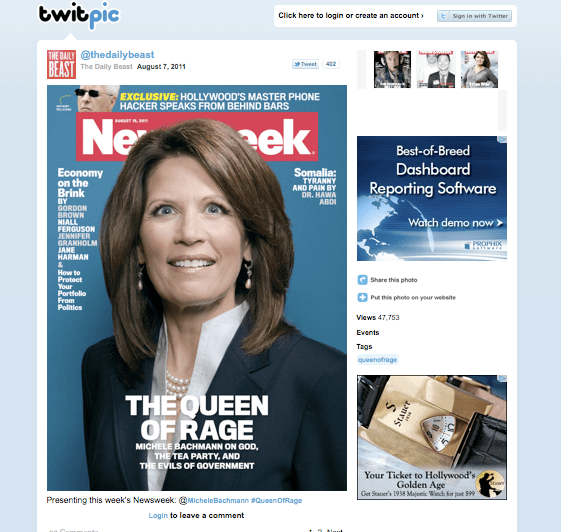
It’s been all the “rage” across media platforms this week: Is this Newsweek cover of GOP presidential candidate Michele Bachmann sexist?

As soon as Newsweek posted this TwitPic of the week's cover Aug. 7, the debate began over whether the image of Michele Bachmann is sexist.

The cover (right) features a close-up of a wide-eyed Bachmann with the headline “QUEEN OF RAGE” that some are saying makes her look “crazy.” The accompanying story has received far less attention.

This isn’t the first time Newsweek has come under fire for its cover of a female politician. Many on both sides have drawn comparisons to a cover of Sarah Palin in running shorts two years ago that was deemed “sexist.” (This also isn’t the first time charges of sexism toward Bachmann have come up in campaign coverage and its not likely to be the last.)

Conservative commentators, like Michelle Malkin, have said the image shows the mainstream media’s liberal bias and have particularly called into question the treatment of conservative women.

Jessica Grose at Slate’s XX Factor said the cover was “unnecessarily unflattering” and pulled out past covers of Republican male candidates that were done using a serious tone (though these were before current editor Tina Brown took over the magazine, as was the Palin cover). Jon Stewart made a similar criticism of Newsweek’s cover photo during “The Daily Show” this week, noting “…Here’s what you can’t say about Michele Bachmann: That she is not photogenic.” (Watch the video here).

The National Organization for Women spoke out against the cover through the Daily Caller. From NOW President Terry O’Neill:

“It’s sexist… Casting her in that expression and then adding ‘The Queen of Rage’ I think [it is]. Gloria Steinem has a very simple test: If this were done to a man or would it ever be done to a man – has it ever been done to a man? Surely this has never been done to a man.”

Gloria Steinem herself has called the photo “borderline.”

Others, like Joan Walsh, have said Brown has “nothing to apologize for.” She points to the fact that there are plenty of shots of “a deranged-looking” George W. Bush, John McCain and Howard Dean that have cropped up in the past. She also linked to a piece from 2006 with what she called “crazy-scary” cover images of Al Gore and Sen. Mark Warner.

As for Newsweek, Brown responded by defending the cover and releasing outtakes from the shoot to show the other options the magazine had and that display a “similar intensity.” In a statement, Brown said, “Michele Bachmann’s intensity is galvanizing voters in Iowa right now and Newsweek’s cover captures that.”

Bachmann herself has for the most part shrugged off questions about the cover by saying, “I didn’t pay a lot of attention to it really.”

What do you think? Is the cover sexist? Share your thoughts in the comment section below.

This is the Gender Report’s Week in Review, a weekly post that highlights some of the major stories related to gender issues this week. Some of these stories may have already appeared in our News Feed or in the week’s Gender Checks. We’ll at times include a longer analysis of stories as well as bring attention to stories that may have slipped through the cracks of the week’s news cycle.

From Bachmann’s migraines to Summer’s Eve: A roundup of six women-related news stories

In honor of The Gender Report marking six months of our monitoring projects this week, we’ve turned this Week in Review post into a recap of six of the women-related news items, in no particular order, that were receiving attention in the media over the past week:

(1) Report recommends full coverage for birth control

In a move that’s being seen as a win for women, a report released Tuesday by the Institute of Medicine recommended that health insurance plans should fully cover the costs of all FDA-approved prescription contraceptives (i.e. without a copay). The report was commissioned by the U.S. Department of Health and Human Services in an effort to determine gaps in women’s health care coverage as part of the health care reform law. The department is now reviewing the report and will make its decision soon.

Though birth control was getting the headlines (and under debate by certain opponents), it wasn’t the only women’s health service the panel recommended that should be offered at no cost sharing. Other services included annual “well-woman” preventative visits, services for pregnant women including screening for gestational diabetes and lactation counseling, screening for sexually transmitted diseases, including HIV, and counseling and screening for domestic violence.

(2) Creators of “Got Milk?” pull PMS-related campaign

One of several posters as part of the Got Milk? PMS campaign

A campaign by those who brought us “Got Milk?” that aimed at PMS was pulled this week after it came under heavy fire for sexism (including through petitions like this one).

The California Milk Processor Board and its advertising agency had launched a campaign around the idea that milk can help reduce symptoms of PMS with posters and a website —  everythingidoiswrong.org — that were targeted at men as a “home for PMS management.”

Posters which pictured men cowering behind offered milk cartons included sayings such as “I’m sorry for the things I did or didn’t do.”

The site now redirects to www.gotdiscussion.org to provide a place for further dialogue about the campaign.

(3) Congresswoman “not a lady”

In response to her criticism of his support of a budget plan that would cut Medicare, Rep. Allen West sent an email calling Rep. Debbie Wasserman Schultz “vile, unprofessional and despicable” and included a line that read, “You have proven repeatedly that you are not a Lady, therefore, shall not be afforded due respect from me!”

Several House Democrat women in response called for an apology and for GOP leadership to condemn the email and rebuke West. The women said this was indicative of the problem of gender discrimination in the workplace.

“We see this as a historic and systemic way that women have been subjected to sexism particularly in this venue, in this political environment,” Rep. Gwen Moore said. “Just once again, we have been told that in order to be a ‘lady,’ we need to just stay in our places.”

(4) Michele Bachmann has migraines

A story first “broke” by The Daily Caller this week set off a firestorm of coverage over whether GOP presidential candidate Michele Bachmann’s migraines matter and would affect her ability to govern. This led to a debate whether coverage of this issue was sexist or not, as migraines affect millions of people, mostly women, and are often linked to menstruation and menopause. As Clara Jeffery of Mother Jones tweeted: “2 to 1 that Bachmann’s pill popping = advil and estrogen. It’s called menopause, people. Survived by powerful women all over the world.”

Additionally, it’s been debated whether her migraines merit attention at all as a deciding factor of whether she should be president. Many commentaries have used the line or something similar to, “I can think of many reasons Michele Bachmann shouldn’t be president, but migraines aren’t one of them…” But others have also noted that it’s natural to scrutinize a presidential candidate’s health She has since released a statement and a doctor’s note on her conditions.

(5) News Corp. women get media attention

With gobs of media attention on the phone-hacking scandal this week, at least one commentary asked the question of whether the women of News Corp. are getting fair coverage or being played off as stereotypes. Judith Timson of the Globe and Mail looks at portrayals of Rebekah Brooks, who recently resigned as CEO of News International,  as well as Wendi Deng Murdoch, wife of Rupert Murdoch who received much media attention this week after giving a hard hit to an attacker of her husband during the parliamentary hearing. Read Timson’s take here.

(6) Summer’s Eve campaign gets flack

Summer’s Eve’s new campaign “Hail to the V” (which its marketing director says is “all about empowerment“) is getting called out for using racist stereotypes as well as taking heat from those who point out its feminine washing product is unhealthy.

The ads in the campaign (some of which apparently appeared before “Harry Potter and the Deathly Hallows – Part 2” of all things) feature the talking hands of a white, black or Latina woman (meant to represent vaginas) with voice narratives that have been described as “racially stereotyping.” As Jessica Valenti said (as quoted by Christie Thompson for Ms.): “White vaginas hit the gym, vagazzle and say BFF a lot. Black vaginas care about their hair, hitting the club and do neck rolls. Latina vaginas say ‘aye aye aye,’ ‘boo,’ and are concerned about tacky leopard thongs. Did I miss anything?” Watch one of the ads to judge for yourself below:

The advertised items are Summer’s Eve douching products, and as several commentaries pointed out, many doctors and the American College of Obstetricians and Gynecologists (ACOG) do not recommend the use of such products (though Summer’s Eve isn’t mentioned specifically) because they can upset the normal balance in a health vagina and can lead to yeast and bacterial infections as well as pushing the bacterial infections up into the other female reproductive organs.

This is the Gender Report’s Week in Review, a weekly post that highlights some of the major stories related to gender issues this week. Some of these stories may have already appeared in our News Feed or in the week’s Gender Checks. We’ll at times include a longer analysis of stories as well as bring attention to stories that may have slipped through the cracks of the week’s news cycle.

Editor’s note: Six months ago, we set out to look at how women are represented in online news both as sources and as authors. To mark our progress, this week we’re reviewing our findings as well as unveiling new statistics based on what we’ve uncovered thus far in a series of posts. View other six-month coverage here.

World Cup brings normalcy to women’s sports

Getty Images (Imae courtesy of http://www.fifa.com)

Despite the United States’ loss in the 2011 Fifa World Cup final to Japan, the tournament as a whole was a boost for the support of female athletes breaking twitter records and stereotypes both here and internationally.

The 1999 first-place finish for the American women is still remembered for Brandi Chastain’s shirtless celebration by many, including some media outlets who used the photo in their coverage of this year’s tournament. But this year’s second-place performance saw the team treated not as trailblazers, but as equals in their own right in a sport who’s women’s teams are often trivialized. The Huffington Post even used the tournament to highlight the role of Title IX in normalizing the access success of female athletes.

As Slate columnist Brian Phillips wrote, “the team managed to capture the nation’s attention without ever having to be a symbol for anything…They weren’t offering a corrective counterexample to the greedy/childish/immoral superstars playing men’s sports. They were just more or less kicking ass, as dramatically and unpredictably as possible.” Post-game coverage from Sports Illustrated.com and others also focused on the women’s performance as athletes, not as role models for their gender. The tournament’s media sponsor was Rogaine. For men.

However, some media coverage still angled to the role of women’s soccer on the international stage. Some fear that the game will start to become more like the men’s tournament, with over-dramatized injuries and theatrics that some say deters from the sport. Others worry that the increased popularity will take away from the diverse styles of play and creative strategies, rather than sheer physicality,  present in this year’s tournament. (Although the U.S. team was noted for being the fittest team in the team’s history.)

The team won’t be able to completely shake off its role-model persona; most local coverage of the tournament focused on young girls idolizing the tournament. But the tournament at least gave these athletes a well-deserved spot in the sports playbooks.

This is the Gender Report’s Week in Review, a weekly post that highlights some of the major stories related to gender issues this week. Some of these stories may have already appeared in our News Feed or in the week’s Gender Checks. We’ll at times include a longer analysis of stories as well as bring attention to stories that may have slipped through the cracks of the week’s news cycle.