Skip to content
  • Home
  • About us
  • Who we are
  • Studies and Statistics
    • Byline Report
    • Our studies
    • Other research
    • Fact sheet – 2011
  • Features and Posts
    • The Basics
    • Reading List
    • Week in Review
    • In the Spotlight
  • Useful resources

The Gender Report

A closer look at gender and online news

female bylines

Women in journalism: Reading list 6/3/2012

June 3, 2012June 29, 2012Jasmine R. LinabaryLeave a comment

The Gender Report provides a weekly round-up of links to online articles that may be of interest to our readers. The links below are to noteworthy articles on topics related to women in journalism and the media during the past week. Articles included in this feature do not necessarily reflect the views of The Gender Report or its writers. View past week’s round-ups here.

Reading List

–It’s 2012 already: why is opinion writing still mostly male? (Columbia Journalism Review) Regarding The OpEd Project’s latest byline survey. See our related post for a round-up of coverage.

–Men Rule Media Coverage of Women’s News (The Daily Beast) (Disclosure: The Gender Report’s co-founders are quoted)

–Why Women Can’t Get Away From “Soft” News (BuzzFeed)

–Former public editor Okrent would like to see New York Times hire female ombud (Poynter)

–Why are there so few female national newspaper editors? (Guardian)

–Women use radio to fight sexual violence (Guardian)

–#GEN2012: Three ideas for getting more women in journalism management (Journalism.co.uk)

–Afghan Broadcaster Defies Expectations of Women (IWPR)

–Vogue Fails Miserably at Capturing the Athleticism of Olympic Athletes (Jezebel)

–I Don’t Want To Be The “Nanny” At Work (BuzzFeed)

–Can the Inquirer Survive on Aging Testosterone? (The Philly Post)

–Promising writer, Yale grad Marina Keegan dies in weekend car accident (Poynter)

–Beyond the Bucket List: Journalist Susan Spencer-Wendel’s Journey (Wall Street Journal)

We encourage readers to submit suggestions of articles to include in future editions of this feature by sending an email to genderreport[at]gmail.com. For links to articles like these throughout the week, follow @GenderReport on Twitter.

Reading Listfemale bylines, Marina Keegan, New York Times, Susan Spencer-Wendel, The OpEd Project, women in journalism

Recap: A look at The Gender Report’s first year by the numbers

February 5, 2012March 11, 2012Jasmine R. Linabary1 Comment

Editor’s note: In January 2011, we set out to examine the ways in which women are represented in online news both as sources and as authors. To mark our first year here at The Gender Report, we’re revealing our findings from our year-long studies as well as other statistics and commentaries in a series of posts. View other coverage of our one-year anniversary here.

—–

During our first year of operation, we spent time looking at representations of sex and gender in Internet news through our own studies and as well as those by others. To review what we’ve accomplished and what it says about the state of women in online journalism, we’ve updated our effort at the six-month mark to pull together our stats through a roundup list as well as some graphs (Scroll below the slideshow for the full list of stats plus links). Here’s our recap as well as a good way to check out our work if you are new to The Gender Report.

This slideshow requires JavaScript.

Gender Checks

Through our weekly Gender Checks, which started the week of Jan. 18 and were our cornerstone study, we looked at a total of eight U.S. news websites (one associated with a traditional newspaper and another that is online-only), two from each of the four geographic regions. In that study, we’ve found the following:

–Month 1: Women as 27.6 percent of sources and with 32.3 percent of bylines (of articles by a person or several of one gender or the other, not including shared bylines between a woman and a man)
–Month 2: Women as 20.8 percent of sources and with 33.3 percent of bylines
–Month 3: Women as 23.5 percent of sources and with 26.9 percent of bylines
–Three month totals: Women as 24.6 percent of sources and with 31 percent of bylines
–Month 4: Women as 30.4 percent of sources and with 57.1 percent of bylines
–Month 5: Women as 19.5 percent of sources and with 33.3 percent of bylines
–Month 6: Women as 27 percent of sources and with 43.3 percent of bylines
–Six month totals: Women as 25.3 percent of sources and with 37.7 percent of bylines (34.7% overall)
–Month 7: Women as 24.6 percent of sources and with 35 percent of bylines
–Month 8: Women as 24.3 percent of sources and with 44.8 percent of bylines
–Month 9: Women as 27 percent of sources and with 25 percent of bylines
–Nine month totals: Women as 25.3 percent of sources and with 41.9 percent of bylines
–Month 10: Women as 25.5 percent of sources and with 29 percent of bylines
–Month 11: Women as 34.4 percent of sources and with 31.8 percent of bylines
–Month 12: Women as 24.4 percent of sources and with 27.3 percent of bylines
–One year totals: Women as 26 percent of sources and with 35.3 percent of bylines (32.2 percent overall)

In addition to the basic findings related female sources and authors from this study’s monitoring, we also have explored the role of the articles’ subject and of source order as it relates to gender representation. See the links provided below:

Article subject:

-Six months: Gender Check breakdown: A look at female authors, sources by article subject
-Nine months: Science and health articles showing high female sources, low female bylines
-One year: One year: A look at female authors, sources by article subject in Gender Check study

Source order:

-Six months: Gender Check breakdown: A look at source order and gender
-One year: One year: Examining the prominence of female sources in Gender Check study

New Media Index

In addition, we’ve also been examining the sourcing and authorship from the most linked to and talked about articles on the web, via the Project for Excellence in Journalism’s New Media Index:

–January 2011: Women as 21.3 percent of sources and with 33.3 percent of bylines (of articles by a person or several of one gender or the other, not including shared bylines between a woman and a man)
–February 2011: Women as 28 percent of sources and with 41.7 percent of bylines
–March 2011: Women as 15.2 percent of sources and with 28.6 percent of bylines
–April 2011: Women as 25 percent of sources and with 28.6 percent of bylines
–May 2011: Women as 13.3 percent of sources and with 11.1 percent of bylines
–June 2011: Women as 20.2 percent of sources and with 36 percent of bylines
–Six months: Women as 20.2 percent of sources and with 31.3 percent of bylines (26.3 percent overall)
–July 2011: Women as 15 percent of sources and with 50 percent of bylines
–August 2011: Women as 14.1 percent of sources and with 10 percent of bylines
–September 2011: Women as 17.6 percent of sources and with 9.5 percent of bylines
–October 2011: Women as 25 percent of sources and with 15 percent of bylines
–November 2011: Women as 27.2 percent of sources and with 10.5 percent of bylines
–December 2011: Women as 15 percent of sources and with 10 percent of bylines
–One year: Women as 19.1 percent of sources and with 23 percent of bylines (19.6 percent overall)

News Frontier Database

We’ve also spent some time looking at the information that can be gleaned through or as an off-shoot of the Columbia Journalism Review’s News Frontier Database.

  • Women made up 28 percent of the “principal staff” of online news outlets (as of June 3, 2011)
  • Women were 22 percent of sources and bylined 30 percent of articles overall in a July 1 sample of the lead articles from the 40 “national” online news outlets in the database.

The Gender Report got a shout-out for these studies from Michael Meyer who is in charge of the database during an interview he did with the media blog 10,000 Words in July.

Newsroom staff breakdowns

To look at gender representations in news creation in a different way aside from a byline count, we’ve been taking stock of the breakdown in each newsroom of the news sites included in our Gender Check monitoring via their online staff lists:

West: (As of May 25, 2011)

  • Seattle Times: Women as 45.5 percent of staff.
  • Seattle P-I: Women as 30 percent of staff.

Midwest: (As of June 22, 2011)

  • St. Louis Post-Dispatch: Women as 31.3 percent of staff.
  • St. Louis Beacon: Women as 60 percent of staff.

*Data from the Northeast and the South still to come.

Author gender and source selection

We’ve also looked at whether the author’s gender affected the use of female sources in our different studies. Here’s what each of these studies showed:

–News Frontier Database “national site study: Women were 38 percent of sources in articles by females and 10 percent of sources in articles by males. Women were 37 percent of sources in those articles with a shared byline by a male and a female.

–New Media Index study: Women were 25.1 percent of sources in articles by females and 18.1 percent of sources in articles by males. Women were only 16.7 percent of sources in articles with a shared byline by a male (or several) and a female.

–Gender Check study: Women were 28.3 percent of sources in articles by females and 24 percent of sources in articles by males. Women were 28.7 percent of sources in articles with a shared byline by a male (or several) and a female.

This issue is one that we’ll continue to look at in the future, particularly because of the differences we are seeing in the shared bylines.

Other studies

For a comparison, here’s what some other studies on the subject of women and journalism (some specifically related to newspapers and some to online outlets) have uncovered:

–American Society of News Editors: 2011 Newsroom Census: Women made up 36.9 percent of those working full time at daily U.S. newspapers.

-International Women’s Media Foundation’s “The Global Report on the Status of Women in the News Media” (Released March 2011): Women currently hold 27 percent of top management jobs and 26 percent of governing jobs in the news media globally. Women hold 36 percent of reporter jobs, or positions at the “junior professional level” and 41 percent of positions at the senior professional level, which includes anchors, senior writers and producers.

–Global Media Monitoring Project (2010): Overall, 37 percent of stories were reported by women, and 36 percent of stories in the online samples were bylined by women. Women were 24 percent of news subjects – people heard or read on traditional platforms like newspapers, television and radio in the sample. They were 23 percent of news subjects in the websites monitored.

Our take

Check back on The Gender Report for our take on what we’ve learned during our first year and what we hope to accomplish in the second.

Findings and Statistics, One Year, Our studiesfemale bylines, female sources, gender, Gender Checks, journalism, New Media Index, News Frontier Database, online news, women in journalism, women in news

One year: A look at female authors, sources by article subject in Gender Check study

February 2, 2012March 27, 2012Jasmine R. LinabaryLeave a comment

Editor’s note: In January 2011, we set out to examine the ways in which women are represented in online news both as sources and as authors. To mark our first year here at The Gender Report, we’re revealing our findings from our year-long studies as well as other statistics and commentaries in a series of posts. View other coverage of our one-year anniversary here.

—–

What article subjects have the lowest representation of female sources and authors? Well, that’s what we’ve looked at in the data from our year-long Gender Check monitoring study.

Yesterday, we released findings in two parts, one on female sources and another on female authors, from this project. We’ve decided to look at our data in some additional ways, including by article subject, to see if there are any differences in the representation of women as sources and authors. We first explored this after the six-month mark in our study and again after nine months. Now after completing 12 months of the project, we’ve examined each of the 354 articles we gender checked by topic to see if the differences we uncovered at earlier points in the study still hold. (For the Gender Check study, we monitored the lead news articles from eight U.S. online news websites. For details, click here.)

To determine article subject, we’ve made use (to the best of our ability) of the Global Media Monitoring Project‘s news stories classification system (Click for a PDF of the system) to categorize stories. This system divides articles into eight categories with a numbering system for further breakdowns within each category.  None of our articles have fallen under the categories of “Other” and ‘The Girl-Child” yet, so we’re sticking with the six remaining categories.

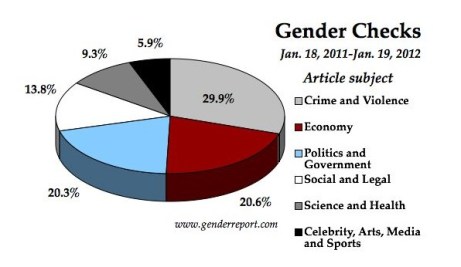
After a year of study, here’s how the articles broke down by subject.

Articles by subject

The largest number of our articles have still fallen under “Crime and Violence” (106 out of 354).The category with the fewest articles was “Celebrity, Arts, Media and Sports” with 21 articles. Below, we’ve broken down each larger category by the number of articles in our sample, the subjects within that category associated with the highest number of articles, and the news site or sites that were the sources for the largest number of articles in that category.

  • Politics and Government: 72 articles; Key subjects: “Other domestic politics, government” (43 articles); Main source: St. Louis Beacon (19 articles)
  • Economy: 73 articles; Key subjects: “Economic policies, strategies” (17 articles); Main source: Seattle Times (15 articles) and St. Louis Beacon (13 articles)
  • Science and Health: 33 articles; Key subjects: “Medicine, health, hygiene, safety” (10 articles); Main source: ProPublica (10 articles)
  • Social and Legal: 49 articles; Key subjects: “Education, childcare, nursery, university, literacy” and “Legal system, judiciary, legislation apart from family” (both with 19 articles); Main source: Seattle Times (11 articles)
  • Crime and Violence: 106 articles; Key subjects: “Violent crime, murder, abduction, assault” (36 articles) and “Non-violent crime, bribery, theft, drugs, corruption” (30 articles); Main sources: Seattle P-I (33 articles) and Stltoday.com (24 articles)
  • Celebrity, Arts, Media and Sports: 21 articles; Key subjects: “Arts, entertainment, leisure, cinema, books, dance” (10 articles); Main sources: Patch (Seminole Heights) (7 articles)

As a note to our readers, we acknowledge that the sample of articles in some categories is still small, so please keep in mind that limitation when viewing our data.

Here’s how the gender representations worked out within those categories:

Sourcing

“Politics and Government” articles dropped to the bottom with the lowest percentage of female sources at 19.9 percent. “Social and Legal” articles had the highest percentage of female sources with 31.4 percent, passing “Science and Health” articles, which had maintained the highest percentage at both the six and nine month marks. As demonstrated in our overall findings, the total sample shows women as 26 percent of sources.

Here’s how it separated out by classification:

  • Politics and Government: 254 males, 63 females (Women as 19.9 percent)
  • Economy: 202 males, 60 females (Women as 22.9 percent)
  • Science and Health: 76 males, 31 females (Women as 29 percent)
  • Social and Legal: 129 males, 59 females (Women as 31.4 percent)
  • Crime and Violence: 262 males, 116 females (Women as 30.7 percent)
  • Celebrity, Arts, Media and Sports: 55 males, 14 females (Women as 20.3 percent)

Authorship

“Science and Health” articles have continued to hold the lowest percentage of female authors at 18.2 percent overall. “Economy” articles have also still demonstrated highest percentage of female authors at 39.7 percent. Overall, women are 32.2 percent of authors.

Here’s the breakdown by classification:

  • Politics and Government: 26 stories by women, 38 by men, 6 shared bylines between a man and a woman, 2 other/unidentified (Women as 36.1 percent)
  • Economy: 29 by women, 40 by men, 4 shared (Women as 39.7 percent)
  • Science and Health: 6 by women, 24 by men, 2 shared, 1 other (Women as 18.2 percent)
  • Social and Legal: 17 by women, 30 by men, 2 shared (Women as 34.7 percent)
  • Crime and Violence: 31 by women, 62 by men, 10 shared, 3 other (Women as 29.2 percent)
  • Celebrity, Arts, Media and Sports: 5 by women, 15 by men, 1 shared (Women as 23.8 percent)

Review our findings

Below you can find links to the breakdown of the articles in our Gender Check study at previous points in the year.

  • Gender Check breakdown: A look at female authors, sources by article subject
  • Nine months: Science and health articles showing high female sources, low female bylines

For other data on gender representations in online news and to compare these findings to others’, check out our “Findings and Statistics” category and our “Useful Resources” page.

We’re interested in what you make of the findings. Share your thoughts in the comment section below or using the #GRdiscuss hashtag on Twitter.

Findings and Statistics, One Year, Our studiesarticle subject, female bylines, female sources, Gender Checks, online news, women in journalism

Women byline 32.2% of lead news articles in year-long Gender Check study

February 1, 2012June 5, 2012Jasmine R. LinabaryLeave a comment

Editor’s note: In January 2011, we set out to examine the ways in which women are represented in online news both as sources and as authors. To mark our first year here at The Gender Report, we’re revealing our findings from our year-long studies as well as other statistics and commentaries in a series of posts. View other coverage of our one-year anniversary here.

—–

Women bylined 32.2 percent of all articles monitored in a year-long study of eight news websites.

This finding was based on the results of The Gender Report’s Gender Check project that aims to monitor gender representations in online news. In this study, we monitored the lead articles from two websites — one associated with a newspaper and one considered online-only — in each of the four geographic regions as defined by the U.S. Census. The websites we examined included the Seattle Times, Seattle P-I, New York Times, ProPublica, Stltoday.com, St. Louis Beacon, Miami Herald and Patch (Seminole Heights).

On a weekly basis, we selected the lead article from each site at the time we visited and performed a “Gender Check” by recording information on the gender of the author and the breakdown of the genders of the human sources referenced in the articles among other details. (For more on what Gender Checks are, read our introductory post here.)

This project began in January 2011 and concluded earlier this month. For the purposes of this study, this made a total of 53 weeks, but due to a missing week, resulted in a total of 52 weeks of monitoring for at least two of our geographic regions. Between Jan. 18, 2011 and Jan. 19, 2012, we examined a total of 354 articles, averaging about 29.5 articles per month. In total, this broke down to 104 articles each from the West and Midwest regions, 78 articles from the Northeast and 68 articles from the South. These lower counts in the Northeast and South are the result of missed weeks. Though this may have have some slight affect on the overall findings, the standings of these regions among the others have remained consistent over time. Earlier today we released the first findings from this study regarding sources in these news articles, reporting that women were 26 percent of human sources referenced overall.

When it came to bylines, women wrote 114 of the articles in our study, while men wrote 209. Twenty-five articles had a shared byline between a man (or men) and a woman. Six articles were by contributors, staff or unbylined. These totals mean women bylined 32.2 percent of articles in our study, and 35.3 percent of articles by a person (or persons) of one gender or the other.

Twenty-two articles in our sample were written by more than one man, while only one article was bylined by more than one woman.

In only one month of our study did the count of women’s bylines exceeded that of men. In the fourth month, women bylined 16 of 32 stories. Men wrote 12 and the remainder were shared bylines between a man and a woman. The lowest percentage of female bylines came in month nine, when women byline 25 percent of articles by authors of one gender or the other and 21.4 percent overall.

Geographic regions

In terms of geographic regions, our sites from the Northeast have continued to hold the lowest percentage of female bylines with 24.4 percent of the articles overall. In our sites from the South, women were nearest parity at 42.6 percent.

  • West: 29 stories by one or more woman, 68 by one or more man, four with a shared byline between a man and a woman, three by contributors or staff (Women at 27.9 percent overall)
  • Northeast: 19 by an individual woman, 47 by one or more man, 12 with a shared byline (Women at 24.4 percent overall)
  • Midwest: 37 by a woman, 58 by one or more man, seven with a shared byline, two by staff (Women at 35.6 percent overall)
  • South: 29 by a woman, 36 by one or more man, two with a shared byline, one unknown (Women at 42.6 percent overall)

Newspaper vs. online-only websites

As we’ve discovered throughout our study, though newspaper-connected sites may have fewer female sources than their online-only counterparts, they do fair a bit better than them when it comes to female bylines. Of the articles from newspaper sites in our study, women byline 38.2 percent of articles by a person(s) of one gender or the other and 33.9 percent overall. This compared to 32.5 percent and 30.5 percent respectively at online-only outlets. This trend held true in all geographic regions, except the Northeast, where ProPublica had a higher percentage of female bylines than the New York Times.

  • Newspaper website: 60 by a woman, 97 by one or more man, 17 with shared bylines between a man and woman, three by contributors/staff (Women at 33.9 percent overall)
  • Online-only: 54 by a woman, 112 by one or more man, eight with shared bylines, three by contributors/staff (Women at 30.5 percent overall)

Individual news websites

The New York Times had the lowest percentage of female bylines overall at 17.95 percent. We did have one site — the Miami Herald — that at the time of our study’s completion showed women as 50 percent of bylines overall.

We want to note that when broken down by each individual news site, our sample size is still small so readers should keep that in mind. More research will be needed to determine whether these percentages are indeed accurate for the individual sites. For now, this is what we’ve found:

  • Seattle Times: 17 by a woman, 31 by one or more man, three with shared bylines, one by contributors/staff (Women at 33 percent overall)
  • Seattle P-I: 12 by a woman, 37 by one or more man, one with a shared byline, two by contributors/staff (Women at 23.1 percent overall)
  • New York Times: Seven by a woman, 25 by one or more man, seven with shared bylines (Women at 17.95 percent overall)
  • ProPublica: 12 by a woman, 22 by one or more man, five with shared bylines (Women at 30.8 percent overall)
  • Stltoday.com: 19 by a woman, 26 by one or more man, five with shared bylines, two by contributors/staff (Women at 36.5 percent overall)
  • St. Louis Beacon: 18 by a woman, 32 by one or more man, two with shared bylines (Women at 34.6 percent overall)
  • Miami Herald: 17 by a woman, 15 by one or more man, two with shared bylines (Women at 50 percent overall)
  • Patch (Seminole Heights): 12 by a woman, 21 by one or more man, one unknown (Women at 35.3 percent overall)

Review findings

Later this week, we’ll be providing a recap of all of our write-ups related to this study’s findings. We’ll also be looking at our Gender Check project data by article subject and by source order.

As a note to our readers, this study does have some limitations. This data simply reflects our findings from eight news websites and results should not be assumed to represent all sites in the regions or the industry as a whole. Further research is needed to confirm or elaborate on these findings, which is something we’ll be looking to do in year two. Stay tuned for more.

For other data on gender representations in online news and to compare these findings to others’, check out our “Findings and Statistics” category and our “Useful Resources” page.

We’re interested in what you make of the findings. Share your thoughts in the comment section below or using the #GRdiscuss hashtag on Twitter.

Findings and Statistics, Gender Checks, One Year, Our studiesfemale bylines, female journalists, Gender Checks, women in journalism, women in news

One year: Project examines gender representations in the New Media Index

January 31, 2012June 5, 2012Jasmine R. LinabaryLeave a comment

Editor’s note: In January 2011, we set out to examine the ways in which women are represented in online news both as sources and as authors. To mark our first year here at The Gender Report, we’re revealing our findings from our year-long studies as well as other statistics and commentaries in a series of posts. View other coverage of our one-year anniversary here.

—–

A year ago, we asked: What percentage of the most talked about articles on the web feature or are written by women? What we found as we sought to answer this question was not encouraging.

But before we share those results, here’s how we approached answering that question. For a full year, from January through December 2011, we monitored each of the web’s top articles based on the links provided by the Project for Excellence in Journalism‘s weekly New Media Index reports. The New Media Index reports the top five linked to and discussed stories and opinion pieces from the web during a Monday through Friday week based on commentary from blogs and social media sites. For the purposes of our study, we chose to focus in on the main top five in the blogosphere.

During each month of this year span, between 11 and 33 articles could be checked, resulting in a total of 250 articles examined for the completed study.

Though each week generally averaged five subjects, there were occasions when more than one link was offered on the subject. When that was the case, we chose to monitor the first mentioned or that which appeared based on the writing as more dominant, unless it was mentioned or implied that two articles shared the attention, in which case we checked both. For some weeks or subjects, no links were provided, resulting in lower numbers during those months’ totals. For each article, we recorded the subject matter, the gender breakdown of the sources and the gender of the authors or producers, similar to what we’ve done with our weekly “gender checks.”

It is important to note that PEJ made some changes to its methodology for the New Media Index in August, including the use of more sites to track the top stories as well as a larger sample size and range of sources (Read more about those change and the process here.) As a result, we did see some major differences in the sources of the articles and our findings in the months after that change, which is why we’ve provided our results overall as well as broken out for those articles before the August changes and those after. This did skew the overall results, so we caution readers to keep these limitations in mind.

Without further ado, here are our overall findings for this study:

Sourcing

In this study, women were 19.1 percent of sources whose gender could be identified. Approximately 520 sources were male and 123 were female.

Our low and high points for the year for female sources came in the first six months. The low point for female sources came in May, when women were only 13.3 percent of sources. The high was in February with 28 percent.

Somewhat disturbing was the finding that 87 of the 250 articles, or 34.8 percent, had no female sources at all, in other words contained only male sources. However this percentage has dropped from the six-month mark, when 41.5 percent of articles contained no female sources. In contrast, only four articles had no male sources.

What has gone up is the percentage of articles with no sources at all. Only 8.5 percent of articles at the six-month mark had no sources. By 12 months, 30.4 percent, or 76 of 250 articles, had none. This difference was largely a result of the change in the New Media Index’s methodology, which resulted in more blog posts rather than news articles in the top five, many of which did not name human sources.

For articles in the sample written by women, females made up 25.1 percent of sources. In articles written by men, that percentage falls to 18.1. In articles with shared bylines between a man (or men) and a woman, 16.7 percent of sources were women.

Authorship
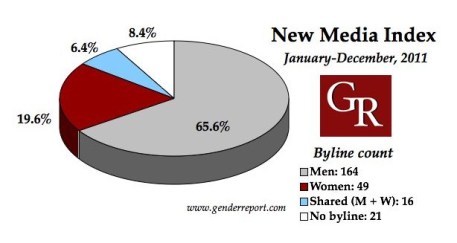
A woman (or on occasion two) bylined 23 percent of articles by authors of one gender or the other and 19.6 percent of articles overall. Over the course of the year, 164 articles were by one or more man, 49 by one or more woman, 16 with a shared byline between a man (or several) and a woman, and 21 were not bylined or were written by staff.

The year low for female authorship occurred in September, when women made up a dismal 9.5 percent of authors of one gender or the other and 8.3 percent overall. February again had the high with women as 41.7 percent.

Twenty-six articles linked to were op-ed or commentary pieces over the course of the year. Just three of those were by women. One was a staff editorial. In addition, of the blog posts, nearly all showing up after the change in methodology, five of 61 were by women and only one of eight posts by a business was by a woman.

During the year, 13 articles were written by more than one person of the same gender. Three were shared bylines with females and 10 shared bylines among males.

Before changes: January to July 2011

Prior to the change in the methodology for the New Media Index, the majority of links provided were to news articles from major news websites, with the majority of articles from the LA Times, Washington Post and BBC. In these seven months, we reviewed 137 articles, averaging 19.6 articles per month. These were the findings overall from these articles:

  • Women were 19.6 percent of sources during this time. The articles contained 374 male sources and 91 female sources. There were on average 66.4 sources in a given month.
  • During this time 45.3 percent of articles contained only male sources. Only three articles contained only female sources. Eleven articles, or 8 percent, contained no sources at all.
  • Thirty-eight articles were written or produced by women while 75 were written by men. This means women wrote 33.6 percent of articles by a person(s) of one gender or the other. Twelve articles had shared bylines between a man and a woman and 12 were by staff, meaning that women had 27.7 percent of bylines overall.

After changes: August to December 2011

In contrast, following the changes in the New Media Index, no particular website had more than five out of the total 113 articles or posts. Those that had five were three tech sites 9 to 5 Mac, Engadget and Ubergizmo, as well as posts from Google on its official company blog. The majority of the top stories during these five months were not from mainstream news sites, but instead blogs and specialty or alternative sites. During this time, there were an average of 22.6 articles per month. The following are the overall findings from these articles and posts:

  • Women were 18 percent of sources. The articles contained 146 male sources and 32 female sources. There were on average half as many sources in a given month as the earlier period with 35.6 sources per month.
  • In this time frame, 22.1 percent of articles, or 25 out of 113, contained no female sources (only male sources). Only one article was the reverse, containing only female sources. However, 57.5 percent of articles during these months, or 65 articles, contained no sources at all.
  • Just eleven articles were written or produced by women while 89 were written by men. By percentage, this means 11 percent of articles by a person(s) of one gender or the other. Four articles had shared bylines between a man and a woman and nine were by staff, making those articles written by women a mere 9.7 percent of the whole.

A look back

Review our posts from the year on our New Media Index study through the links below:

  • Examining gender representations in the New Media Index (June-April)
  • May brought few female sources, bylines in New Media Index stories
  • Women’s presence higher in June after low showing in May’s New Media Index count
  • Equal number of male, female bylines in July New Media Index but low female source count
  • Lowest percentage of female authors yet in August’s New Media Index count
  • Second month in a row with dismal female byline count in New Media Index stories
  • New Media Index: Findings from October, November show slight increase in female sources, bylines
  • December’s New Media Index count results in low female bylines, sources

For other data on gender representations in online news and to compare these findings to others’, check out our “Findings and Statistics” category and our “Useful Resources” page.

Up next: Check back Wednesday for results from our year-long Gender Check study.

We’re interested in what you make of the findings. Share your thoughts in the comment section below or using the #GRdiscuss hashtag on Twitter.

Findings and Statistics, One Year, Our studiesfemale bylines, female sources, gender, New Media Index, Project for Excellence in Journalism, women in journalism
Previous Articles
Next Articles

Recent Posts

  • Women in journalism: Reading list for 10/27/2014
  • Women in journalism: Reading list for 9/14/2014
  • Women in journalism: Reading list for 8/10/2014

What is The Gender Report?

The Gender Report is a website that aims to monitor gender representations in online news. Contact us at genderreport@gmail.com. Follow @genderreport on Twitter.

Connect with us

  • On Facebook
  • On Twitter

Most Popular

  • Home

Search

Enter your email address to follow The Gender Report and receive notifications of new posts by email.

Join 198 other subscribers

RSS

RSS Feed

Create a free website or blog at WordPress.com.
Privacy & Cookies: This site uses cookies. By continuing to use this website, you agree to their use.
To find out more, including how to control cookies, see here: Cookie Policy
  • Subscribe Subscribed
    • The Gender Report
    • Join 198 other subscribers
    • Already have a WordPress.com account? Log in now.
    • The Gender Report
    • Subscribe Subscribed
    • Sign up
    • Log in
    • Report this content
    • View site in Reader
    • Manage subscriptions
    • Collapse this bar
 

Loading Comments...