Where are the women in the Romenesko discussion?

Journalism industry icon Jim Romenesko resigned last night, premature of his planned early retirement, following allegations by the Poynter Institute of “questionable attribution” in his posts. Romenesko, considered by some to be the godfather of the aggregator, has run a media news blog at Poynter for the past 12 years. Questions about his writing appear to have been raised by Erika Fry, an assistant editor at the Columbia Journalism Review.

Julie Moos, who is the director of Poynter Online, wrote the posts about the “incomplete” attribution and Romenesko’s resignation. She has also received a large amount of criticism in this situation. Read her original post here to see examples and make your own opinion on the issue.

While there is plenty to be looked at and discussed here, we were drawn in by a Twitter request from Anne Elizabeth Moore: “I’d also like to see a gender breakdown of Romenesko links, Romenesko defenders, and @juliemmoos twitter-detractors. @GenderReport?”

Here’s where it got interesting on our part. While a gender breakdown of all of those subjects would be challenging, time-consuming and perhaps a project we’ll set aside to do more on later, we did pull a few small samples of the conversation to look at.

These were the early posts about the issue that appeared through a Google news search and that were being passed around on Twitter prior to the announcement of Romenesko’s resignation (after that and as of this morning, you’ll find more than 100). Notice anything about the majority of the authors?

And then where are a few “stories” via Storify that collected what the authors suggest are key tweets on the issue. Notice anything here?

Moos herself retweeted (or MT-ed) nearly 100 tweets about the issue as of the end of the business day Thursday, including comments on all sides. These included by rough count 73 tweets from men, 14 from women and six from organizations or groups (some tweet authors, both male and female, were repeated). You’ll find similar results if you look at the comment sections of both of her posts on the issues. Just scroll down through the comments.

Media columnist Jack Shafer asked on Twitter whether all the press critics would be standing up for Romenesko and then proceeded to list 20 of them. By my count, none are female.

And in a wrap up of the discussion and response posted on Romenesko+ on Poynter today by Adam Hochberg, the trend continues. If we don’t include the key players (Moos, Romenesko and Fry) in our count, those who are named as expressing an opinion on the matter are eight men and no women.

While we haven’t completed Moore’s request fully, our quest to look at gender in this conversation did raise some questions.

Where are the women commenting on this issue? If you do a Twitter search for Romenesko, you’ll find some women tweeting about it (and obviously a few women scattered throughout in the above small samples), but in terms of the bulk of the early conversation, it is made to appear, based on all of the above, mostly male dominated.

And where are the women press critics? Is this still a very male dominated position? From Shafer’s collection, it appears so.

These are questions we don’t have answers for, but we’re interested in your thoughts. Let us know what you think in the comment section below.

UPDATE: This post received quite a bit of traffic Friday as the journalism world reacted to Romenesko’s resignation. Here are a few snapshots of responses to our post on Twitter:

Additionally, media writer Rachel Sklar asked Shafer how he defined press critic for his list that included only men. This was his response:

To which media writer Alicia Shepard said, “HELLO???,” noting that she probably tweeted more about Romenesko than she had tweeted in weeks. Also, in response to the exchange, Clara Jeffery, editor of Mother Jones, posted:

Sklar and others suggested a need to begin work on a lady journo list. We’re glad our post helped spark this discussion and we look forward to seeing the list emerge.

Week in Review: 7 billion people and 7 stories about women

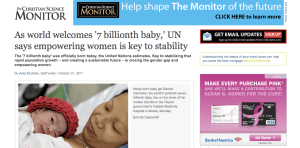
"As world welcomes '7 billionth baby,' UN says empowering women is key to stability" - Christian Science Monitor

According to United Nations estimates, the world population hit 7 billion this week. As a result, we’ve turned this week’s Week in Review post into a seven-story round-up of top news related to women and girls.

1. Seven billion and counting

With the world population hitting 7 billion, the UN argued that empowering women is vital to stabilizing growth, as demonstrated in this Christian Science Monitor piece. A baby girl named Danica Camacho born in the Philippines on Oct. 31 became the symbolic seven billionth baby.

2. Women’s rights in the Arab Spring

Continued concerns about the role of women and women’s rights during upheaval in the Middle East emerged this week. U.S. State Department officials spoke to a Senate committee about the issues Wednesday. Tunisian women demonstrated regarding their rights on the same day in light of the election victories of an Islamic party.

3. Herman Cain deals with sexual harassment accusations

Campaign coverage this week was dominated by allegations that presidential candidate Herman Cain was accused of sexual harassment during his time working for the National Restaurant Association in the late 1990s. Politico broke the story that at least two women had complained of “inappropriate behavior” from Cain. These women ultimately left their jobs with financial packages and having signed nondisclosure causes, meaning they are unable to discuss the issues. Cain has denied the claims and suggested it was the work of candidate Rick Perry’s campaign. A third woman came forward saying she considered filing a workplace complaint against Cain. One woman received permission to speak about the matter publicly and issued a statement through her lawyer.

4. Journalists and sexual violence

The Atlantic published a piece by Lauren Wolfe, director of Women Under Siege, about journalists and sexual violence, specifically the efforts of Jineth Bedoya Lima, a Colombian journalist to seek justice nearly a dozen years after she was drugged, kidnapped and gang raped. Women Under Siege is a new initiative by the Womens’ Media Center on sexualized violence in conflict situations.

5. Gender-based online harassment

Women writers also spoke out this week regarding the harassment they receive online for writing and expressing their opinions and called for it to stop. Women detailed comments ranging from their level of attractiveness to threats of gang rape and mutilation. One woman, Laurie Penny, referred to a woman’s opinion as the “mini-skirt of the Internet.”

6. Not Funny Facebook

In an effort to combat a specific issue of misogyny online, activists campaigned to put pressure on Facebook to enforce and clarify its guidelines and to remove pages that promote sexual violence. Facebook’s Terms of Service do ban “hateful, threatening” content and those that contained “graphic or gratuitous violence,” but Facebook has refused to remove these pages, saying they are jokes or don’t qualify as hate speech. Campaigns included a “Rape is Not Funny” campaign in the UK and a Change.org petition and social media campaign (See #notfunnyfacebook on Twitter) in the US. As of the time of this post, campaigners noted that at least one page — “You know she’s playing hard to get when your chasing her down an alleyway” — has been taken down this week.

7. Feminism and the web

For those looking for a good read, New York Magazine published a piece this week titled “The Rebirth of the Feminist Manifesto” about the ways the blogosphere has “transformed” the feminist conversation. It includes interviews with a number of feminist figures on the web and a roundup of some links to their sites.

This is the Gender Report’s Week in Review, a weekly post that highlights some of the major stories related to gender issues this week. Some of these stories may have already appeared in our News Feed or in the week’s Gender Checks. We’ll at times include a longer analysis of stories as well as bring attention to stories that may have slipped through the cracks of the week’s news cycle.

Manicures and Monarchy: A Week in Review

Our Week in Review wanted to bring some attention to a smattering of stories that may not have been above the fold or scroll bar but still dealt with important gender issues:

  • Michele Bachmann‘s gender issues came back into play last week as several news outlets, including the Washington Post, and Jezebel, commented on her manicure during one of the GOP primary debates. One blogger for the Huffington Post even went so far as to contrast her ” youthful and natural” hairstyle to an “oh-so-fake” nails, balanced out by her makeup. The blog also linked to a slideshow focused on her eyelash lengths in various appearances this summer. This isn’t the first time Bachmann’s appearance has been a news item in this primary season. See our previous coverage here.
  • This week a unanimous vote by 16 British Commonwealths gave women an equal right to the British throne under the Royal Marriage Act. The constitutional changes would mean a first-born girl has precedence over a younger brother. Under the old succession laws, dating back more than 300 years, the heir to the throne is the first-born son of the monarch. Only when there are no sons, as in the case of the Queen’s father George VI, does the crown pass to the eldest daughter, as explained by the BBC. The change will only apply to children born in the future, and not applied retroactively. The outdated rule found newfound attention this spring after the marriage of Prince William and Catherine, Duchess of Cambridge. The law is only an issue for the 16 commonwealths that recognize the Queen as their head of state. See Prime Minister David Cameron’s announcement of the change here.

This is the Gender Report’s Week in Review, a weekly post that highlights some of the major stories related to gender issues this week. Some of these stories may have already appeared in our News Feed or in the week’s Gender Checks. We’ll at times include a longer analysis of stories as well as bring attention to stories that may have slipped through the cracks of the week’s news cycle.