White House study shows persisting gap in wages, despite education advancement

In the first comprehensive government study of its kind since 1963, President Obama released Women in America this week, examining the “social and economic well-being” of women in the United States.

The New York Times synthesized that across all education levels, women are still earning just 75 percent of men’s wages in comparable positions. NBC Nightly News focused on the study’s findings that more women than men earn college degrees at both the undergraduate and graduate levels.

Supporting the White House’s concession that the study didn’t necessarily reveal new information, several stories have been published in recent years highlighting this wage gap across professions. Time magazine tackled the topic in a 1982 cover titled “How Long ‘Till Equality?” In 1999, MIT released data that showed female faculty at the science-focused university suffered not only pay disparities, but also less access to awards, resources and opportunities for professional accomplishments. In 2010, Newsweek published a feature about the $66,000 pay gap for female lawyers.

The original study, compiled by Eleanor Roosevelt as a result of President Kennedy’s Commission On the Status of Women, reported disparaging data that eventually led to the Equal Pay Act of 1963.  One of Obama’s first actions in office was to create the Council on Women and Girls, an agency with the goal of ensuring other government agencies “take into account the needs of women and girls in the policies they draft, the programs they create, the legislation they support.”

The study was broken up into sections tackling families and income, education, employment, health, and crime and violence.

Some highlights of the study:

  • The median age for a college educated woman to marry is 30 years old.
  • Female students are more likely to experience electronic bullying than male students.
  • Women continue to outlive men, but their five-year advantage is narrowing the gap that used to exist between male and female longevity.
  • Less women than men have lost their jobs in the recent economic recession (see USA Today’s analysis of the business sector).
  • White women actually experience the largest pay gap of any racial group; Asian women earn 82 percent as Asian men, and African American and Latina women earn 94 and 90 percent of the wage of men in their same racial group, respectively.
  • Rates of women suffering from violent crimes are decreasing.
  • The cesarean rate rose from 21 percent in 1996 to 32 percent in 2008, the highest rate ever reported in the United States.

The full study (which is actually quite readable and user-friendly) can be found here: Women_in_America.

A look at sex

Another study released this week examined a more targeted aspect of women’s participation in society: sexual activity. The National Survey of Family Growth, compiled by the CDC, concluded that abstinence from sexual activity in both women and men aged 15 to 24 has increased by almost 7 percent from the last survey in 2002. However, in the 25-to-44 age group,  98 percent of females and 97 percent of males report having had vaginal intercourse, with about 90 percent having oral sex as well.

Other data noted a significant decrease in teenage pregnancy rates (almost 40 percent), which some have attributed to both increased condom use and delayed sexual activity. The survey also revealed women are more likely to have a same-sex encounter and less likely to have more than 15 sexual partners in their lifetime (male or female).

This is the Gender Report’s Week in Review, a weekly post that highlights some of the major stories related to gender issues this week. Some of these stories may have already appeared in our News Feed or in the week’s Gender Checks. We’ll at times include a longer analysis of stories as well as bring attention to stories that may have slipped through the cracks of the week’s news cycle.
‘War on Women’ rages on this week

Filling the majority of the gender-related news hole this week, and throughout the month of February, was the ongoing Republican action on the issues of abortion and women’s health that have been called a “War on Women.”

On the federal level, the U.S. House of Representatives voted at the end of last week as part of a spending bill to eliminate funding to Title X programs, which help low-income families with family planning and contraception, and block Planned Parenthood from receiving federal funding. Roughly a third of Planned Parenthood’s budget comes from federal, state and local governments, according to a New York Times article.

Though the focus of the debate is around its abortion services, the organization doesn’t currently receive federal funds for abortions. The organization’s website highlights that only about three percent of all its health services are abortion related. Planned Parenthood provides family planning, cancer screenings, treatment for sexually transmitted diseases and other services for both men and women but particularly for low-income women.

The House vote was emotional, being preceded by Democratic Rep. Jackie Speier sharing her personal experience with abortion on the floor.

In response to the decision, a campaign to stand with Planned Parenthood was launched, along with a petition and other letter writing campaignsto legislators. A “Rally for Women’s Health” is planned for today, Feb. 26, in New York. A number of public figures have spoken out on the issue this week from Jon Stewart on “The Daily Show” to New York City Mayor Michael R. Bloomberg.

Some of the other budget actions that would affect women include cuts to international family planning (including barring funds from going to the United Nations Population Fund), Head Start and Women Infant Children (WIC) program, which provides food and nutrition assistance for low-income women with children under age 5.

Several state legislatures were in the news for reproductive health and abortion issues in the past week. Here are some of the highlights:

  • A proposed Georgia law could give the death penalty for miscarriages (as described by Mother Jones)
  • Virginia’s General Assembly voted Thursday that abortion clinics should be regulated as hospitals in a move that may put the majority of the clinics out of business.
  • Iowa bills that would allow for “justifiable homicide” in defense of an unborn child, similar to legislation introduced and shelved in South Dakota earlier this month and proposed in Nebraska, have stirred concerns that they could be used to condone the killing of abortion doctors.

Also making headlines was a controversial anti-abortion billboard erected in New York City this week (and subsequently taken down) that angered some residents. The board showed a young black girl with the words “the most dangerous place for an African-American is in the womb.”

Also in the news: Movie time

With the Academy Awards slated for Sunday, in discussion is the representation of women in the film industry, including looks at the “most powerful women” at this year’s Oscars.

Following last year’s history-making awards season in which a woman (Kathryn Bigelow) won the coveted best director award for the first time, no women are up for the prize in 2011. Additionally, no women are up for awards in cinematography. For writing, only nominees for “Winter’s Bone” for adapted screenplay and “The Kids Are All Right” for original screenplay have female authors listed.

A study by the Center for the Study of Women in Television and Film at San Diego State University in 2010 found that women made up only “7 percent of directors, 10 percent of writers, 15 percent of executive producers, 24 percent of producers, 18 percent of editors and 2 percent of cinematographers,” according to a post by Martha Lauzen for the Women’s Media Center.

This is the Gender Report’s Week in Review, a weekly post that highlights some of the major stories related to gender issues this week. Some of these stories may have already appeared in our News Feed or in the week’s Gender Checks. We’ll at times include a longer analysis of stories as well as bring attention to stories that may have slipped through the cracks of the week’s news cycle.

Journalist’s sexual assault brings attention to larger issues of cultural norm of harrassment

On Tuesday, CBS news issued a statement saying “60 Minutes” correspondent Lara Logan had sustained “brutal and sustained sexual assault and beating.” As the news organization’s chief foreign correspondent, Logan was in the midst of the jubilation in Tahrir Square after former President stepped down. Logan was hospitalized upon her immediate return to the United States and is currently recovering in her Washington D.C. home, according to a CBS update.

After the story broke on several broadcast, print and online news organizations, controversy came from several different areas.

NYU Fellow and freelance journalist Nir Rosen tweeted that Logan was just trying to outdo CNN correspondent Anderson Cooper and she fabricated the assault. He posted apologies that added to public outrage, tweeting “ah f*** it, i apologize for being insensitive, its always wrong, thats obvious, but i’m rolling my eyes at all the attention she will get.”*

Rosen resigned from his NYU fellowship soon after. The Poytner Institute also reported other media mishandlings of the story, including a reader’s poll that asked if Logan was to blame for her own assault.

Logan’s assault and resulting news coverage finds us looking at several different aspects of this story: the cultural norm many women in Egypt experienced long before the assault, different media policies on covering a sexual assault and the treatment of female journalists on foreign assignments.

The Associated Press (as printed in the Washington Post) interviewed Egyptian women about their own experiences during the protests. Many women reported a “new Egypt” in which they were seen as equal participants in the political demonstrations, free to smoke, wear jeans and mingle in mixed sex groups. The Gender Report commented before on the critical role women were playing in the developing protests.

However, some women feared this norm would not last. A 2008 survey by the Egyptian Center for Women’s Rights found that 83 percent of Egyptian women and 98 percent of foreign women in Cairo said they had been harassed – while 62 percent of men admitted to harassing.

CNN’s American Morning aired an interview with Egyptian columnist Mona Eltahawy, who since the assault has used her Twitter page to discuss women’s rights in the Arab world. Eltahawy said as a woman and as a journalist who has been groped and harassed on several assignments, she wanted to open the discussion up to women in both Egypt and the U.S. who shared their own experiences with harassment and assault.

Ms. Magazine posted similar sentiments, saying,  “The people of Egypt, including women, know their power. I hope their next revolution will be to end gender-based harassment and assault. And I know that many there hope for the same.”

The Committee to Protect Journalists commented that they currently did not have good data on the sexual assault, rape or harassment of women journalists because the cases are rarely reported or the women ask that their stories not be made public. However, the site did review cases from the Congo, Columbia, Mexico, Pakistan in which journalists were attacked, kidnapped, or sexually assaulted. The story quoted journalist Franchou Namegabe Nabintu’s 2009 report to CPJ regarding sexual assault:

“Sexual violence against journalists will remain underreported until the stigma is removed. While that’s certainly true in principle, we also recognize that the decision to discuss sexual violence is a very personal one. We will continue to document incidents of sexual violence as they are brought to us, but always with the consent of the journalist involved.”

The Poynter Institute also reported information regarding the coverage of sexual assault cases. After it become a referenced piece in early articles about Logan’s attack, the Columbia Journalism Review reposted its 2007 article that looked at foreign correspondents and sexual abuse.

As best I can tell, the Associated Press (as published in the Washington Post) was the only news organization to formerly comment on the use of Logan’s name, saying “The Associated Press does not name victims of sexual assault unless the victim agrees to be identified.” Most news organizations follow a similar policy.

Read other commentary on this story:

  • Fox News, criticizing Rosen’s tweets
  • The Daily Beast, on harassment experiences of women in Egypt
  • The Atlantic, on Rosen’s tweets and the role of Twitter in journalism and public opinion

*Actual tweet used full spelling of profanity

This is the Gender Report’s Week in Review, a weekly post that highlights some of the major stories related to gender issues this week. Some of these stories may have already appeared in our News Feed or in the week’s Gender Checks. We’ll at times include a longer analysis of stories as well as bring attention to stories that may have slipped through the cracks of the week’s news cycle.

Update: We follow the same standards as news sites with our comment section, which means no personal attacks, threats or victim blaming will be allowed. If you do any of those, your comments will be deleted.

Week in Review: Feb. 7 – Feb. 11

*Week in Review is a weekly post that highlights some of the major stories related to gender issues this week. Some of these stories may have already appeared in our News Feed or in the week’s Gender Checks. We’ll at times include a longer analysis of stories as well as bring attention to stories that may have slipped through the cracks of the week’s news cycle.

Women in the publishing industry

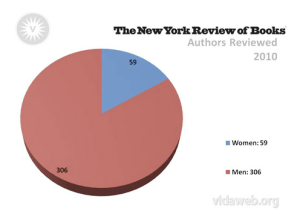
VIDA, an organization for women in the literary arts, recently released statistics from 2010 that showed a disparity in the number of female book reviewers and books by women that are reviewed in magazines and literary journals compared to men. The group showed its findings through 40 different pie charts looking at 14 magazines. Only on two charts did women outnumber men (cover to cover authors at The Atlantic and in authors reviewed at Poetry). Here are some examples of their findings:

Graph by VIDA
  • Only about 14 percent of the authors reviewed by The New Republic werefemale — 55 male authors and nine females.
  • The New York Times Book Review had 438 male bylines and 295 female bylines,and those reviewed a total of 807authors, 283 of which were women.
  • The New York Review of Books women had 39 bylines to men’s 200 and 59 female authors were reviewed compared to 306 men.

The issue was picked up across the web, mostly by women and a few men, and spurred debate this week around why this gap exists. Continue reading

Week in Review: Jan. 24-28

*Week in Review is a weekly post that highlights some of the major stories related to gender issues this week. Some of these stories may have already appeared in our News Feed or in the week’s Gender Checks. We’ll at times include a longer analysis of stories as well as bring attention to stories that may have slipped through the cracks of the week’s news cycle.

State of the Union

President Barack Obama gave his second State of the Union address Tuesday, discussing a plan to “win the future.” Media outlets focused in on key issues in the speech such as investing in education and infrastructure to stay competitive with other nations as well as working to reduce the deficit.

The blogosphere was a”twitter” with commentary, including some women who noted the absence of certain social issues. During their #sheparty discussion on Twitter on Wednesday, the Women’s Media Center asked what the take was on Obama’s speech. Commenters noticed missing issues such as equal pay, violence against women and abortion.

Also observed was the coverage of the speech. A post at Feministing provided a roundup of commentary on the address, noting at the end that it was “virtually impossible to find any female pundits commenting on the SOTU on the nation’s most notable progressive media outlets.”

At the same time, the Women’s Media Center released its report card for Obama on the state of the union for women and children, giving him an overall pass “with room for improvement.” Obama’s lowest grade on the report card, aside from some incompletes, was a C for appointing women. It cites the Center for American Women and Politics and notes that Obama appointed women to fill seven of 22 existing cabinet or sub-cabinet positions, or approximately 32 percent. The high for women was under President Bill Clinton at 42 percent. It also partly holds Obama responsible as a leader of the Democratic party for the lack of women running in recent elections. Quoting Katherine Kleeman with the CAWP, the report card notes, “the Democrats aren’t putting as much effort as the Republicans into grooming great women candidates at the local level.”

In other news

Also this week, women were part of the dialogue on the situations on Tunisia and Egypt. N’Dri Assie-Lumumba, a professor of Africana Studies at Cornell University, has noted that women are playing significant roles in these social movements. She says, “Even if African and Middle Eastern women don’t always have easy access to public platforms to express their ideas and voice their opinions,… they have consistently constituted a formidable and determining force in the struggle against any system of oppression.”

Here are a couple articles to check out if you’ve missed them.

-NPR: “In Tunisia, Women Play Equal Role In Revolution

-AFP: “Tunisian women fear Islamist return

-Guardian: “An eyewitness account (by a woman) of the Egypt protests

-Daily Beast: “Egypt Revolution: the Purity Protests” (Women increasingly taking part in the politics of the street)