Count shows few women as National Magazine Award finalists

The announcement of the 2012 National Magazine Award finalists drew attention this week, not for the finalists themselves but for those who were missing.

Ann Friedman pointed out that no women were listed among finalists for the American Society of Magazine Editors’ awards in the reporting, feature writing, profile writing, essays and criticism, columns and commentary categories. However, women were the majority of candidates for the public interest, personal service and fiction categories, in other words, two those three categories are “servicey” (as Friedman noted) and most of the articles that were nominated are on “women’s issues,” such as body image (including an article on getting a “mommy tuck”), relationship or sexual violence, or specific women’s health issues like breast cancer.

This provoked a number of posts and commentary. Alyssa Rosenberg at Think Progress pointed out the fact that the awards include a women’s magazine category but no men’s magazine category, meaning men’s mags are included as general interest. References were also made to VIDA’s annual byline count, which has shown male authors dominating the space in top magazines. Said VIDA’s Erin Belieu in an interview with Mother Jones, “The National Magazine Awards have sent a pretty clear message… When it comes to a career in journalism, chicks should stick to writing about chicks.”

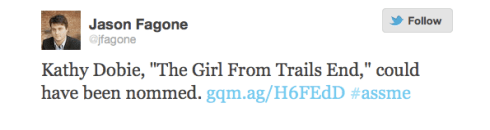
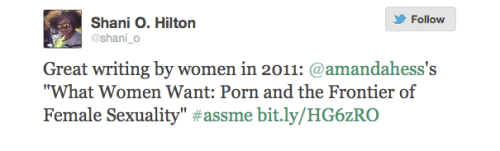
Meanwhile, Brooke Hatfield started an #ASSME hashtag on Twitter in an effort to point out quality work by women in 2011. Here are some examples:

All of this drew a response from Sid Holt, the chief executive of ASME, who explained the selection process and called the criticisms “kind of silly,” according to Poynter. He also identified women who have been in nominated in recent years. Rosenberg reported that Holt did acknowledge that the questioned women’s magazine category has been a “subject of debate” and explained the reasoning behind it.

Read commentaries on women and the awards as well as the judging process in the articles below:

What do you think of the lack of women finalists in major award categories? Are counts like this important? What do they mean? Share your thoughts in the comment section below.
Percent of women in newsrooms unchanged in latest ASNE Newsroom Census

Women continue to comprise 36.9 percent of those working full-time at daily U.S. newspapers, according to the American Society of News Editors‘ 2012 Newsroom Census. That percentage remains unchanged from 2011’s survey.

ASNE Newsroom Census 2012

This year ASNE collaborated with the Center for Advanced Social Research at the Missouri School of Journalism for its annual survey effort. ASNE, which has conducted the census since 1978, unveiled this year’s findings at its convention this week in Washington, D.C. The employment survey showed declines in total newsroom employment as well as in positions held by minorities.

Though the organization’s press release on the Newsroom Census focused on these issues, the accompanying tables depict the current gender breakdown in newsrooms. The Newsroom Census tables, which include data from 1999 to the present, show that the percentage of women in newsrooms has not changed more than roughly a percentage point in that time frame. The high was 37.7 percent in 2006 and the low occurred in 2010 at 36.6 percent. The current percentage of women in newsrooms — 36.9 percent — is the same as it was in 1999, 2003 and 2011. In the current survey, the number of women working full-time at daily newspapers was 14,971, while 25,595 employees were men.

Additionally, survey results are broken down by gender and race. Based on these charts, about 15.3 percent of female staff members in the survey were minority women. Last year, ASNE reported that minority women made up 19.3 percent of female staffers. Meanwhile, minority men were roughly 10.5 percent of male employees in the current survey. That percentage was 10.8 the year prior. This is the first year the survey has included a “multi-racial” category, which may slightly skew our understanding of changes in the breakdowns by each race (For the complete breakdown, see Table K).

A separate table tracks gender and job category. Of the four job categories identified, women had the highest representation among copy/layout editors and online producers at 42.3 percent and lowest among photographers, artists and videographers at 25.2. percent. None of the categories had more than a one percent change from the previous year. The percentage of women in three categories — supervisors, reporters and writers and photographers, artists and videographers — dropped slightly, while the percentage of female copy/layout editors and online producers rose. Two categories set records this year, with women at their highest percentage in the past 14 years for copy/layout editors and online producers but at their lowest in that same time frame among reporters and writers at 38 percent.

Find out more about the latest census using the links below to the press release as well as charts related to newsroom gender breakdowns.

Read our post on the 2011 Newsroom Census here. For more studies and resources on gender in the news media, view our “Useful Resources” page.

Women in journalism: Reading list 3/31/12

The Gender Report provides a weekly round-up of links to online articles that may be of interest to our readers. The links below are to noteworthy articles on topics related to women in journalism and the media during the past week. Articles included in this feature do not necessarily reflect the views of The Gender Report or its writers. View past week’s round-ups here.

Reading List

WMC Releases Media Guide for Gender Neutral Coverage of Women Candidates and Politicians (Women’s Media Center)

JAWS members offer interview tips (Journalism & Women Symposium)

OU will use alumna’s endowment for scholarships for female journalists (The Oklahoma Daily)

Miriam O’Reilly: There was seething resentment when I went back to BBC (The Guardian)

Joanne Zerkel remembered as ‘a champion for women’  (Southtown Star)

Priscilla L. Buckley, steward of conservative National Review and sister of William, dies (Washington Post)

Rachel Maddow: The Fresh Air Interview (NPR)

Christiane Amanpour Returns To CNN: Network Releases New Promo For ‘Amanpour’ (Huffington Post)

From waitressing to writing for The New York Times (Community College Success)

For a Week, Couric Will Co-Host ‘Good Morning America’ (New York Times)

Journalist/Multi-Tasker Sarah Tressler Gives First Interview Since Being Outed as a Stripper (Jezebel)

We encourage readers to submit suggestions of articles to include in future editions of this feature by sending an email to genderreport[at]gmail.com. For links to articles like these throughout the week, follow @GenderReport on Twitter.

Women in journalism: Reading list 3/25/12

The Gender Report provides a weekly round-up of links to online articles that may be of interest to our readers. The links below are to noteworthy articles on topics related to women in journalism and the media during the past week. Articles included in this feature do not necessarily reflect the views of The Gender Report or its writers. View past week’s round-ups here.

Reading List

State of the News Media 2012 (Project for Excellence in Journalism) – Five of top 20 newsmakers in 2011 were women.

Beyond the Glass Ceiling: Women in Journalism (Engenderings)

Four Women-Led News Projects Pick Up Prizes from McCormick Foundation (MediaShift Idea Lab)

JAWS CAMP Fellowships available for 2012 (Journalism & Women Symposium)

Channel 4’s gender equality under the spotlight as several key women leave (Guardian)

Dorothy Townsend dies at 88; L.A. Times reporter broke newsroom barrier (LA Times)

Equal access: Melissa Ludtke broke barriers as a female reporter (National Baseball Hall of Fame)

WaPo loses another top exec (Romenesko) – Jenny Abramson leaving to join a D.C.-based digital start-up

Melanie Sill, former Sacramento Bee editor, selected as KPCC’s executive editor (KPCC)

‘One of the Hardest-Working Women in Television Journalism’ (TVNewser) – On MSNBC’s Chris Jansing

Liberian Writer Mae Azango Forced Into Hiding for Story on Female Genital Cutting (Daily Beast)

We encourage readers to submit suggestions of articles to include in future editions of this feature by sending an email to genderreport[at]gmail.com. For links to articles like these throughout the week, follow @GenderReport on Twitter.

Women in journalism: Reading list 3/18/12

The Gender Report provides a weekly round-up of links to online articles that may be of interest to our readers. The links below are to noteworthy articles on topics related to women in journalism and the media during the past week. Articles included in this feature do not necessarily reflect the views of The Gender Report or its writers. View past week’s round-ups here.

Reading List

Zimbabwe’s Female Journalists Get U.S. Backing to Promote Equity in The Newsrooms (Voice of America)

Female journalists offer students insights (The National) – a panel discussion as part of the Women as Global Leaders conference hosted by Zayed University

#jpod – Gender and conflict journalism: How far have we come? (Journalism.co.uk)

Scripps Howard Awards announced (Poynter)

Her Rightful Place (Insider Higher Ed) – female philosophers and the New York Times’ obits

Reporting on conflict: ‘No-brainer that women are out there’ (Journalism.co.uk)

Are Book Publishers To Blame For Gender Discrimination? (Huffington Post)

Future of Feminism: No More Media Sexualization of Women (Ms. Blog)

Alice C. Steinbach, Pulitzer Prize winner, dies at 78 (Baltimore Sun)

In Liberia, reporting on genital mutilation draws threats (CPJ)

Liberia: IFJ Calls On Govt to Protect Threatened Female Journalist (AllAfrica)

Azerbaijan journalist ‘blackmailed’ with explicit video (The New Age)

Man arrested in connection to assault on journalist (INSI)

Marie Colvin: Mourners say farewell to ‘talented, compassionate’ war reporter (The Guardian)

Jill Abramson on the NYT as local vs. international paper: ‘We can have it all’ (Poynter)

‘WSJ’ hires away ‘New York Times’ social media editor Liz Heron (Capital New York)

We encourage readers to submit suggestions of articles to include in future editions of this feature by sending an email to genderreport[at]gmail.com. For links to articles like these throughout the week, follow @GenderReport on Twitter.