Women in journalism: Reading list 9/9/2012

The Gender Report provides a weekly round-up of links to online articles that may be of interest to our readers. The links below are to noteworthy articles on topics related to women in journalism and the media during the past week. Articles included in this feature do not necessarily reflect the views of The Gender Report or its writers. View past week’s round-ups here.
Reading List

Women’s representation in media: the best data on the subject to date (Guardian Data Blog)

-What’s Changed, and What Hasn’t, Since the Women of Newsweek Sued Their Bosses (XX Factor)

40 Years Later, Newsweek Sex Discrimination Persists (Women’s eNews) An excerpt from “The Good Girls Revolt”

Reporting from the Front Lines of War: Kathy Gannon and Anja Niedringhaus (International Women’s Media Foundation)

What’s in a name? The rhetoric of rape (Women Under Siege)

Chicago Sun-Times pursues politician who dares to be a mom (by Erik Wemple)

Women, Women, Everywhere — but Not Much About Their Paychecks (by Margaret Sullivan)

Announcing Our Ending Violence Against Women Digital Action Campaign (World Pulse)

Global Press Institute Founder Wins $100,000 Social Justice Innovation Prize (GPI)

Margaret Sullivan: ‘It’s not about me handing down pronouncements’ (Poynter)

Iranian activist [and journalist] Zhila Bani-Yaghoub packs her bags and heads to prison (Guardian)

Reporting Poverty: Emily Brennan interviews Katherine Boo (Guernica)

Mexican journalist Lydia Cacho: ‘I don’t scare easily’ (Guardian)

New Editor at Cosmopolitan: Joanna Coles Replaces Kate White (Media Decoder)

Charlize Theron, Thunder Road to Produce Film About Slain War Reporter [Marie Colvin] (Hollywood Reporter)

So What Do You Do, Jessica Bennett, Executive Editor of Tumblr’s Storyboard? (Mediabistro)

We encourage readers to submit suggestions of articles to include in future editions of this feature by sending an email to genderreport[at]gmail.com. For links to articles like these throughout the week, follow @GenderReport on Twitter.

CDC releases study on rape and domestic violence

A national study released this week revealed the prevalence of rape, sexual assault and domestic violence in the United States as well as the effects and health consequences of these experiences.

The National Intimate Partner and Sexual Violence Survey was done by the Centers for Disease Control and Prevention and was supported by the National Institute of Justice and the Department of Defense. The study itself involved a telephone survey in 2010 of more than 16,500 adults. The report is thought to help guide and target prevention efforts.

The Centers for Disease Control and Prevention released the findings of a survey on rape and domestic violence this week. Click the image to view the report or executive summary.

Some of the report’s key numbers related to U.S. adults included:

  • Overall, more than one in three women and one in four men reported having experienced rape, physical violence or stalking by an intimate partner at some point in their lives.
  • One in five women and one in 71 men said they had been raped or experienced an attempted rape during their lifetime. More than half of female victims reported being raped by an intimate partner and another nearly 41 percent by an acquaintance. More than half of male victims also reported being raped by an acquaintance.
  • One in six women and one in 19 men have been stalked at some point in their lives.
  • One in four women and one in seven men reported having experienced “severe physical violence” by an intimate partner.

Additionally, findings focused on the impact of intimate partner violence, a look at these issues by race and ethnicity, violence in the last 12 months and health consequences for victims.

Many news outlets and online news sites picked up on the release of the survey results and reported on the findings. Stories focused on different aspects of the survey’s results. Stories also tended to either point out how “shocking,” “surprising” or “disturbing” these findings were or, in contrast, to point out that the study’s findings were not news. Those who stated the latter usually did credit the survey for confirming the prevalence of these issues and discrediting myths surrounding these topics, such as the idea that most rapes are perpetrated by strangers. These differences in emphasis and interpretation are most clearly demonstrated in the titles of the articles below:

Read an executive summary of the survey or the full report here.

This is the Gender Report’s Week in Review, a weekly post that highlights some of the major stories related to gender issues this week. Some of these stories may have already appeared in our News Feed or in the week’s Gender Checks. We’ll at times include a longer analysis of stories as well as bring attention to stories that may have slipped through the cracks of the week’s news cycle.

Week in Review: 7 billion people and 7 stories about women

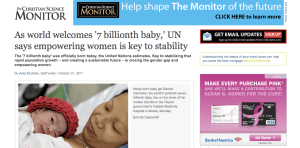
"As world welcomes '7 billionth baby,' UN says empowering women is key to stability" - Christian Science Monitor

According to United Nations estimates, the world population hit 7 billion this week. As a result, we’ve turned this week’s Week in Review post into a seven-story round-up of top news related to women and girls.

1. Seven billion and counting

With the world population hitting 7 billion, the UN argued that empowering women is vital to stabilizing growth, as demonstrated in this Christian Science Monitor piece. A baby girl named Danica Camacho born in the Philippines on Oct. 31 became the symbolic seven billionth baby.

2. Women’s rights in the Arab Spring

Continued concerns about the role of women and women’s rights during upheaval in the Middle East emerged this week. U.S. State Department officials spoke to a Senate committee about the issues Wednesday. Tunisian women demonstrated regarding their rights on the same day in light of the election victories of an Islamic party.

3. Herman Cain deals with sexual harassment accusations

Campaign coverage this week was dominated by allegations that presidential candidate Herman Cain was accused of sexual harassment during his time working for the National Restaurant Association in the late 1990s. Politico broke the story that at least two women had complained of “inappropriate behavior” from Cain. These women ultimately left their jobs with financial packages and having signed nondisclosure causes, meaning they are unable to discuss the issues. Cain has denied the claims and suggested it was the work of candidate Rick Perry’s campaign. A third woman came forward saying she considered filing a workplace complaint against Cain. One woman received permission to speak about the matter publicly and issued a statement through her lawyer.

4. Journalists and sexual violence

The Atlantic published a piece by Lauren Wolfe, director of Women Under Siege, about journalists and sexual violence, specifically the efforts of Jineth Bedoya Lima, a Colombian journalist to seek justice nearly a dozen years after she was drugged, kidnapped and gang raped. Women Under Siege is a new initiative by the Womens’ Media Center on sexualized violence in conflict situations.

5. Gender-based online harassment

Women writers also spoke out this week regarding the harassment they receive online for writing and expressing their opinions and called for it to stop. Women detailed comments ranging from their level of attractiveness to threats of gang rape and mutilation. One woman, Laurie Penny, referred to a woman’s opinion as the “mini-skirt of the Internet.”

6. Not Funny Facebook

In an effort to combat a specific issue of misogyny online, activists campaigned to put pressure on Facebook to enforce and clarify its guidelines and to remove pages that promote sexual violence. Facebook’s Terms of Service do ban “hateful, threatening” content and those that contained “graphic or gratuitous violence,” but Facebook has refused to remove these pages, saying they are jokes or don’t qualify as hate speech. Campaigns included a “Rape is Not Funny” campaign in the UK and a Change.org petition and social media campaign (See #notfunnyfacebook on Twitter) in the US. As of the time of this post, campaigners noted that at least one page — “You know she’s playing hard to get when your chasing her down an alleyway” — has been taken down this week.

7. Feminism and the web

For those looking for a good read, New York Magazine published a piece this week titled “The Rebirth of the Feminist Manifesto” about the ways the blogosphere has “transformed” the feminist conversation. It includes interviews with a number of feminist figures on the web and a roundup of some links to their sites.

This is the Gender Report’s Week in Review, a weekly post that highlights some of the major stories related to gender issues this week. Some of these stories may have already appeared in our News Feed or in the week’s Gender Checks. We’ll at times include a longer analysis of stories as well as bring attention to stories that may have slipped through the cracks of the week’s news cycle.

Week in Review: Jan. 31 – Feb. 4

*Week in Review is a weekly post that highlights some of the major stories related to gender issues this week. Some of these stories may have already appeared in our News Feed or in the week’s Gender Checks. We’ll at times include a longer analysis of stories as well as bring attention to stories that may have slipped through the cracks of the week’s news cycle.

Healthcare legislation

This week the GOP moved forward with its plan to dismantle Obama’s healthcare plan by focusing on portions of the legislation dealing with federal funds for abortions. On Monday H.R.3, named  the “No Taxpayer Funding for Abortion Act,” introduced language that would redefine the terms under which a woman could receive federal funds for an abortion after rape or incest. The proposed change aimed to limit funding to pregnancies resulting from “forcible” rape. After criticism from several groups, a spokesman for Rep. Chris Smith (R-N.J.), one of the bill’s authors, said the word “forcible” would be dropped. He told the Washington Post Thursday that lawmakers decided to change the term because it was being “misconstrued.” The bill will now revert back to the language already in place through the Hyde Amendment.

The Hyde Amendment*, originally passed in 1976, governs the current uses and restrictions of federal funds used for abortions. Federal funds cannot be used except in cases of rape, incest, or when a mother’s life is in danger. It also bans abortion funding for women on Medicaid, women in the military or Peace Corps, and those who receive medical care from Indian Health Services. The bill proposed by Smith and other sponsors will make the restrictions set in place by the Hyde Amendment a permanent appropriations law. Currently it has to be recodfied in appropriations each year.

Planned Parenthood also took the spotlight later in this week’s news cycle after undercover videos showed employees giving medical advice to men posing as pimps of child prostitutes. One worker was fired as a result of the tapes. Some members of Congress are using the videos as momentum to remove all federal funding from the organization under H.R.614Live Action, the group responsible for the videos, claims staff turned a blind eye to sexual trafficking and exploitation of minors.

Thursday, 27 groups sent a letter to Congress in support of Planned Parenthood, including the NAACP and Sierra Club. “Right-wing groups are once again attempting to destroy an organization dedicated to providing crucial primary care services to Americans that need them most. Armed with heavily edited videos, countless lies, and a shameless echo chamber that repeats unfounded accusations ad nauseam, they’ve now turned their sights to Planned Parenthood, which offers a range of important health and reproductive services,” the letter reads (as taken from POLITICO excerpt).

According to its website, over 3 million men and women received health-related services from Planned Parenthood’s 820 health centers last year, including 1 million Pap tests and 4 million tests and treatment for STDs. Three percent of all Planned Parenthood health services are abortion services. Currently the organization does not receive federal money for any of its abortion services.

In Other News

A study released this week showed that after 10 years, Wikipedia’s contributor base consisted of less than 15 percent female authors.  The disparity also shows up in the emphasis of posts by male vs. female authors. Sue Gardner, the executive director of the foundation, has set a goal to raise the share of female contributors to 25 percent by 2015 (as reported in the New York Times).

*The link to the full text of the Hyde Amendment was taken from the National Right to Life website. The site provided the most easily accessible link to the original legislation, but is not in any way an endorsement of this group or its stance on this issue. Whenever possible the Gender Report tries to link to original sources and primary documents or otherwise fully cites any reprinted quotes or information.