CDC releases study on rape and domestic violence

A national study released this week revealed the prevalence of rape, sexual assault and domestic violence in the United States as well as the effects and health consequences of these experiences.

The National Intimate Partner and Sexual Violence Survey was done by the Centers for Disease Control and Prevention and was supported by the National Institute of Justice and the Department of Defense. The study itself involved a telephone survey in 2010 of more than 16,500 adults. The report is thought to help guide and target prevention efforts.

The Centers for Disease Control and Prevention released the findings of a survey on rape and domestic violence this week. Click the image to view the report or executive summary.

Some of the report’s key numbers related to U.S. adults included:

  • Overall, more than one in three women and one in four men reported having experienced rape, physical violence or stalking by an intimate partner at some point in their lives.
  • One in five women and one in 71 men said they had been raped or experienced an attempted rape during their lifetime. More than half of female victims reported being raped by an intimate partner and another nearly 41 percent by an acquaintance. More than half of male victims also reported being raped by an acquaintance.
  • One in six women and one in 19 men have been stalked at some point in their lives.
  • One in four women and one in seven men reported having experienced “severe physical violence” by an intimate partner.

Additionally, findings focused on the impact of intimate partner violence, a look at these issues by race and ethnicity, violence in the last 12 months and health consequences for victims.

Many news outlets and online news sites picked up on the release of the survey results and reported on the findings. Stories focused on different aspects of the survey’s results. Stories also tended to either point out how “shocking,” “surprising” or “disturbing” these findings were or, in contrast, to point out that the study’s findings were not news. Those who stated the latter usually did credit the survey for confirming the prevalence of these issues and discrediting myths surrounding these topics, such as the idea that most rapes are perpetrated by strangers. These differences in emphasis and interpretation are most clearly demonstrated in the titles of the articles below:

Read an executive summary of the survey or the full report here.

This is the Gender Report’s Week in Review, a weekly post that highlights some of the major stories related to gender issues this week. Some of these stories may have already appeared in our News Feed or in the week’s Gender Checks. We’ll at times include a longer analysis of stories as well as bring attention to stories that may have slipped through the cracks of the week’s news cycle.

FDA overruled in decision on contraceptive

In what was called a “rare” and “politicized” split between the FDA and the Health and Human Services Department, emergency contraceptives will still require a prescription for those under 17 years old.

Kathleen Sebelius, the HHS secretary, overruled the FDA conclusion that Plan-B One Step was safe for younger girls to use as an over the counter medication. This was the first time the department’s secretary has overruled and FDA commission in policy decisions. Both the FDA and Sebelius issued dueling press statements, spurring on the dueling coverage in the press.

A Fox News opinion columnist called the decision miraculous, saying “now parents don’t have to worry about their thirteen-year-old daughters picking up death-causing drugs while buying bubble gum and the latest Teen Beat at local drug stores.” Similar sentiments from the Washington Times concluded that “the liberal support of young teens having wide access to post-sex contraception is part of the slow, but steady unraveling of moral code in this country.” (Another columnist for the Times published a piece supporting the use of Plan B.)

Other groups angered by Sebelius’s ruling called the decision a setback for science. Susan Wood, a Washington Post columnist and former FDA assistant commissioner for women’s health, called the decision a “betrayal” of Obama’s pledge to uphold scientific integrity and that “no other over-the-counter medication has the FDA ever required extra data for a particular age group.”

On Thursday, President Obama released a statement supporting Seibelius’s decision. He called on his role as a father and said that although he did not play a role in the overruling, he thought “most parents” would feel as he did.

The FDA’s commission on the contraceptive determined that the product was safe and effective in adolescent females, that adolescent females understood the product was not for routine use, and that the product would not protect them against sexually transmitted disease. Seibelius based her decision on her doubt that the pill was safe for girls as young as 11 years old, and that the data submitted “do not conclusively establish that Plan B One-Step should be made available over the counter for all girls of reproductive age.”

Plan B, also known as the “morning after” pill, has been on the market since its FDA approval in 1999 and has never been far from controversy. It became available without a prescription to those 18 and older in 2006, and to 17 year olds in 2009 after a federal court’s recommendation. Its generic version, Next Choice, also came onto the market in 2006. Other controversy around the pill rose as pharmacists began to refuse to fill prescriptions for it and other forms of birth control.

Check out some of the other discussions on the topic:

This is the Gender Report’s Week in Review, a weekly post that highlights some of the major stories related to gender issues this week. Some of these stories may have already appeared in our News Feed or in the week’s Gender Checks. We’ll at times include a longer analysis of stories as well as bring attention to stories that may have slipped through the cracks of the week’s news cycle.
Week in Review: Women journalists in the news

This week was chock-full of stories about women in journalism. Here are a few of the highlights and links for where you can find more.

Treatment of female journalists abroad

Photojournalist Lynsey Addario, who was working on assignment for the New York Times, was strip searched and “humiliated” by soldiers during a security check when she entered Israel from the Gaza Strip, according to an article by the Associated Press. Due to her pregnancy, Addario requested not to have to go through the X-ray machine out of concern for her child. She instead was forced to go through the machine three times while soldiers watched and laughed. She then was strip searched by a female officer. An apology came Monday for the incident from Israel’s Defense Ministry.

After being released, journalist Mona Eltahawy posted this photo to Twitter showing the casts she needed as a result of injuries sustained during her detainment by security forces in Egypt. Eltahawy says she was beaten and sexually assaulted.

In addition, as we reported on last week, the risks for women reporters in Egypt are gaining media attention again after two female foreign journalists were sexually assaulted. The issue continued in the news this week as the women shared their stories.

Caroline Sinz, a broadcast journalist from France, was assaulted while covering protests. Additionally. Egyptian-American blogger and journalist Mona Eltahawy was beaten and sexually assaulted by local Egyptian security forces. A number of articles told of the pervasiveness of sexual assault, not just for journalists, and told these women’s stories. Here are a few:

Many reports made mention of “60 Minutes” reporter Lara Logan, who was sexually assaulted in Tahrir Square in February (Read our post on that attack here). The Women’s Media Center posted a video interview with Logan by founding president Carol Jenkins discussing her experience this week. Logan received the center’s Whole Truth Award, which was one of several given out at the Women’s Media Awards this week (Update: Read the WMC’s write up on the awards here).

Women who lead

The American Journalism Review this week looked at the question of whether women lead newsrooms differently. The article was specifically a response to the following comment by Jill Abramson, who (as we’ve previously written about) recently became the first woman to serve as the New York Times’ executive editor: “The idea that women journalists bring a different taste in stories or sensibility isn’t true” (as stated in a Sept. 10 New York Times column). The AJR article found that many top female managers and researchers disagree with her statement.

In addition, a new study in New Zealand by Dr. Catherine Strong looked at reasons behind the lack of women in journalism management and why women leave journalism. Strong attributed this issue to a “glass bubble” instead of the “glass ceiling.” Read more about the study here.

Other articles of note

A number of other noteworthy articles on topics related to women and media, including women journalists, popped up lately. Here are a few to add to your reading list if you haven’t already:

This is the Gender Report’s Week in Review, a weekly post that highlights some of the major stories related to gender issues this week. Some of these stories may have already appeared in our News Feed or in the week’s Gender Checks. We’ll at times include a longer analysis of stories as well as bring attention to stories that may have slipped through the cracks of the week’s news cycle.

Week in Review: A look at the Middle East

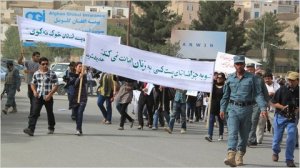
Photo credited to BBC Persian, from the New York Times. Participants marched against the widespread public sexual harassment of women on the streets of Kabul, Afghanistan, last July.

As political and social change continues to sweep through Egypt, Libya, Yemen and several other parts of the Middle East and Africa, the Gender Report looked at the key role women are playing in these processes. We’ve written before about protests, participation in marches, and pushes for representative government in these areas. Here are a few updates in these cases we found in our News Feed, as well as their representation in the media:

  • Libya: Women continue to speak out against rapes committed during the country’s long civil war, asking the new government to provide financial, legal and counseling support to victims. Read more via the Associated Press (as syndicated by the Washington Post).
  • Afghanistan: Nicholas Kristof, an avid supporter of women’s rights, featured a guest post by Noorjahan Akbar on his New York Times blog on her experiences with women marching for awareness of sexual harassment concerns. The post also highlighted organizations and women that are continuing this fight.
  • Egypt: The safety of female journalists in Tahrir Square continues to make headlines as another women, this time a female broadcast journalist from France, was assaulted while covering the protests. The organization Reporters Sans Frontieres, recanted a recommendation to remove female journalists from Tahrir Square for their own safety, after many journalists criticized the statement. One opinion piece for the Guardian said “If women journalists are told it’s too dangerous for them to go there, those voices are likely to be silenced altogether.” The Gender Report earlier highlighted the sexual assault of a “60 Minutes” reporter in February.

Have you seen or read other coverage of women in the Middle East? Post a comment or tweet it to the Gender Report or our News Feed, @GRNewsFeed or @GenderReport.

Week in Review: 7 billion people and 7 stories about women

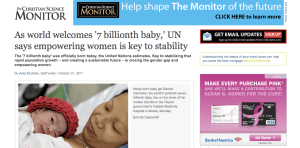
"As world welcomes '7 billionth baby,' UN says empowering women is key to stability" - Christian Science Monitor

According to United Nations estimates, the world population hit 7 billion this week. As a result, we’ve turned this week’s Week in Review post into a seven-story round-up of top news related to women and girls.

1. Seven billion and counting

With the world population hitting 7 billion, the UN argued that empowering women is vital to stabilizing growth, as demonstrated in this Christian Science Monitor piece. A baby girl named Danica Camacho born in the Philippines on Oct. 31 became the symbolic seven billionth baby.

2. Women’s rights in the Arab Spring

Continued concerns about the role of women and women’s rights during upheaval in the Middle East emerged this week. U.S. State Department officials spoke to a Senate committee about the issues Wednesday. Tunisian women demonstrated regarding their rights on the same day in light of the election victories of an Islamic party.

3. Herman Cain deals with sexual harassment accusations

Campaign coverage this week was dominated by allegations that presidential candidate Herman Cain was accused of sexual harassment during his time working for the National Restaurant Association in the late 1990s. Politico broke the story that at least two women had complained of “inappropriate behavior” from Cain. These women ultimately left their jobs with financial packages and having signed nondisclosure causes, meaning they are unable to discuss the issues. Cain has denied the claims and suggested it was the work of candidate Rick Perry’s campaign. A third woman came forward saying she considered filing a workplace complaint against Cain. One woman received permission to speak about the matter publicly and issued a statement through her lawyer.

4. Journalists and sexual violence

The Atlantic published a piece by Lauren Wolfe, director of Women Under Siege, about journalists and sexual violence, specifically the efforts of Jineth Bedoya Lima, a Colombian journalist to seek justice nearly a dozen years after she was drugged, kidnapped and gang raped. Women Under Siege is a new initiative by the Womens’ Media Center on sexualized violence in conflict situations.

5. Gender-based online harassment

Women writers also spoke out this week regarding the harassment they receive online for writing and expressing their opinions and called for it to stop. Women detailed comments ranging from their level of attractiveness to threats of gang rape and mutilation. One woman, Laurie Penny, referred to a woman’s opinion as the “mini-skirt of the Internet.”

6. Not Funny Facebook

In an effort to combat a specific issue of misogyny online, activists campaigned to put pressure on Facebook to enforce and clarify its guidelines and to remove pages that promote sexual violence. Facebook’s Terms of Service do ban “hateful, threatening” content and those that contained “graphic or gratuitous violence,” but Facebook has refused to remove these pages, saying they are jokes or don’t qualify as hate speech. Campaigns included a “Rape is Not Funny” campaign in the UK and a Change.org petition and social media campaign (See #notfunnyfacebook on Twitter) in the US. As of the time of this post, campaigners noted that at least one page — “You know she’s playing hard to get when your chasing her down an alleyway” — has been taken down this week.

7. Feminism and the web

For those looking for a good read, New York Magazine published a piece this week titled “The Rebirth of the Feminist Manifesto” about the ways the blogosphere has “transformed” the feminist conversation. It includes interviews with a number of feminist figures on the web and a roundup of some links to their sites.

This is the Gender Report’s Week in Review, a weekly post that highlights some of the major stories related to gender issues this week. Some of these stories may have already appeared in our News Feed or in the week’s Gender Checks. We’ll at times include a longer analysis of stories as well as bring attention to stories that may have slipped through the cracks of the week’s news cycle.